Rigid Body Dynamics and the Center of Mass of a Rigid Body
We dig into what a rigid body actually is (spoiler: it's an idealized fake lol) and grind through center of mass integrals for 3D solids and 2D plates, hemisphere included.
Rigid body mechanics…
Rigid body? A strong object? Right?lol
Yeah. That’s right lolol
But how strong is it — it’s hella strong
So why do we study particle systems first and then move on to the mechanics of rigid bodies?
The rigid body here is an ideal object, so it doesn’t exist on Earth!!
Like, is there some freaking insanely strong megaton steel ball that never bends or deforms no matter what?
Nope, everything deforms at least a ti~~~ny bit, right?
So then, why do we learn particle systems and then learn rigid bodies?????
Rigid body: it’s said to be a particle system where relative positions are fixed, or where the distance between any two particles is always constant.
The particle systems are moving, and the fact that the distance between those particle systems is always the same means
It won’t allow even a 0.0000000000000001 deformation
OKBR
So let’s find the center of mass of a rigid body.
Previously it was a discrete configuration of particles,
but now it’s composed of continuous particles,
so we throw out the sigma symbol, and meaning-wise it’s still a sum, it’s a sum with the same meaning, but
if we use the integral, which means the sum of ‘continuous’ things,
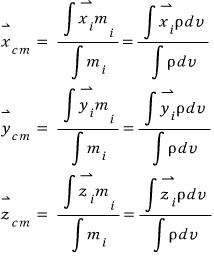
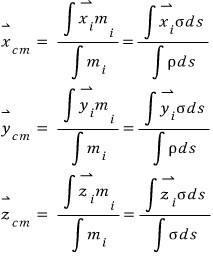
Alright then, let’s calculate the center of mass for x, y, z.
If the rigid body is a 3D object
If the rigid body is a 2D plate
So for a solid hemisphere and a solid hemisphere shell, I’ll calculate the center of mass as practice~
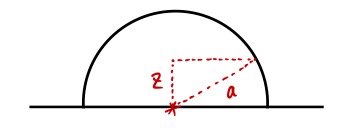
This right here is a hemisphere!! It’s completely filled inside
If so, it’s way too obvious that Xcm and Ycm are 0, right? right??
Right now the O point is that spot marked with an x.^^
So the key is finding Zcm,
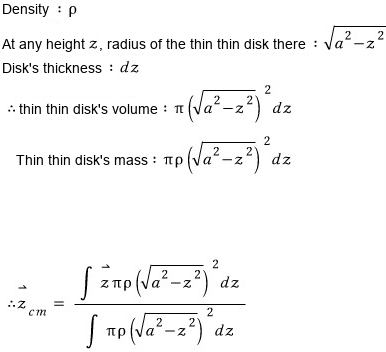
We chop it into thi~~~n disks at height z! Did you chop it?(in your head)
After chopping, how are we going to add them up — we’re going to multiply by the z-value, which is the position where the disk is
That z-value is called the weight
We take that z-value as the weight, multiply it by the mass of that thin thin disk, add them all up!
Then divide by the total mass, and you can think of that as Zcm
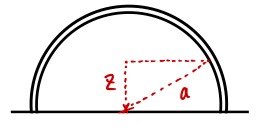
The hemisphere shell is easy too hehe
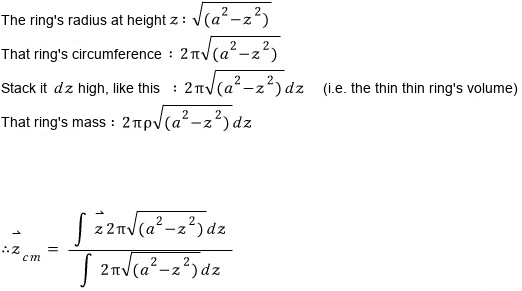
This time, instead of a disk at an arbitrary height z,
you can think of it as a ring
We multiply the mass of that ring by the weight of height z, and then
add them allll up again, and then divide by the total mass (the total mass of the hemisphere shell)!!!
Comments
Discussion happens via GitHub Discussions. You'll need a GitHub account to comment.