Moment of Inertia: Perpendicular Axis Theorem and Parallel Axis Theorem
We spin up a planar rigid body, derive the moment of inertia from scratch, then work through the perpendicular and parallel axis theorems step by step!
Today we’re going to rotate a rigid body
(It’s going to rotate about a fixed axis, and for now we’ll rotate a ‘planar rigid body’.)
lol lz go go go go
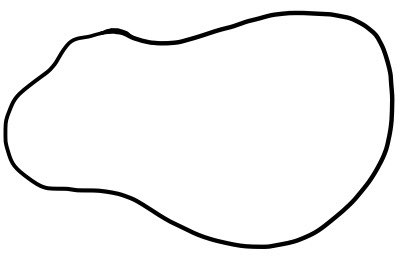
Into a rigid body like this
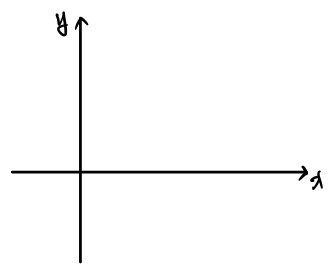
I’ll insert coordinate axes like this.
(the z-axis pokes out of the monitor….)
Alright, and since we’re going to rotate it, let me draw the figure expressing all the variables related to the rotation??!
Like this
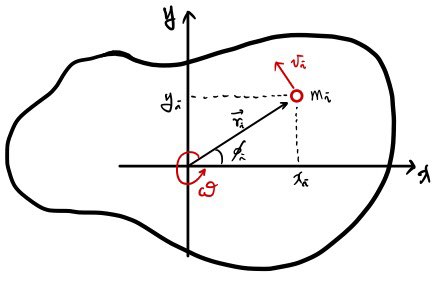
And since this is a rigid body, it’s made up of countless particles, so
I’ve represented the i-th particle

. (the
particle is located at (

,

,0))
You know the linear velocity of each individual mi is w · ri, right?
(

since it’s always 90 degrees)
Then lemme compute the kinetic energy that arises from the rotation~
We just need to add up the energy of every individual particle
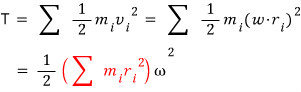
Whoa!!!! Hold on!!!! For translational motion, the kinetic energy is (one-half)(em)(velocity squared), but
when I compute the kinetic energy for rotation,,,, it turns out I can express it as (one-half)(red thingy)(angular velocity squared)?!!
Just like mass in translational motion, can’t I think of that red part as something like a mass for rotational motion?!!!
We thought of the mass in translational motion as ‘inertia’,
so couldn’t we also think of it as the ‘inertia’ for rotation?!??!
(I’ll unpack that meaning step by step down below)

Alright, we agree to define that red-highlighted part as the moment of inertia about the z-axis, ‘I-zee’.
(ri is the distance from the z-axis (the axis of rotation)!!!@)
But you really have to remember the current situation.
Right now we built this equation under the explicit constraints that it was a planar plate and the axis was ‘fixed’,
and we also made an agreement about what ‘moment of inertia’ means.
Y’all better not forget that…
Alright alright alright, once more
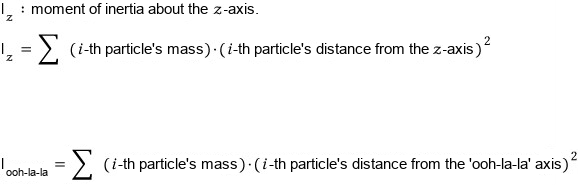
The reason the concept of moment of inertia is important is,
as I hinted above,
just like mass in translational motion (just plain moving motion), there is some ‘something’ that we can think of like a mass when rotating too.
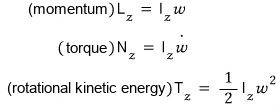
We can express them in exactly the same way. Only, the velocity isn’t v — it’s the angular velocity omega, which represents the velocity when rotating
p = mv
F = ma
Right!??!?!!!
We’ve found something similar to when an object undergoes translational motion. In translational motion the velocity is v, and in rotational motion it’s the angular velocity w
And it’s the moment of inertia that plays the role of mass in rotational motion.
So let me scribble down the moment of inertia, which plays something like ’the role of mass’, one more time
When the same force (torque, rotational force) acts on some object, the one with a larger moment of inertia has a relatively smaller angular velocity!!
(It’s the same as in translational motion, exactly the same — even in translational motion, when you hit something with the same force, the one with larger mass didn’t have that big a change in velocity, right? hehe)
Aha~! So I can also think of the moment of inertia I as roughly the mass m in translational motion!
Now let me think about this the same way I thought about the Center of Mass.
How did I think about it back then,
please look at that equation for computing the moment of inertia.
We took each point-mass’s mass and the distance of that point-mass from the ‘axis of rotation’, “squared” it, and added them up.
(Unfortunately, since we didn’t divide by the total mass, it doesn’t carry the meaning of an average T_T)
But each of those squares is multiplied by something. That something is ’the mass of that point-mass’
So at each distance, a kind of ‘weighting’ is assigned.
Even for masses that are at the same distance, having a big mass there versus a small mass is going to be different,
so we can think of it as that kind of weighting being assigned.
And we added up all of those weighted things!!! That’s what got defined as the ‘moment of inertia’.
I’ll end the physical meaning here.
As for why it’s squared,,,, just
just like how people discovered that universal gravitation is an inverse-square law,
for rotational motion too, defining the moment of inertia to play the role of mass,
it might be easier to think of it as a kind of discovery? — that a squared law exists.
Now let me tell you a fun fact about rigid-body rotation.
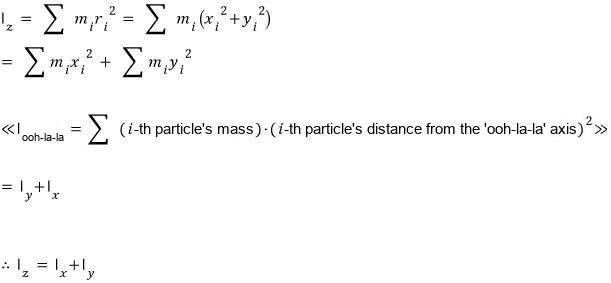
<<ah, when I’m studying science, stuff like this is really fascinating to me,. isn’t this the wonder of nature lolol am I overreacting? lol>>
This is called the perpendicular axis theorem
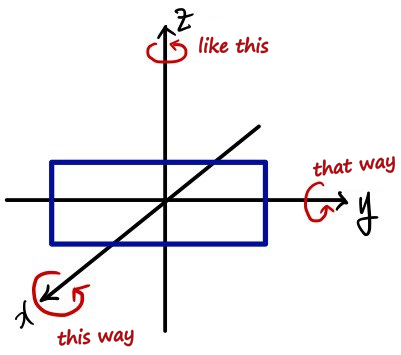
Iz = Ix + Iy
the moment of inertia when you rotate it “like this”
is equal to the sum of the moment of inertia when you rotate it “this way” and the moment of inertia when you rotate it “that way”!
If you think about it~~ do they really have to be the x, y, z axes?
The axes are for you to choose however you want anyway???
Ahahaha so the conclusion is that the moment of inertia of a “planar plate” about some perpendicular axis
is equal to the sum of the moments of inertia about any two mutually perpendicular axes in the plane that pass through the intersection of that perpendicular axis and the plane!!!!
This is exactly the “perpendicular axis theorem”.
Earlier we did the whole about-the-center-of-mass, about-the-center-of-mass~
this sort of thing, centering everything around the center of mass, right?!
This time too, let me describe some planar plate centered on the center of mass.
First~ there’s a planar “plate” rotating about the z-axis. (Again, a rigid planar plate, plate plate plate plate)
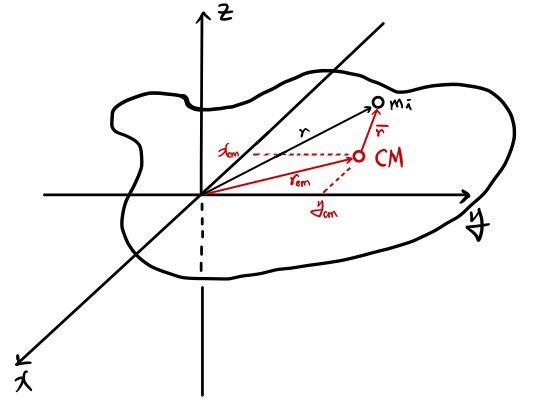
Let the coordinates of the Center of Mass be (Xcm, Ycm, 0).
And taking the position vector with the center of mass as the center — since we’ve done that all along from before
I’ll just write the equationnn, heh
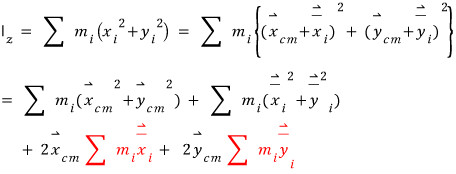
(the red parts being 0 is getting tiresome by now, so tiresome lol)
Then
let me write it once more

Alright, let’s look at the back term first. In the back term, what’s inside the parentheses is ri-bar squared.
Aha!!! This is the moment of inertia when there’s an axis stuck in the CM parallel to the z-axis!!
So the pink-pink term could be called I(cm)~~~
Ah, the front-term green-green green(green) term is Xcm squared plus Ycm squared, so
if we use big-bro Pythagoras’s theorem, that sum is rcm squared
Ah, then since it has nothing to do with i, it comes out of the sigma sign, and
the green(green) term is just rcm squared times mass m
rcm is just the distance between the z-axis and the CM (center of mass), so let’s call that distance l (el)
So
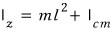
Wow, this is fascinating too
This right here is called the ‘parallel axis theorem’
“The moment of inertia of a rigid body about an arbitrary axis is equal to the sum of the moment of inertia about an axis that passes through the center of mass and is parallel to that arbitrary axis, and the object’s mass multiplied by the square of the distance between the two axes…!!!”
And for reference, this parallel axis theorem (unlike the perpendicular axis theorem we covered earlier)
is said to be applicable not just to planar plates but to all rigid bodies!!!!!!
So when the moment of inertia about an arbitrary axis is hard to compute, but the moment of inertia when you stick the axis through the CM and rotate is easy to compute?
In that kind of case we can put this equation to use, hehe
Comments
Discussion happens via GitHub Discussions. You'll need a GitHub account to comment.