Radius of Gyration
A casual breakdown of the radius of gyration — what it really means to divide moment of inertia by total mass and slap a root on it to get an average distance feel.
radius of gyration (k)
let’s take a look. First off, gyration radius: gyration is something related to the moment of inertia (I).
You remember m-r-squared (mr^2) for each particle, right?
Now, we need to look at this I from a different perspective.
The way we’re going to look at this guy called moment-of-inertia (moment of inertia, I) now is,
it’s the distance ri from the axis of rotation squared, with a “weight” of ‘mi’ added onto it all… would that be a fair way to put it????@?@
(This was in the book, and once I understood it, it was really a nice way of putting it.)
Oh, and as for why we squared ri and multiplied it by the weight mi,
depending on where you set the origin, ri can be (+) or (-), right? To get rid of that effect, we squared everything and summed it up
To get rid of that effect, and to look only at ’the distance it’s apart’.
Now, where we’ve gotten to so far is,
we’ve done the work of taking the i-th m value, multiplying it by ri squared, and summing them all up ~.

Up to here
What kind of act is it to divide this moment of inertia I by the total mass m???
Can we think of it as the act of getting rid of all the mi weights???

And then, the act of putting a root over the whole thing,
what kind of act can we interpret this as???
Can we interpret it as the act of canceling out that ’exaggerated’ effect that came from squaring all those ri’s and summing them up????
We just made ’the mean of the squared distances’. (Reminds me of the geometric mean.)
This mean of squared distances is written as k, and it’s called the radius of gyration.
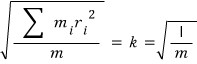
Common sense-wise, if the average of the distances is big, it’d be hard to spin, right????
(Or maybe hard to stop from spinning?)
Ahh~~~ the feel you get from this physical quantity, you could say it’s pretty much similar to I.
Actually, this radius of gyration k also captures the averaging process that lies at the foundation of the concept of I quite well, you know.
Comments
Discussion happens via GitHub Discussions. You'll need a GitHub account to comment.