Physical Pendulum and Center of Oscillation
We hang a rigid body and let it swing to derive its period, and it turns out it's basically the same as the simple pendulum you memorized in high school — with k²/l sneaking right in!
In high school Physics II, we’d fix a string to the ceiling, hang an iron ball on it and swing it ~ swing it ~, but here we’ll hang a rigid body and let it swing.
(Well, you could just hang a sweet potato on a skewer and let it swing, but for ease of understanding, let’s suppose for now that we’ve hung a 2D planar plate on a skewer)
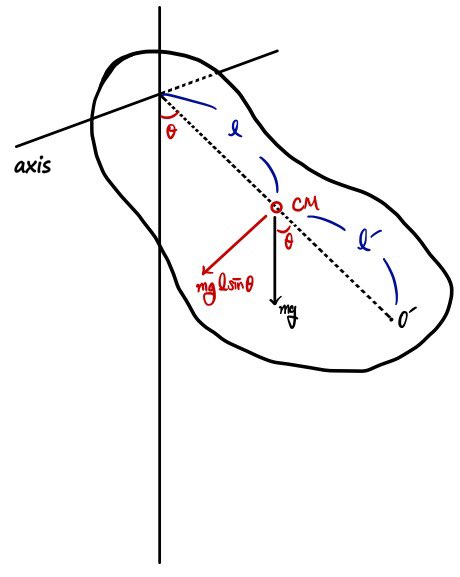
So a rigid plate is hanging on a skewer like this.
At this ‘instant’, what’s the magnitude of the torque about the rotation axis created by Earth’s gravity????
$mgl\sin\theta$ (that $l$ is the letter “el”). Right? Torque $\mathbf{N} = \mathbf{r} \times \mathbf{F}$ is a vector, but I just looked at the magnitude.
And if we use  , this equation we learned earlier,

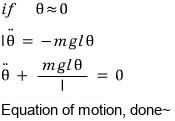
This isn’t the time to solve for the general solution of a differential equation, so I’ll just write down the general solution for $\theta$ directly. haha

Things like $\theta_0$ or the $\Phi$ at the end are determined by initial conditions, so you don’t need to worry about them much haha. So,
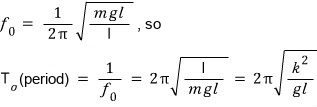
The radius of gyration $k$ we did before is hiding in here~~ Aha, so if a rigid body whose CM is a distance $l$ from the axis does pendulum motion (only when the swing angle is freaking small), the period comes out like this?
But??? It looks similar to the period we learned in high school physics class!! That’s the very formula we memorized back then as “LG Electronics, Miss Kim” — $l/g$ and $m/k$!!

This one!!! Oho~~~ We can find a similarity between the pendulum motion of a rigid body and the simple pendulum motion we learned in high school!!!
Specifically, the period of a physical pendulum is the same as the period of a simple pendulum with length $k^2/l$.
Alright alright, let’s check.
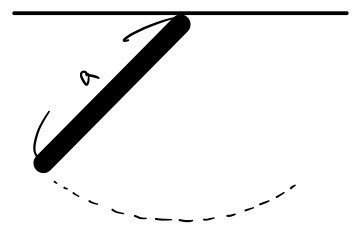
Let’s check. For a thin long~ rod of length $a$, what’s the square of the radius of gyration?
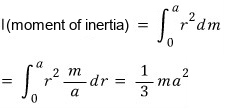
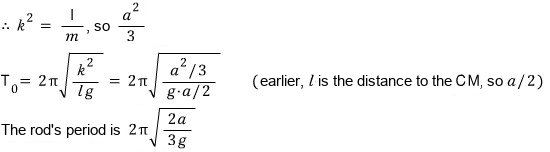
Aaaaaaah okey-dokey
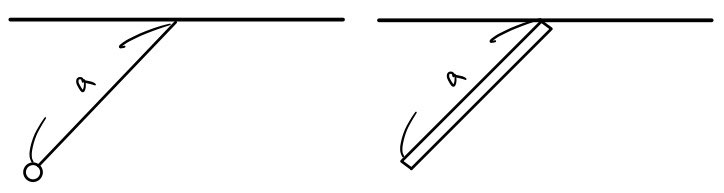
The rod has the same period as a simple pendulum of length $2a/3$ hehehe (how cool hehe)
You might wonder why I keep going on and on about the period…
I did it to investigate the “center of oscillation.”
You know when you put in 500 won and hit the ball that comes flying? Sometimes when you swing, the bat vibrates like crazy and your hands get super numb, and other times, even though you clearly hit the ball super hard (like you made a really clean?? Clear shot?), your hands didn’t go numb.
Nope! It wasn’t because you hit it too cleanly!
It’s because you hit it at the center of oscillation.
Let me look into that secret, the ‘center of oscillation.’
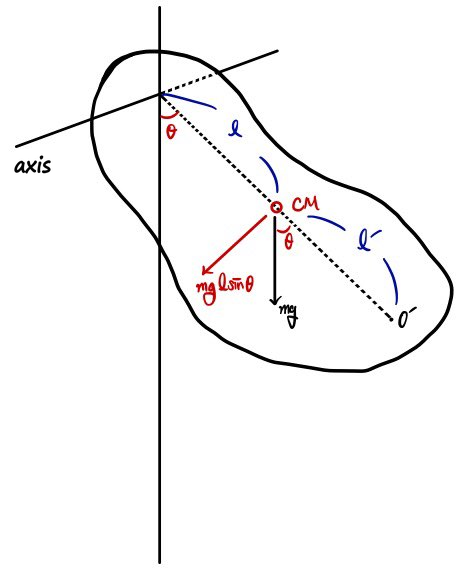
First, let me express the moment of inertia $I$ using the parallel axis theorem.
(The parallel axis theorem applies to all rigid bodies, whereas the perpendicular axis theorem only applied to flat rigid plate-plate-plate-plate-plate-plate-plates, remember??)
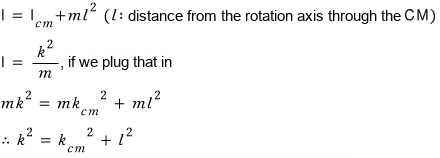
Alright alright alright, then
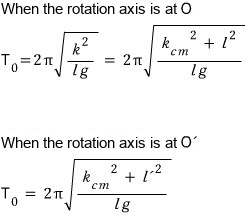
One is the period when the rotation axis is a distance $l$ from the CM, and the other is the period when the rotation axis is a distance $l'$ from the CM~
(What you always need to be careful about is that the swing angle has to be freaking small;;)
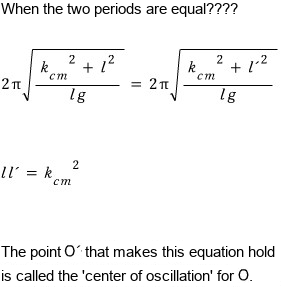
When you swing a baseball bat, if it hits this center of oscillation, the batter gets less impact… So when we grip point $O$ on the bat and whack the ball, if the part where the ball hits happens to be point $O'$, that’s exactly the point you feel as a clear shot lol
Because I’m gripping the bat, that point becomes one axis, and then because the ball hits right at point $O'$, that becomes another axis too, right? (center of percussion?)
So apparently among baseball people, this part is called the sweet-zone (I don’t really know baseball T_T)
Heads-up. The figures here are the original notes, slips and all. A few things to watch for:
- In the picture of the two pendulums, the simple pendulum with the rod’s period has length $\frac{2a}{3} = \frac{k^2}{l}$, not $a$: both swing with $T = 2\pi\sqrt{\frac{2a}{3g}}$.
- In the picture that plugs in the radius of gyration, the relation is $I = mk^2$ (as $k^2 = \frac{I}{m}$ before it); the picture writes $I = \frac{k^2}{m}$, while its next line uses the right one.
- In the period about $O'$, the distance from the axis to the CM is $l'$, so $T_0 = 2\pi\sqrt{\frac{k_{cm}^2 + l'^2}{l'g}}$; with $l'g$ under the root, setting the two periods equal gives $ll' = k_{cm}^2$. The pictures write $lg$ there.
Comments
Discussion happens via GitHub Discussions. You'll need a GitHub account to comment.