Rigid Body in Planar Motion
We level up from fixed-axis rotation to planar motion where the axis moves too, and figure out that sneaky extra term that pops up in the torque equation T_T
Today, now…T.T tears are flowing.
The rotations we did before were all about a fixed axis. But now it seems we have to send off the fixed axis…T_T
Now the axis of rotation moves too~…
For now, let me rewrite the angular momentum.
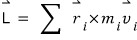
What was the derivative of momentum (rate of change with respect to time)? It was force, right???
But since this is angular momentum, the derivative becomes torque, the rotational force.

Now then, we need to look again at a rotating particle system,
since right now we’re in the “rigid body in plane motion” part, when we want to know about rotation of a particle system, I’ll introduce an origin O’ for the coordinate system we’ll use.
Origin O is the origin of the inertial reference frame (just the coordinate system that looks at things like translational motion).
<<Ah, and leave open the possibility that origin O’ may be accelerating with respect to O~>>
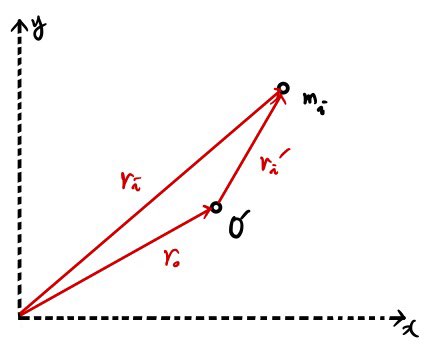
I’ll set each vector like this!
Now let’s try computing the total torque N’ about the O’ axis.
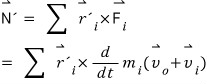
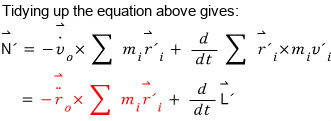
Unlike the case where the rotation axis is fixed, a red term got added~ heh. Ah but,
as you can see, if the rotation axis moves at constant velocity, it becomes 0, right?
That red term is what gets added~ when the rotation axis is accelerating hehe hihi.
Let me organize the cases where that red term becomes 0.

As one example of the third case,
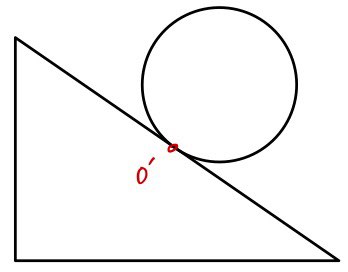
When something is rolling down like this, and the contact surface is O’, the acceleration of O’ is in the direction of the centripetal acceleration,
and the direction of sigma m_i r’_i also points toward that center (CM)!!!
That is, when the acceleration of the rotation axis points toward the CM, the angle between the two becomes 0,
and since the value of sin theta is 0, the cross product is 0.
So the red term becomes 0~ ^^ hehe.
Comments
Discussion happens via GitHub Discussions. You'll need a GitHub account to comment.