Three-Dimensional Motion of a Rigid Body
We level up from planar rigid bodies to full 3D — think spinning a sweet potato on an arbitrary axis — and grind through the inertia tensor using direction cosines and cross products.
Previously the rigid body was doing planar motion, but now it’s 3D, huh~
So if before we were playing with a planar rigid body, now we have to play with a sweet potato…
“Rotation of a rigid body about an arbitrary axis”
Let’s play with the sweet potato for real. Let’s stick an arbitrary axis into the sweet potato and spin it.
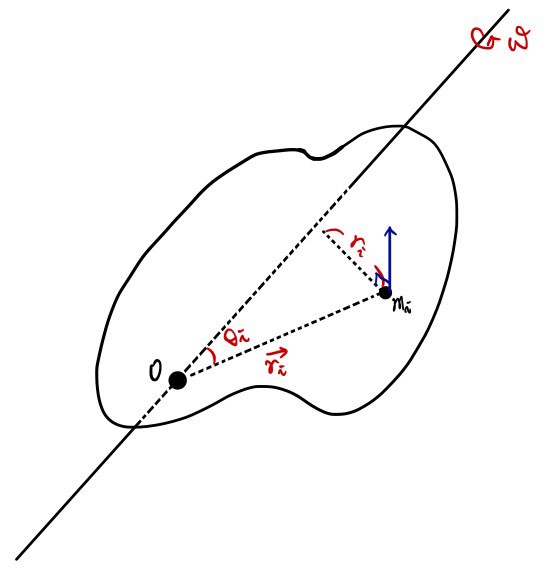
Shall we find the moment of inertia, which we’ve covered most centrally in rotation?
[I = sigma m(i) r(i) squared] — it was this,
but since it’s a 3D rigid body, there’s a slight difference from the planar case.
What is it?
Moment of inertia… “the thing where you multiply the weight mi by how far it is from the axis, and add it all up…” — that was the concept, right? heh
If you remember that concept, you need to think about the ‘distance from the axis’.
Aha.
If the reference is the origin O, then by using the angle and multiplying by sinθ(i),
we get r(i)⊥, which is the distance between mi and the axis. Makes sense, right?

’n-hat’ is the direction vector of the axis. Then that formula makes sense too!!!
Now I’m going to play with that formula,
but before playing, I’ll define ’n-hat’ using direction cosines.
The direction cosines that we learned in high school Math II….!
I just kind of remember it as a way of expressing a direction vector using the angles between the direction vector and the x, y, z axes.
Everyone’s gonna have to drag up that memory from way deep in your head hehe

The r(i) vector, expressed in the x, y, z coordinate system, is
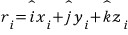

Yoho
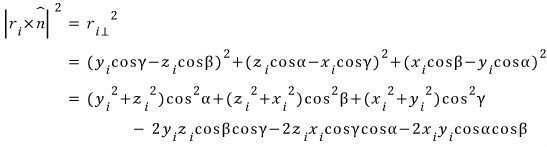
Alright, now we’ve got all the ingredients. Let’s find the moment of inertia I.
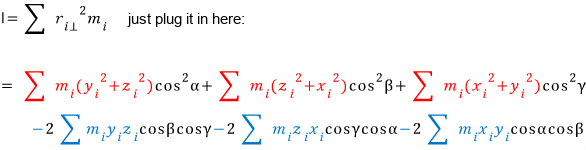
Doesn’t the red part look really familiar?????????? We saw it a ton earlier, right?
Yes, that’s right. It’s the moment of inertia about the x-axis, moment of inertia about the y-axis, and moment of inertia about the z-axis~~~~~
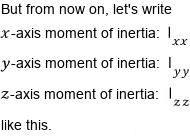
Now the problem is the part I left in blue at the bottom,,, I’ve never seen a form like that before.
But if you just look at the ‘dimensions’, it does seem kind of similar to moment of inertia.
People decided to call this the ‘product of inertia’.
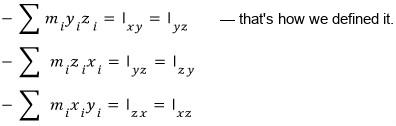
What this means is that the product of inertia can be seen as a measure of how asymmetric the rigid body is with respect to the rotation axis,
It can be seen as how far~~ it is from the principal axis, which we’ll learn about later.
You’ll understand when we get to the later content^^ no worries nini~
To roughly explain the principal axis, (we’ll do it again later)
The axis that makes the rotating body symmetric about all axes (x, y, z) is called the principal axis.
For example, if there’s something like my pencil case, and you ask what the principal axis is,
you could say this is the principal axis
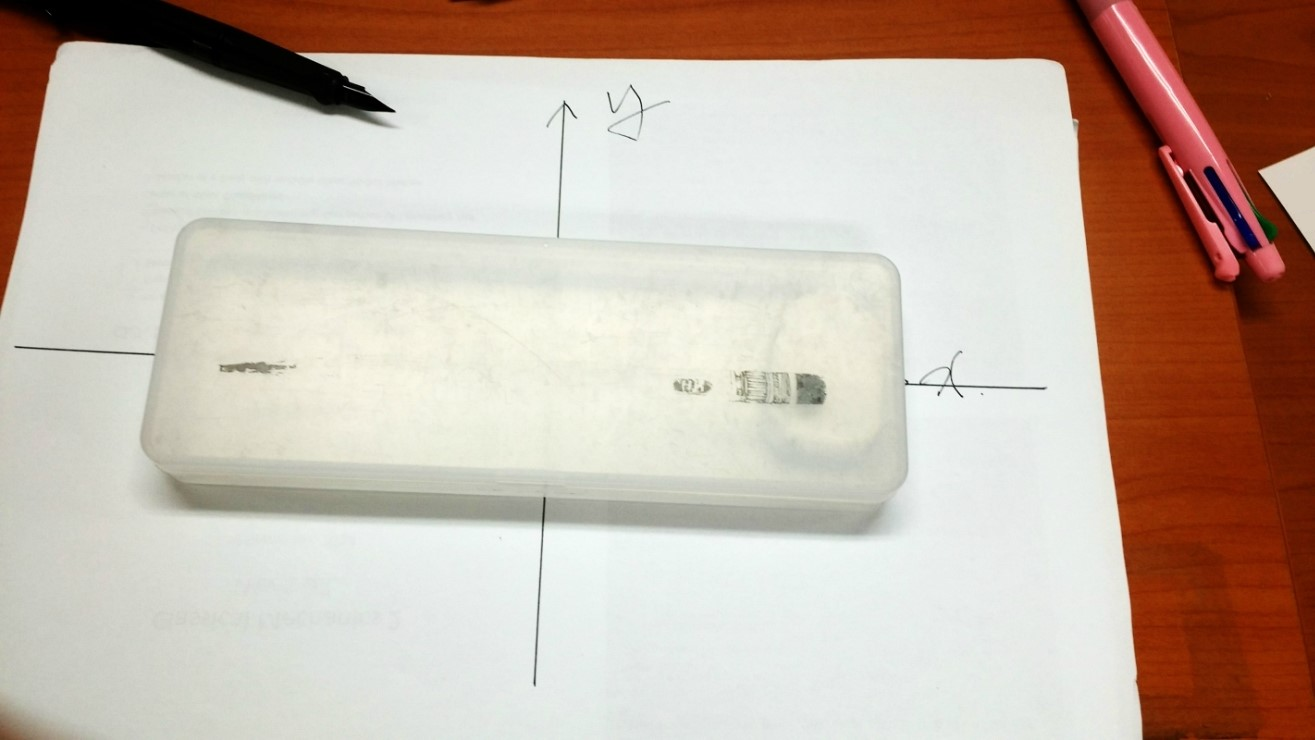
you could say this is the principal axis
Because it’s symmetric about the x-axis, symmetric about the y-axis, and symmetric about the z-axis.
But for this pencil case, you can just eyeball it and
go right here~~~
but where’s the principal axis for a sweet potato???? Ah, of course I don’t know either.
That’s when!! you use the product of inertia~ you find where all the products of inertia become ~~ 0~
How to? Duh, by integration
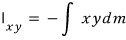
So, since the moment of inertia in sigma notation is annoying to look at (it just looks complicated),
I’ll rewrite it with some new conventions.

Comments
Discussion happens via GitHub Discussions. You'll need a GitHub account to comment.