The Inertia Tensor
Still fuzzy on what a tensor really *is*, but studying the moment-of-inertia tensor this time actually made things click — let's muddle through it together!
Alright, now …. I think it’s time to introduce the concept of tensors.
Before studying this myself, I searched the internet and looked at the tensor part in a mathematical physics book, but I couldn’t really understand it properly?
To really understand tensors, if you study relativity thoroughly~~, at some point!
‘Ah, so this is a tensor!’ — you’ll start to feel it.
Actually the physical quantity called a tensor is used a lot in relativity too they say… so I think this much is the best I can do. T_T Let’s somehow get through it well..
Okay okay, physical quantities can broadly be described in 3 ways.
Scalar, vector, and tensor. I heard this from my professor,
Um. To put it simply, if a scalar is thinking only about the magnitude of a force,
a vector describes even the direction of that force, right???
And a tensor? A tensor they say considers even the plane on which it acts…(don’t get it lol lol lol)
But I do understand at least this much.
A tensor doesn’t change even when the coordinate system changes.
In the case of a vector, if the origin of the coordinate system moves from O to O’, the vector changes too, right????
So it’s also hard to deal with the equations? Ah
Anyway, a tensor is some…. kind of? vector-like? it’s vector-like but different! definitely different.. thing that doesn’t change even when the coordinate system changes.
In my opinion, when a sweet potato rotates like this, the moment-of-inertia tensor, and,
when the sweet potato over ~~ there rotates the same way like this, or when it’s flipped and rotates,
all ~~ if the rotation is the very ~~~ same “like this” rotation, then in that case the tensor is all the ~~~ same?
And that tensor can be represented as a matrix. That’s about the level of it I think.
So a tensor can be calculated ‘from any reference point,’ and therefore it is called ‘absolute.’
(Do you get a sense of what I’m saying? As you read through this post, you’ll start to see what I mean.)
To tell you the conclusion first, I don’t know what a tensor is,
but at least the ‘moment-of-inertia tensor’ — going through it this time, I actually got it!!!!
Okay, first, the moment of inertia tensor we’ll be handling is defined as a matrix like this.
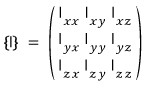
The n-hat unit vector can also be written as a matrix, right?

You know, blah blah about i, j, k unit vectors, right??
The (scalar) moment of inertia is a value related to “some object” and a ‘rotation axis,’
the value, even for the same object, changes with respect to the rotation axis — that’s what I (moment of inertia) is, so we need to keep this in mind.
The relationship between the moment of inertia tensor and the moment of inertia is
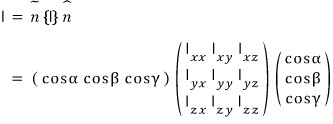
(For this relation, you can just recall the derivation of the moment of inertia from the earlier post.)
Why do we learn the moment of inertia tensor? When dealing with 3D rigid bodies, it’s convenient,
The reason we kept using vectors over and over was because it’s convenient, right? Here too, dealing with this tensor (dealing with matrices) is convenient, and
from now on I’ll write out those convenient reasons..
Today’s main purpose — expressing the angular momentum vector and the scalar rotational kinetic energy in terms of the moment of inertia tensor is the final goaaal!!
● Angular momentum vector
We’ve studied up to finding I for a rigid body moving in 3D and on top of that even tensors?(up to now)
Now using the tensor, how the angular momentum, rotational kinetic energy, etc. become conveniently expressed as tensors,
and in later posts, how much more convenient it becomes when we use the principal axis — you can focus on those things.
Okay, just like we did before, angular momentum is the total sum of the angular momenta of individual particles.(sweet potato individual particle one~ one~)
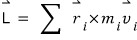
Ah, but earlier we did v=rw, right?
It was v=w x r, but for a planar rigid body the axis was at 90 degrees anyway, so I used the dot product.!!!
Here I’m trying to keep it simple, but since w and r aren’t necessarily at 90 degrees, I can’t express it easily with the dot product??
Then before substituting, let me briefly pull mi to the front of the expression.
Like this
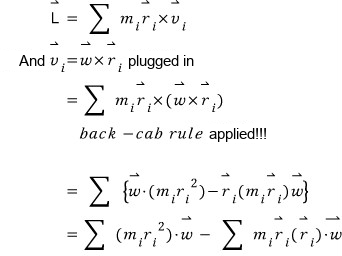
Got this far….. now here, w (omega) has nothing to do with i, so I’d like to pull it out… can I pull it out?
(With my math knowledge so far, it doesn’t look possible?)
Ugh, whatever!!!! Let’s just pull it out for now!!!!!!!!!!!!!!!

In the latter term, you must NOT treat ri.ri as ri squared!!!!
This type of vector product is called a dyad product. It’s a kind of tensor apparently..
Aha so,

The red part is what they say is the tensor… that is, multiplying a tensor by a vector gives a vector, ???
Then what about the front term????
The front term is a scalar, so let’s multiply by the unit tensor {1} to match it as the same matrix!!
Then we need to know the dyad product.
The unit tensor {1} in dyad product form is ii+jj+kk, they say~~~
«A brief detour into the dyad product»
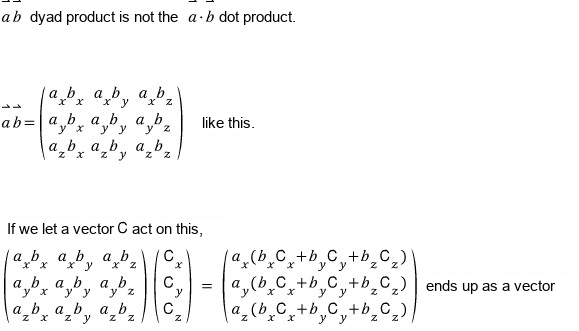
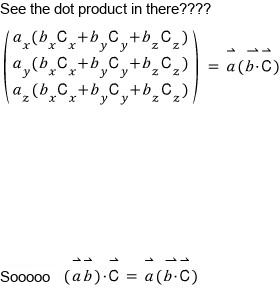
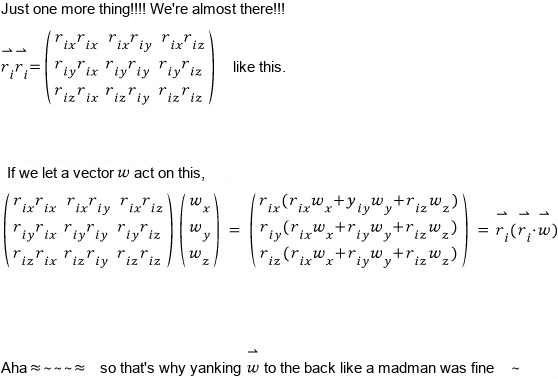
Okay then, I’ll go back to the very top now!!!
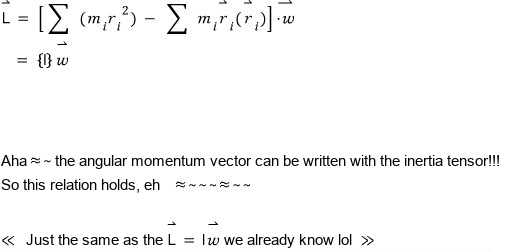
● Rotational kinetic energy
This time I’ll express energy as a tensor too. A breather lol
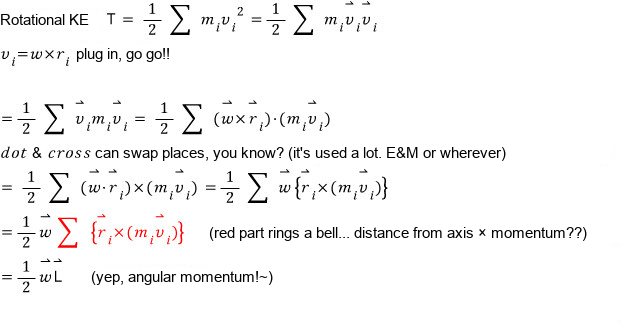
Okay okay okay okay okay okay okay okay
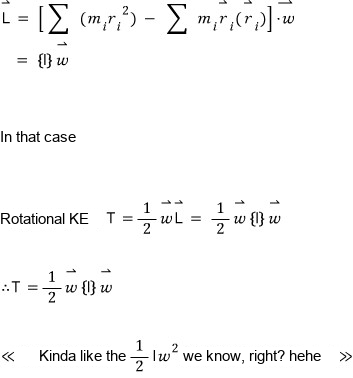
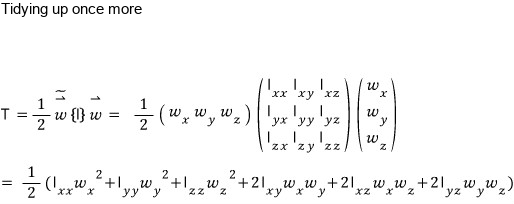
Copy-pasting from above
Comments
Discussion happens via GitHub Discussions. You'll need a GitHub account to comment.