Principal Axes of a Rigid Body
We finally dig into principal axes — the special axes on a rigid body where all the products of inertia vanish, plus all the notation conventions that come with them!
Today we’re doing the principal axes of a rigid body!!!! Principal Axis ha (not a swear word))
Let’s take a look at this principal axis that I briefly mentioned earlier.
Um, the time we briefly touched on it before was when we were talking about products of inertia — the principal axis came up then.
At that time I attached a picture of a ridiculous pencil case lolol
Today let’s say it’s a sweet potato, sweet potato sweet potato
Now let’s set up x, y, z axes on the sweet potato!!! Any which way!!!
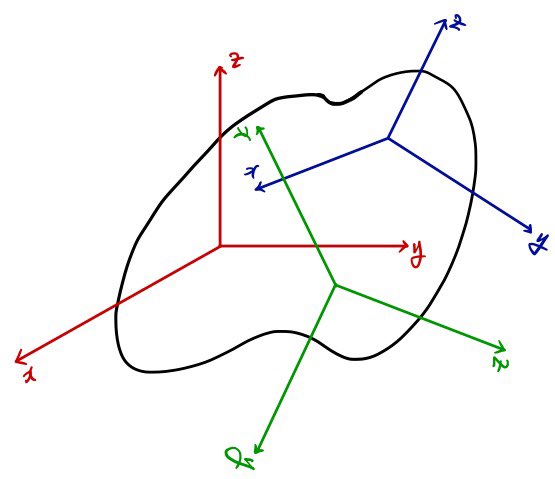
What I want to say is that axes are something you get to pick for yourself.
You can pick them in red, in blue, or in green.
Right!!!
Now think about the components of the inertia tensor at that time.
For example, the component of the product of inertia called Ixy is
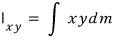
so
aha!!!! depending on how you pick the axes, the components of the inertia tensor are different!!!
Now, on that sweet potato, there are thousands, tens of thousands, hundreds of millions, ten quadrillions …………….
an infinite number of ways to pick axes.
Among these infinitely many axis cases, there is definitely one axis where Ixy, Ixz, Izy are all 0.
That~~ axis is!! what we call the principal Axis!! Got it??
(For reference, in the usu~~al case they say you take the CM as the point O)
Another convention comes in, convention convention~~~
Say that~ axis drawn in red in the picture above is the principal axis (principal axis), then!!
At that time we notate it differently from the other axes. The names of the axes aren’t x, y, z but 1, 2, 3.
Like this
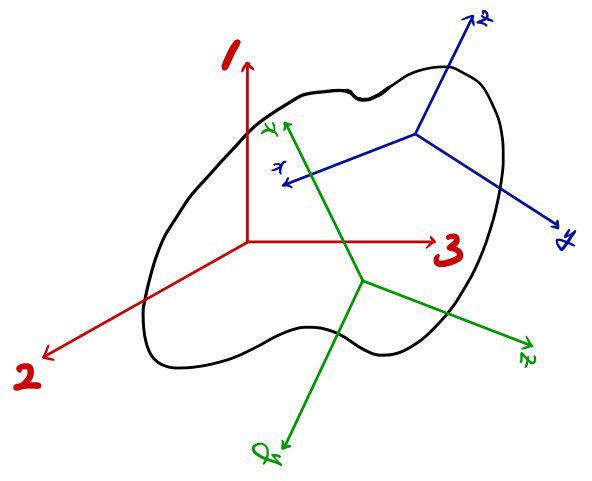
“Excuse me GD park manager, does the x-axis reallyyy have to be the 1-axis and the y-axis the 2-axis”
“and the z-axis the 3-axis???????”
Nope~ as long as it’s 1, 2, 3 somehow it’s fine, but
there’s just a convention for axes as common sense, and I can tell you this as common sense.
If you take the cross product of the x, y unit vectors, the direction has to come out as z,
if you take the cross product of the y, z unit vectors, the direction has to come out as x,
if you take the cross product of the z, x unit vectors, the direction has to come out as y
this is just,.. something I overheard somewhere too.
If this basis is broken, apparently the mathematical tools don’t work!!
because things stop being consistent??? I think you should at least match 1, 2, 3 to that extent.
Now, and another convention another convention another convention another convention another convention another convention
this principal axis is treated so specially, I don’t know what makes it so important
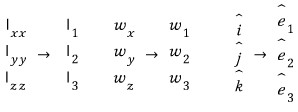
A notation convention to show that it’s the principal axis!!!!
Got it?!?!!
We’ll notate it differently like this~~~~ the principal axis is precious, hehe
When it’s the principal axis, the moment of inertia also….. T_T T_T T_T T_T (ugh!!)
Its name is “principal-axis moment of inertia (principal moment of inertia)”
remember at the very beginning when we talked about the principal axis, we said the principal axis is the one where the products of inertia all~~ become 0???
yes yes yes yes, so in the components of the principal-axis inertia tensor, the product-of-inertia terms are all 0.
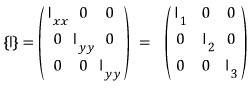
Why do we learn this principal axis~~ and why do we use it!!!
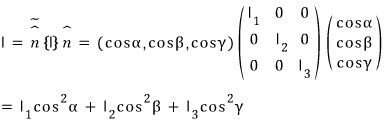
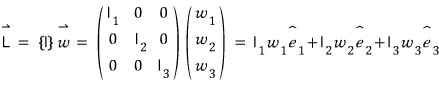
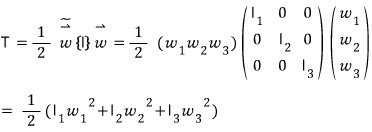
It’s because, in a coordinate system whose axes coincide with the principal axes, the moment of inertia, angular momentum, and rotational kinetic energy about an arbitrary rotation axis take extremely simple forms!!
- Moment of inertia (scalar) — this was just acting the direction-cosine vector of the rotation axis on the tensor from the front and back, right???
- Angular momentum (vector) — this was just acting the angular velocity vector omega on such a tensor, right????
- Also kinetic energy (scalar) —
Let’s go a liiiittle further ha
there’s something we haven’t thought about up to now.
Namely, “dynamic balance!!”
It’s a problem in 3D
In 3D, is the direction of L always the same as the direction of w???????
That’s nono !
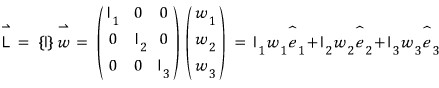
The direction of L can be different!!
But! there’s a case where they’re the same!
Namely!!!! “if one of the three principal axes is the rotation axis! the direction of L and the direction of w are the same.”
If one among the 1, 2, 3 axes is the rotation axis, then L // w, I’m saying hehehe understand?
Shall we check it with a formula
Say it rotates about the 1-axis. Then the w vector is w = (w1, 0, 0), rotating like that?!!?
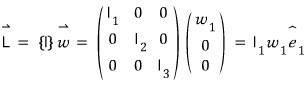
The L vector also has nothing but an e1 component, so lolol L // w, right? hehehe
At this time we say it’s in dynamic balance!
If the direction of the angular momentum and the direction of the angular velocity are the same, apparently it rotates “freakin’ smooooth~~~~ly”
You know when you’re spinning something and that torque appears and the thing itself wobbles around, you’ve seen that right,
that’s because it’s not in dynamic balance, apparently.
Since the time variation of the L vector is torque, there seems to be a discrepancy?????? that arises from that.
Comments
Discussion happens via GitHub Discussions. You'll need a GitHub account to comment.