Euler's Equations of Motion for a Rigid Body
We finally put inertia tensors and principal axes to work deriving Euler's equations of motion for a rigid body, with a spinning sweet potato thrown in for good measure.
Man, I feel like I’ve been cursing out Euler a lot since coming to university lolololol ah seriously
There’s just too much….T_T
I even wrote a report about this guy once lolololololololol
Apparently he did so much research that he went blind
But
Even after losing his sight he kept on doing research…….ha…dang………..hehe
Anyway let’s get started.
Up until the last posting I studied Principal Axis. What’s the principal axis???
When you set up coordinate axes for some object, if you just slap them on any ol’ way, the product of inertia terms stick around in the inertia tensor and the calculation gets messy,
but if you pick the principal axis BAM!!!! the product of inertia terms vanish, so
L = {I}w and T = (w{I}w)/2
when you use these formulas it becomes super simple.
Alright, having studied up to this point
we’ve basically acquired the tools — tensors and the principal axis!!! tools lol
Now we’re going to study more general 3D rotational motion of a rigid body.
Hmm, how should I put it
it’s like sticking a sweet potato on a skewer, spinning it round and round, and throwing it lol (totally hopeless, right?)
Well that’s what I mean anyway, and now the axis of rotation moves too, hehehehe
Now two coordinate axes come into play.
Just the fixed coordinate system (inertial frame) and the coordinate system that rotates along with the rotating object (rotating frame)
Hmm so
the coordinate system just sit~~ting still watching the spinning flying sweet potato is the inertial frame, and
the coordinate system stuck to the spinning flying sweet potato and rotating along with it is the rotating frame (like if you sat on the sweet potato and rode it??maybe?)
The relation connecting this inertial frame and rotating frame we learned way~~~ back~~~
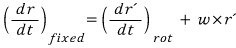
We learned this earlier!
But for now, we’ll spin the sweet potato but not throw it.
And let’s look at the angular momentum
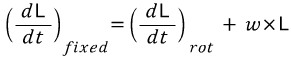
(Here the vectors L and L’ are the same right?? Why are they the same?? Because it’s not flying!!)
Alright so one coordinate system is sitting still
and the other coordinate system has the same O but rotates along with the sweet potato
the relation connecting the two coordinate systems is as above!! hehehehe
(Here you can understand w x L as something like an inertial force. You learn that inertial force is a (fictitious force) inertial force arising from the difference between coordinate systems, right????)
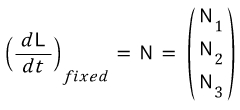
Alright, on the left side of the above equation is …….. just torque, right, torque???? (Let’s say the coordinate axes are the principal axes.)
The right side is!!!!!!!!!!!!!!!!
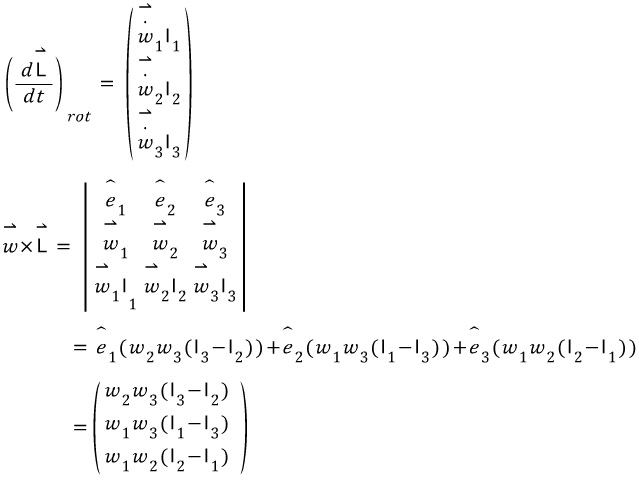
Smooshing the left side and right side we got together jjapong-ohhhh-bbiribbarabbobbo-bbo-bbobbobbobbong gives
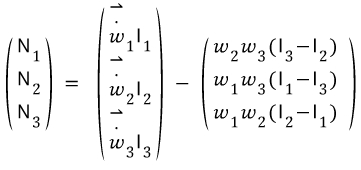
This right here is Euler’s equation of rigid body motion expressed component-wise along the principal axes of the rigid body.
For example, suppose there’s an object rotating with a constant angular velocity!!
(Since it’s constant angular velocity, the angular acceleration is 0)
The Euler equation in this case is
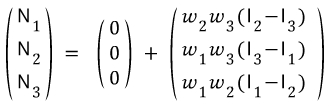
Alright and let’s add one more condition: let’s say the rotation axis is the 1-axis, one of the principal axes.
That means w1=w, w2=0, w3=0
Then the right side all becomes~~~ 0 ???
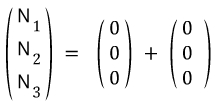
N1=0, N2=0, N3=0
they’re all 0
What does this mean….
N=0, which means there’s no torque at all.
Earlier I said that if the direction of w and the direction of the principal axis are the same, then L//w
this holds (parallel) and we called that dynamic balance,
and now with Euler’s equation we know it exactly!
That the torque is 0.
Ahaa~~ so that’s why the rotational motion is stable~
(This isn’t in the book, it’s just something I did because I was curious…….T_T)
Comments
Discussion happens via GitHub Discussions. You'll need a GitHub account to comment.