Euler Angles
Breaking down Euler angles — those three tricky angles (Θ, Φ, ψ) that link a fixed coordinate system to a rotating one — using a spinning top as our guide.
Euler, why did you do so many things..T_T
Every single one of them is hard too.. T_T
This time it’s Euler angles.
We’re going to learn how to describe a rotating object using Euler angles!
Let’s say the rotating object is a spinning top!
Now there are many viewpoints from which to look at a top,
and the most commonly used method among them is the one that uses Euler angles (Eulerian Angle).
( Ah, and since a spinning top is the universal example for a rotating object, and a top also has the physical property of being symmetric, looking at a top makes things easier )
Let’s all imagine a top that’s spinning.
Euler angles are said to be one method that links a fixed coordinate system with a rotating coordinate system.
At this point the definition of the angles is important.
We write them as Θ, Φ, ψ.
You need to know well what angles theta, phi, and psi each define.
“The 1,2,3 coordinate system labeled with numbers is the coordinate system that’s fixed to the rigid body along the previously defined principal axes and rotates together with it.
The Oxyz coordinate system has a fixed orientation in space.
The third coordinate system, the Ox’y’z’ coordinate system, provides the relationship between the principal axes attached to the rigid body and the axes fixed in space.
<<Now, three coordinate systems have appeared. The 1,2,3 coordinate system, the Oxyz coordinate system, the Ox’y’z’ coordinate system>>
Don’t have a meltdown!!! The 1,2,3 coordinate system is the axes that are stuck right onto the top and rotating along with it,
and Oxyz is just the coordinate system fixed in space.
And it’s important to understand the newly introduced Ox’y’z’ coordinate system — there’s a convention for the Ox’y’z’ coordinate system. Please understand this well.
“The z’ axis coincides with the 3 axis or with the symmetry axis of the rigid body."
“The x’ axis is defined as the line of intersection of the 12 plane and the xy plane.
Such an axis is called the line of nodes."
“The angle between the x axis and the x’ axis is called Φ."
“The angle between the z axis and the z’(3) axis is called Θ."
“The rotation of the rigid body about the 3 axis is expressed by the angle ψ between the 1 axis and the x’ axis"
The three angles theta, phi, psi completely determine the orientation of the rigid body in space. These are called Euler angles (Eulerian angles).
Don’t have a meltdown — once you look at the picture, you’ll go “ohhh that’s what that meant!!!” and immediately get the feel for it!!
Just a little more, heave-ho heave-ho
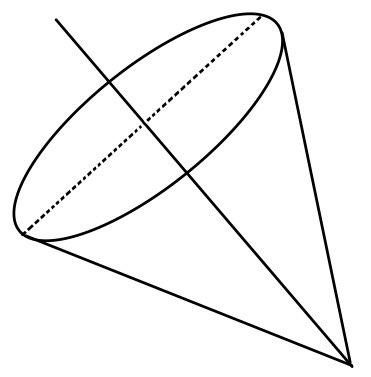
Let’s say a top shaped like this is currently spinning.
First, if we draw in the O123 coordinate axes~
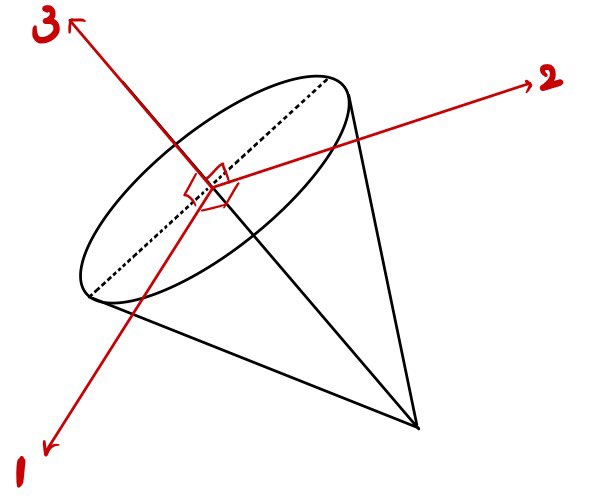
While it’s spinning round and round,
I took a snapshot~ click.
So even though the 1,2,3 axes look stationary, right now they’re spinniiing~
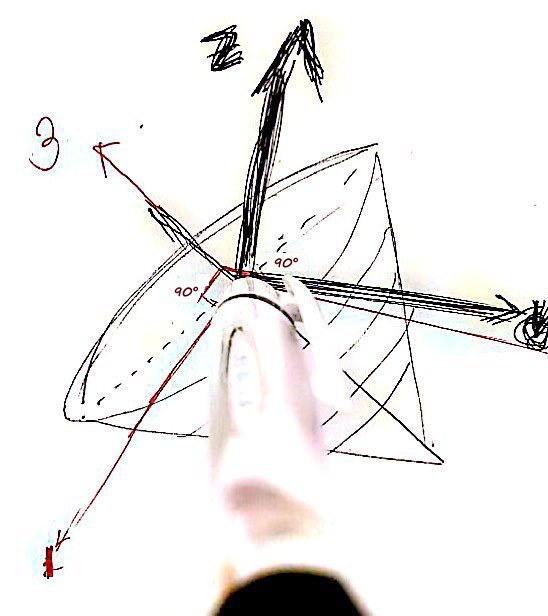
This time I also drew in Oxyz, the fixed coordinate system hehehe
The x axis is the direction popping out toward you, so my pen made an appearance lololololol
(Unintentionally this is a Jetstream PPL ad)
Okay okay okay, the Oxyz coordinate axes and the O123 coordinate axes have the same origin, right?
And since the 1,2,3 axes are principal axes where the products of inertia are 0, the 3 axis is in the same direction as the rotation axis.
Up to here is easy, right?
Now
let’s get into the Ox’y’z’ axes properly — how they’re defined by convention, one by one, step by step.
First, let’s just write down the definitions
“The z’ axis coincides with the 3 axis or with the symmetry axis of the rigid body."
“The x’ axis is defined as the line of intersection of the 12 plane and the xy plane. Such an axis is called the line of nodes."
(You’re asking why there’s no definition for the y’ axis? Since z’ × x’ = y’, once two axes are decided the rest is decided automatically~ heh)
So the z’ axis is easy — it coincides with the 3 axis.
Just one left. Find the line of intersection of the 12 plane and the xy plane and that’s the x’ axis!!!
Alright then, let’s go off in search of that line of nodes.
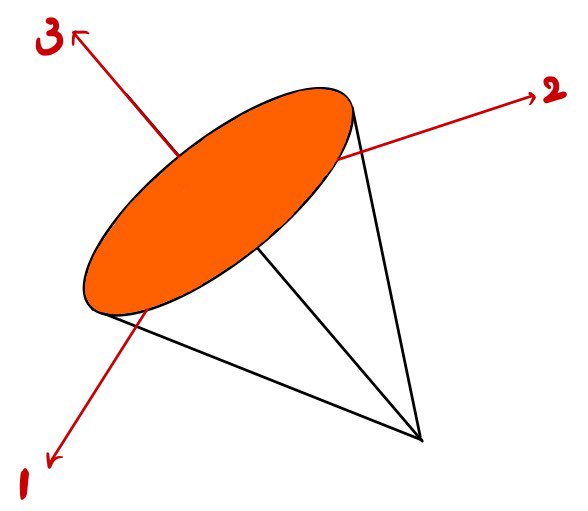
Since we said it’s the intersection of the xy plane and the 12 plane,
rather than imagining the 12 plane, it’d be better to just think of the deck plane of the top.
The part I colored in,
that part must be a portion of the 12 plane, right?
Now we’re going to take a knife and slice right through. (The edge of the cross section that comes out after slicing would be the intersection line)!
How do we slice that thing?
Let me just hammer it out in words.
The top is spinning on the ground (tilted juuust~ a little)
Parallel to the ground, and passing through the center of the top’s deck — slice with a knife, swoosh!!!
When you slice it cleanly!!!!! an edge appears on the deck — that’s the x’ axis!!!!!!
Are words easier?????????hehehehe
Got the feel!
I’ll hammer out the y’ axis in words too. Of course
it’s also fine to find its direction by taking the cross product of the z’ and x’ we found,
but I’ll hammer it out in words.
You take that spinning top and chop a knife straight down perpendicular to the ground, with the knife passing through the center of the top’s deck — bam! slice it,
and the edge that appears!!!!!! is the y’ axis!!!!!!
There’s a picture I’ll use later in the explanation, let me attach it briefly here
(@@@@well-drawn alert@@@@)
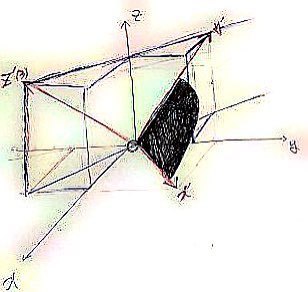
When you slice the top parallel to the ground, swoosh!!
When you slice it perpendicular to the ground, swoosh!!
and the edges
You get it now???????
Yes! Moving on
Now the angles!!!!
Let’s look at theta, phi, psi.
The O123 axes are missing from the picture above,
but the 3 axis is the same as the z axis, so we don’t need to draw it!!!
The 1 axis is in the middle of spinning, so it’s whirling around~ but I’ll snap a picture of it~~
(I won’t draw the 2 axis. When you draw it three-dimensionally the picture gets too cluttered.)
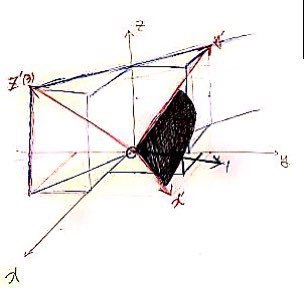
I drew only the 1 axis in the picture above!!!!!!!!!!!!!!!!!
You see the (3) in parentheses next to the z’ axis, right? Right now only the 2 axis is missing! Please figure out the 2 axis on your own,
since it’s not difficult.
Alright, then the first one!!!!!!
“The angle between the x axis and the x’ axis is called Φ."
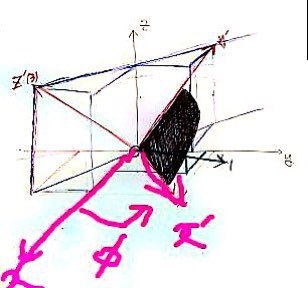
So this is the definition of phi!!
Easy!! Phi is right there!!
“The angle between the z axis and the z’(3) axis is called Θ."
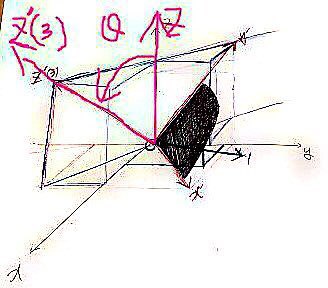
The angle theta is also easy!!!!!!!!!!
“The rotation of the rigid body about the 3 axis is expressed by the angle ψ between the 1 axis and the x’ axis"
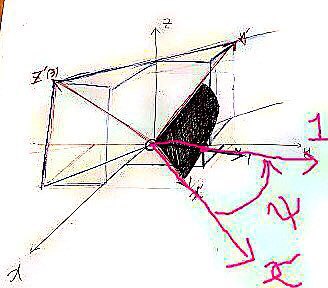
The angle psi is also easy! Psi is just the angle that talks about the spin???hehehe
Yep yep yep yep that’s right, spin spin spin!
The picture with all of these angles drawn in is right here!!!
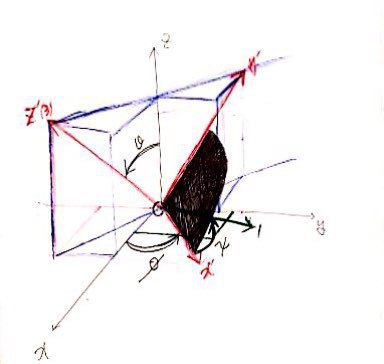
Okay okay okay okay, those angles right now are at the exact!!!! moment when the snapshot was taken of the spinning top.
So those angles will all be completely changed even after just 0.0000001 seconds. (Though they might not change!)
So what I’m trying to say is hehehe
When the top is spinning, is the angle theta always constant, or does it always change?
If the top is spinning quietly in place, theta might be in a state of not changing, even just for a moment.
But what about a top that’s almost dying??? The top is going to topple over slowly, so theta will change, right??
It’s the same with the angle phi. It can be in a situation where it changes, or in a situation where it doesn’t change,
so you shouldn’t think these variables are necessarily numbers that change or necessarily numbers that don’t change, you know?
That said, the angle psi will always change lolol, since the top is spinning lol
Well it’s basic content,
but at first I kept getting confused hehe
I’ll stop here and prepare part 2 of the Euler angles posting.
Comments
Discussion happens via GitHub Discussions. You'll need a GitHub account to comment.