Euler Angles (Part 2)
Picking up right where we left off — breaking down what ψ̇, θ̇, and φ̇ actually mean physically for a spinning top, then working out their vector directions step by step.
I’ll just continue right on…
Suddenly an equation pops out of nowhere
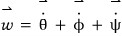
The professor goes “You don’t understand this one~~~~~ "
What the heck
I absolutely hate memorizing!!!!
For now I decided to just accept it and move on T_TT_TT_TT_T
Ugh!!
For now I think I can tell what each one means!!!!!

How fast the top is spinning?!

How fast the rotation axis of the top is moving away from (or getting closer to) the vertical axis of the ground
Or how fast the top is losing its balance and collapsing??

This one is how fast the rotation ‘axis’ itself is rotating!!
I filmed a little video
The pen is the rotation axis of the top. Axis! Axis! Axis!!!! You can think of it as the 3-axis or z’-axis~?
How fast that axis rotates like this??? — that’s what it means
Alright, now let’s figure out the directions of the vectors.

What’s its direction?? It would be the direction of the x’-axis~~~?

What’s its direction??? It’d be the z-axis, rising up vertically from the ground!! (or plunging straight down vertically)

Its direction would be the same as the z’(3)-axis~~~~~~~~~~~~~~~~~~~~~~~???????
So psi, as expected, means spin. Spin spin.
So we’re going to look at it with the spin component taken out!!! What we get after removing the spin component
isn’t omega, it’s omega prime w’, and we leave psi out!

Like this.
The relationship between omega and omega prime is super obvious but~~~~

Alright, done~~~ Then! Now let’s express the vectors in terms of the unit vectors of the O123 axes (e1, e2, e3).
If you just follow along by doing orthogonal projections step by step, you can express them as the unit vectors of O123, so follow along with projection!!
First,
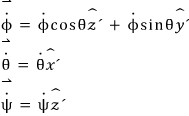

Let’s dot both the left side and right side with the vectors (e1, e2, e3)
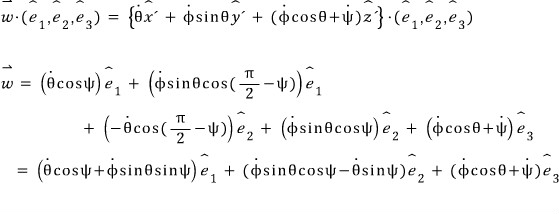
Successfully shredded-shredded-ripped the w vector apart in terms of the unit vectors of the O123 coordinate axes~~~~~
Why did we do this???
Because the principal axes are precious… heh
Once you’ve got this much of the concept down, just following the book,
precession, top motion, and stuff like that are easy to follow along!
So I’m going to boldly skip posting about them.
Classical mechanics is just way too hard T_TT_TT_T so I decided I’d post about the parts where it’s hard to grasp the concepts!
Still, let’s study together!!!!
Everyone, hang in there!!!!
It feels kinda sad to end the classical mechanics posts here.. T_T T_T But
I didn’t take Classical Mechanics 1, you know???
I’ll see you again in the 2015 spring semester lol lol lol lol lol lol lol lol
Thanks to the study method of going through postings, this semester I got 1st place in the entire physics major, all subjects,
and got an A+! lol lol lol lol lol lol lol
Yesss!
Comments
Discussion happens via GitHub Discussions. You'll need a GitHub account to comment.