Angle ψ Between the Ellipse Axis and the x-Axis
Finally nailed the derivation for the angle ψ that an ellipse's major axis makes with the x-axis — posting it because nobody else seems to have one up.
Back in my early college years…


when there’s an ellipse like this, for the angle psi that the major axis makes with the x-axis (sweats), the classical mechanics textbook had written the relation like this,
$$\tan 2\psi = \frac{2AB\cos\Delta}{A^2 - B^2}$$That fixes the axes, but tangent alone can swap the long and short ones! To select the major axis, use $\psi=\tfrac12\operatorname{atan2}(2AB\cos\Delta,A^2-B^2)$, modulo $\pi$. If $A=B$ and $\cos\Delta=0$, it’s a circle and there’s no unique major axis.
and left the derivation of this formula as homework. While moving that post over to English, I realized I hadn’t properly derived it back then. T_T
Well… anyway, today I did manage to do it.
The reason I’m bothering to put up a post is that a lot of people ask about this, but a post with the derivation doesn’t seem to come up in searches, so I’m putting one up…
Actually, I don’t think what I worked out is the standard approach, and I’m sure there has to be an easier method, but anyway, I did prove it. T_T
Sigh…
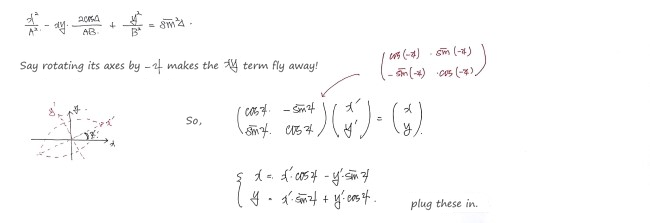
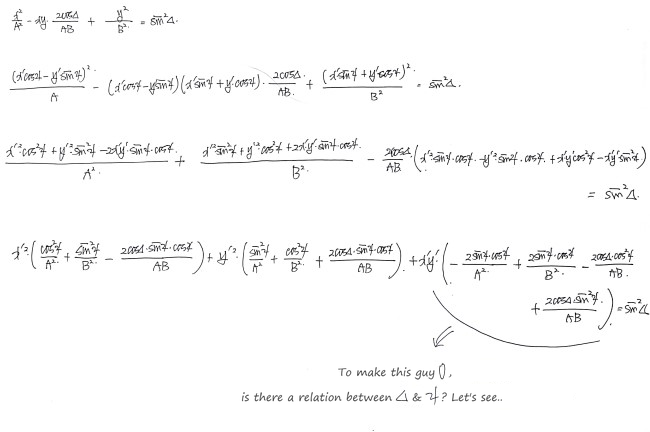

Heads-up. The figures here are the original notes, slips and all. A few things to watch for:
- In the second line of the substitution, the first fraction is $\frac{(x'\cos\psi - y'\sin\psi)^2}{A^2}$, with $A^2$ below (the line writes $A$); the next line has $A^2$ again, so $\tan 2\psi = \frac{2AB\cos\Delta}{A^2 - B^2}$ is right.
Comments
Discussion happens via GitHub Discussions. You'll need a GitHub account to comment.