Time Value of Money
A fun, casual walkthrough of time value of money concepts — future value, present value, and the compound value interest factor (CVIF) explained with zero boring.
So now let’s properly look at the techniques financial management uses for the time value of money. We’ll start slowly, with the idea that money grows!
Money grows: future value
Say I currently have S in money, and the annual bank deposit interest rate is r. We’ll take r as positive and constant for now. Am I going to keep that money in a safe at home, or in the trunk of my car? Did I commit a crime? Unless it came through some shady route, I’d put it in the bank, right?
Then the deposit interest makes the money grow by this much:
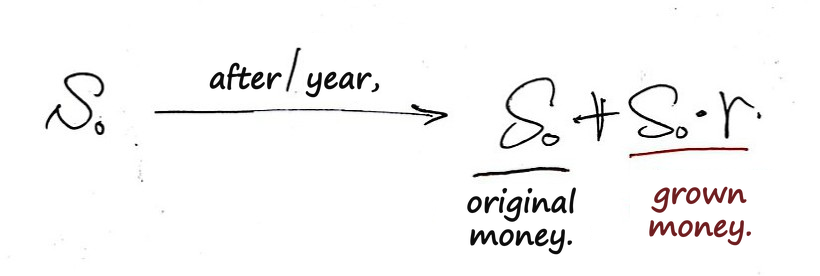
Alright, now leave S there for 2 years, just like that. Of course, we’re still assuming the interest rate stays at r.

Let’s clean that up:
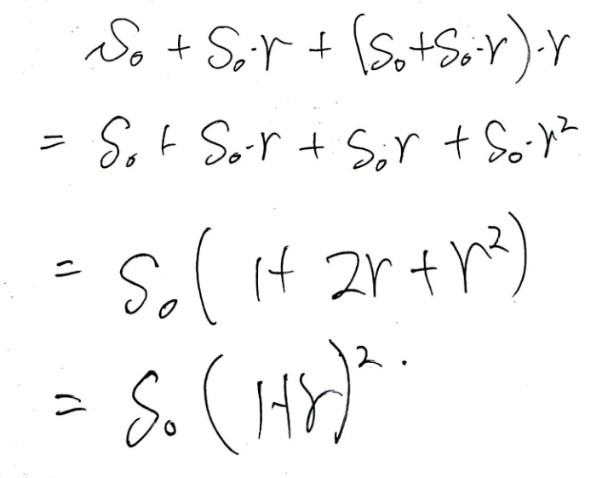
Shall we try 3 years too?
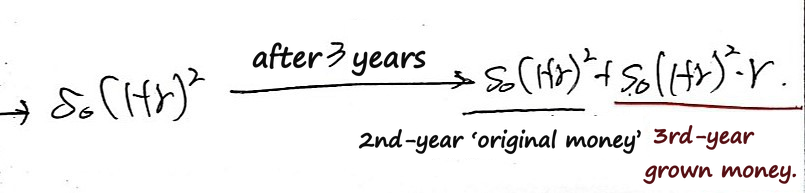
Clean up the calculation, and we get  .
.
We learned sequences in high school. Checking up to the 3rd year lets us spot the pattern: as long as the interest rate stays at r, the value of S after n years becomes  . We can be pretty confident of that! Plug any natural number into n, and we can find the value after that many years.
That’s right: all we had to do was multiply by “this guy,” 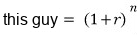 !
!
This guy is called the compound value interest factor: CVIF. These days, a calculator gives us the value easily. People in the old days couldn’t possibly have had calculators like ours, though. Our ancestors probably used something like this:
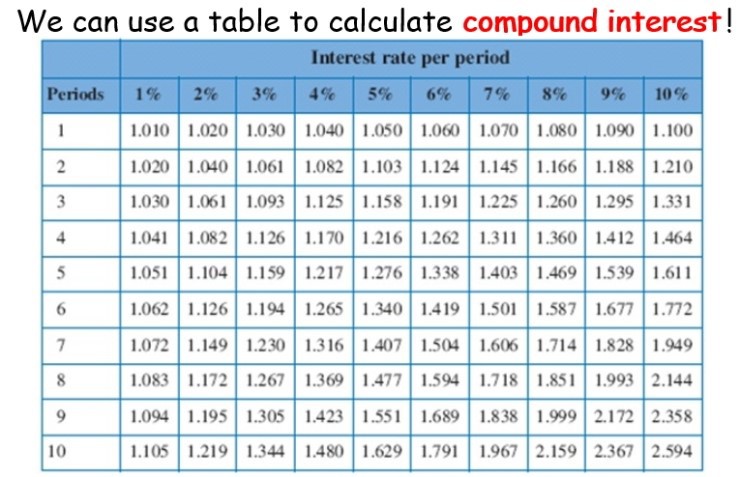
(from. http://slideplayer.com/slide/9016453/)
Oh my goodness. What we just did was find future value: “I have S now. What will it be worth after n years?” That’s the question we answered, so the name shouldn’t cause much controversy.
Bring future money back to the present
Now, what question does present value answer?
“Mmm, my friend says he’ll give me P after n years. What’s that worth right now?” That’s the question.
A fun side story, by the way. Yes, I’m about to wander off.
My professor once asked why geometry developed. Geometry: Euclid, triangles whose interior angles add up to 180 degrees, blah blah about quadrilaterals, bringing compasses to middle-school class and drawing circles. That picture-drawing stuff, Euclidean geometry!
Here is the playful story my professor told about measuring land, war and expanding territories. Someone’s land grows, and he says, “Hey, slave, I’m curious how much land I own. Go measure it and come back!” “Yes, my lord!”
The land keeps getting bigger. “Hey, slave! I’m curious about my land again. This time, run around it and come back!” “Yes, my lord!” Eventually the territory gets so huge that someone sent out might never return…?
So they hire smart commoners: “Calculate it for me, please!” Anyway, that was my professor’s joking picture of geometry as an “aristocratic discipline.”
I was trying to talk about converting to present value. Why did this story suddenly appear? It’s related. Even in the old days, with all that barter, people made contracts too. Lots of them.
There’s even an ancient Greek story about Thales and a deal involving olive presses! Look up the philosopher Thales if you’re curious. It’s often retold as an early options-like arrangement, rather than proof of the very first modern options trade.
In that same joking picture, finance and present value are “aristocratic disciplines” too. Hire a smart commoner: “Hey, I’ve got this contract,” or “I’m supposed to receive money a few years from now. How much is this contract, this promise worth? Convert it to money. Money is what matters to me! Money, money, money!”
Anyway, back to our question: “My friend says he’ll give me P after n years. What’s that worth now?” That’s where I was before I veered off somewhere else. Heh.
Let’s twist it into an equivalent question. “P comes in after n years” becomes “How much would I need now for it to become P after n years?” Answer the second question, and we’ve answered the first.
Say we have x now. After n years it becomes  . So we just need to find the x that makes equal to P. A simple equation does it:
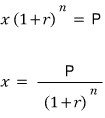
Done. Put simply, the present value of P received after n years is  . Same thing! If you’re curious about present value, multiply by “that thing.”
This time “that guy” is 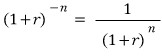 , called the present value interest factor: PVIF. CVIF, PVIF: the same story, and neither derivation is difficult. That should do for now.
But keep the assumption in mind: the interest rate stays at r for the whole n years.
We’ll use expressions like this a lot: P to be received after 5 years, “discounted” at interest rate r, is  . Here, discounting means bringing money back to present value, taking time into account. Shaving it down, so to speak.
A payment every year: count the dates
Until now, we had a single S’s future value or a single P’s present value. Now let’s make it multiple payments.
If you faithfully put in S every year, what happens to its value after 10 years?
You put in S 10 times, so it’s 10 Ss, or 10S? That’s the elementary-school answer. Take interest into account and answer like a high-schooler, and you draw a picture like this:
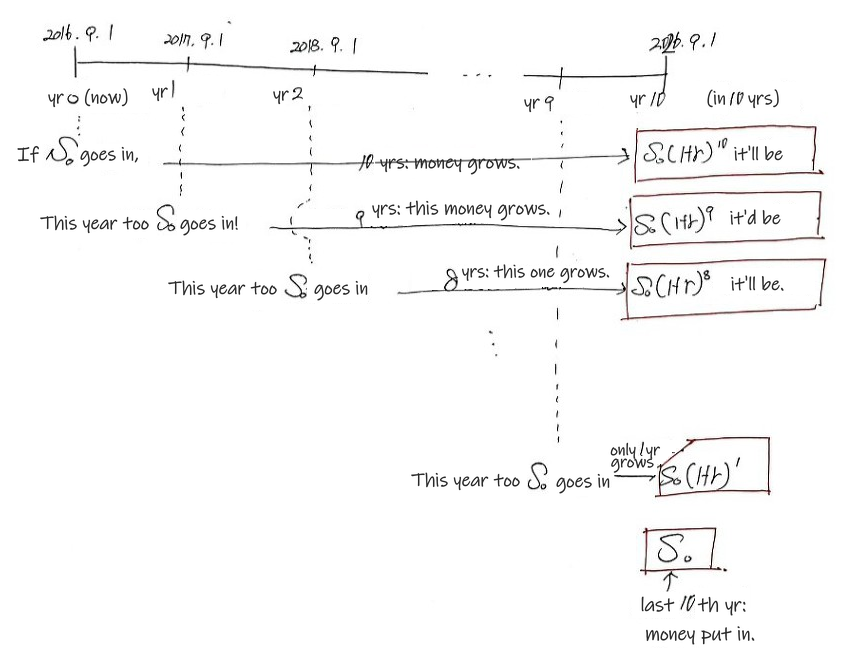
Watch that timeline: I have put in a payment at year 0 and another at every year through year 10. That makes 11 payments here, rather than the 10 I originally asked about.
When my high-school maths teacher drew these, my brain would melt and I’d just go to sleep. Now here I am drawing one myself. Ugh. How time flies.
The sum of everything piled up in the 10th year is the value after 10 years. So let’s add it all up. First, write a stylish sigma. Boom!
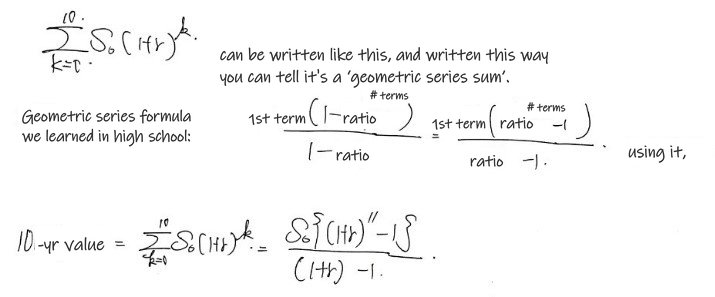
Huh? It’s probably different from the book. I deliberately started with a different example to show how much it matters whether money goes in at year 0, now, or not. Right?
No… actually, I made a mistake. I accidentally put S at year 0. Heh. It’s all my fault, lol.
You’ve got to read a problem carefully before solving it. A sloppy guy like me… honestly! From now on, if there are no special conditions, as in r=6%, n=10, we’ll take the default to be no payment at year 0. Why is the book written that way? I don’t know.
Now let’s derive the value after n years when we put in S each year starting next year, the annuity-like thing.
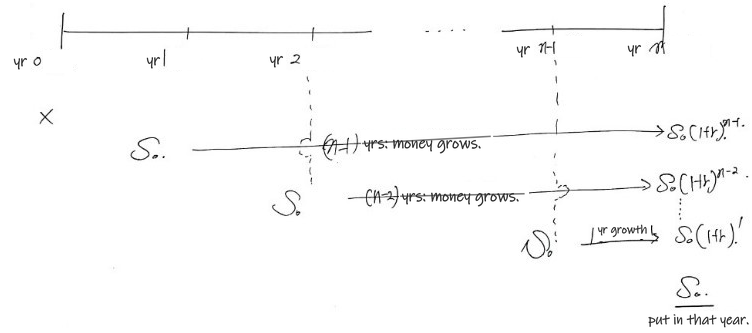
OK, this time we’ll get the result I wanted. Add up all the values at year n:
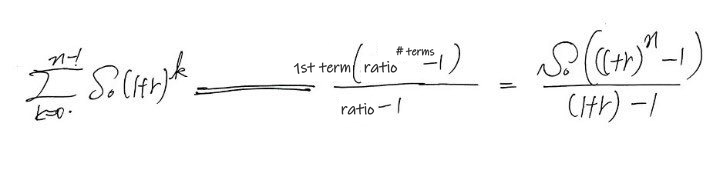
Yep, there it is: the value after n years. “Save the same S every year, while interest stays at r,” and the answer is S times “this thing,” 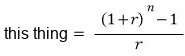 . It’s called the compound value interest factor for an annuity: CVIFA.
Annuity factors have old-school tables too, lol. This particular picture is a present-value annuity factor table, PVIFA, which we’ll use next. It isn’t a table of the future-value factor CVIFA.
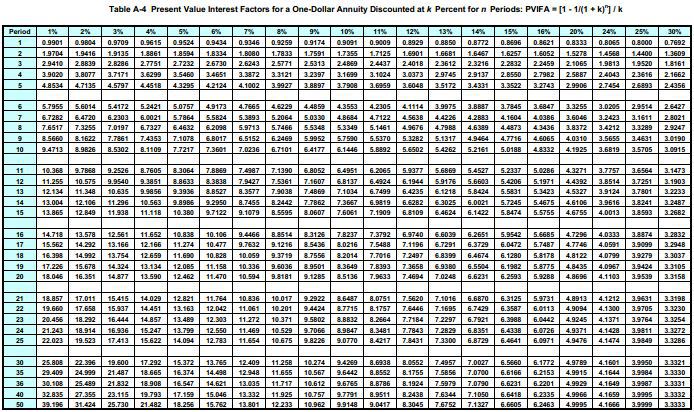
(from. eroleplay.ru/pvifa-table-PDF.html)
Shudder. Why are there so many? Let’s move on quickly.
A payment every year: what is it worth now?
What’s our situation this time? A school bully making someone bring them things? No, that’s a bit violent. Let’s say you won an annuity lottery instead. Starting next year, 5 million won will come in every year.
I’ll move a little faster now: show the picture, use the geometric-series formula, introduce the factor and move on. There’s still a lot left. Ugh.
You’re supposed to receive 5 million won every year for n years, but you nag to get it all at once. Is asking for 5n million won reasonable?
No, right? It makes sense to bring each of those payments back to present value, then ask for their sum. Let’s work through the picture and the geometric-series formula:
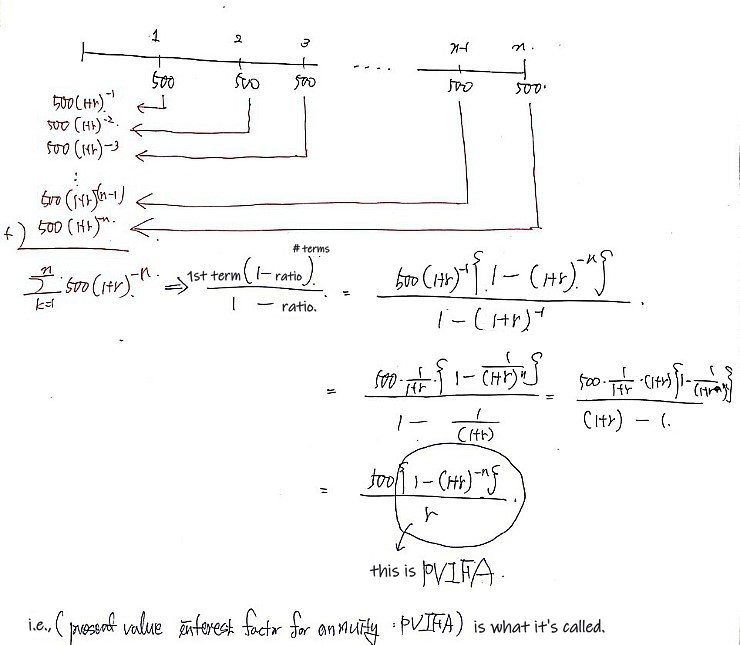
What if the payments go on forever? There’s even something called a perpetual bond. For a constant positive discount rate r, can’t we just send n to infinity in the formula above?
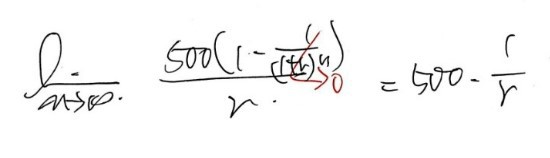
Take the limit, and… too simple! We don’t even need a factor table for this. Moving on!
Payments that grow by a steady rate
We should discuss the future and present values of irregular cash flows too. “Irregular” sounds hopeless. Well, there is no single neat geometric-series shortcut: we can still compound or discount each payment separately and add the values.
But what if the payments aren’t constant, yet do follow a rule? So we’re thinking about non-constant, rather than irregular, cash flows: payments that grow at a constant rate. The principle is the same.
We’re going to save for n years, with the payments growing at rate g. The first payment is 1 million won. The second is 1 million won times (1+g), the third is 1 million won times (1+g)^2, and the nth payment is 1 million won times (1+g)^(n-1). Here g is the growth rate written as a decimal. The pictures count amounts in units of 10,000 won, so their 100 means 1 million won.
In that case, what’s the future value after n years?
Let’s first take n payments starting now, at years 0 through n-1. The first is today, and each later payment grows by g. Same old routine: put in the picture, then apply the geometric-series formula.
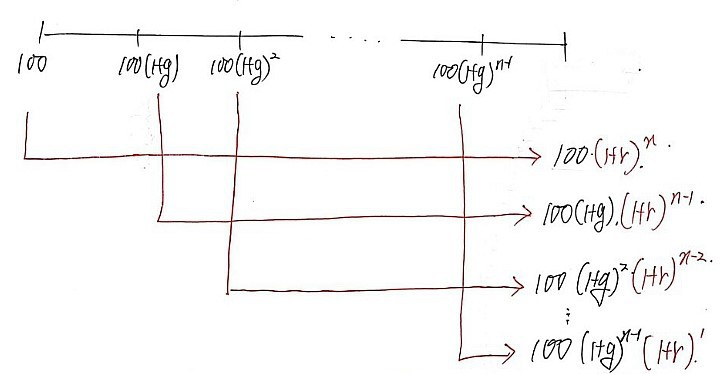
Oho, I can see it straight away. The first term is 100(1+r)^n in the picture’s 10,000-won units. The common ratio is (1+g)/(1+r), so it’s a geometric sequence! And the number of terms is n!
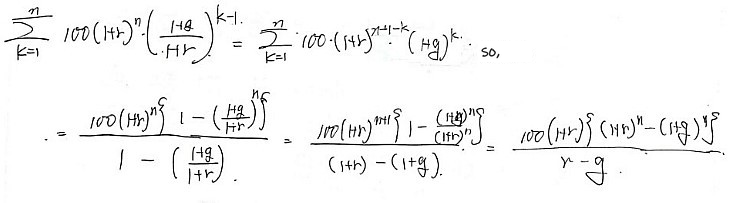
Oh yes, done. What if the n payments instead start next year, at years 1 through n?
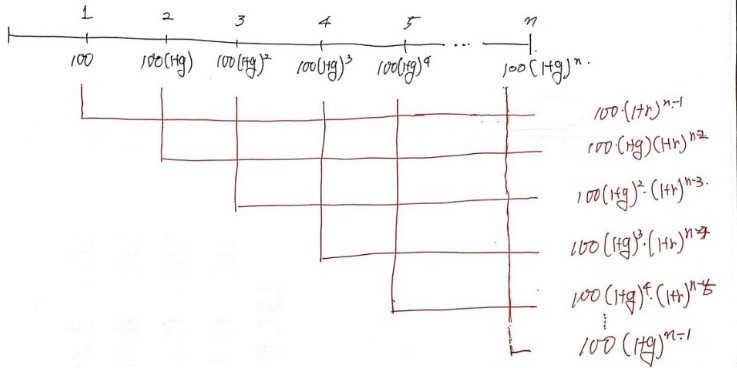
Then the first term is 100(1+r)^(n-1), the common ratio is (1+g)/(1+r), and the count is n. So:
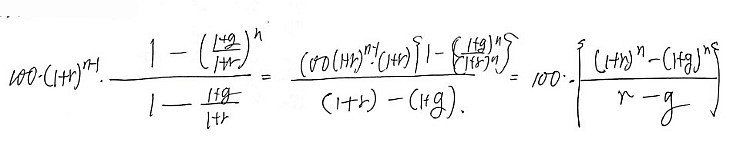
The fractions with r-g assume r and g are different. If r=g, all n compounded payments have the same value: the total is n times 1 million won times (1+r)^n when payments start now, or n times 1 million won times (1+r)^(n-1) when they start next year.
Wow. It’s done! Same geometric-series idea, with the payment dates doing the work.
Heads-up. The figures here are the original notes, slips and all. A few things to watch for:
- In the picture that adds up the present values of the 500 payments, the sum is written $\sum_{k=1}^{n} 500(1+r)^{-n}$; the exponent should be $-k$, since each payment is discounted for its own number of years. The result $500\{1-(1+r)^{-n}\}/r$ is right.
- In the picture for growing payments that start now, the first line’s right-hand sum has $(1+g)^{k}$; it should be $(1+g)^{k-1}$, because $100(1+r)^{n}\left(\frac{1+g}{1+r}\right)^{k-1} = 100(1+r)^{n+1-k}(1+g)^{k-1}$. The closed form at the end is right.
- In the timeline for growing payments that start next year, the payment at year $n$ is labeled $100(1+g)^{n}$; it should be $100(1+g)^{n-1}$, as the last term on the right of the same picture and the next formula have it.
Comments
Discussion happens via GitHub Discussions. You'll need a GitHub account to comment.