Economic Feasibility Evaluation of Investment Projects
A rundown of the 6 methods for evaluating investment cash flows — from ARR and payback period to NPV — complete with worked examples and each method's sneaky strengths and weaknesses.
We learned about cash flows earlier. Once cash flows are measured like that, we have to evaluate the investment proposals: which cash flow is better, and which one is worse?
So the idea is to measure the cash flows of various projects and then evaluate what we’ve measured. This is what we call economic evaluation. It helps us see which proposal to pick and which one to reject.
The book lists 6 methods: average rate of return, payback period, net present value, profitability index, internal rate of return, and capital allocation. Of these 6 methods, we’ll work through the first five here.
1. Average rate of return
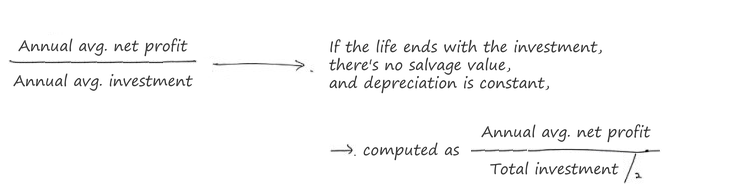
The average rate of return (ARR) divides the expected annual average profit by the average amount invested:

This uses accounting profit, so it’s also called the accounting rate of return. There’s a little shortcut to the calculation:
Example 8.1
Equipment costs 35 million won, lasts 5 years, and has no salvage value. Its estimated annual net profits are shown below, in units of 10,000 won.
| Year | 1 | 2 | 3 | 4 | 5 |
|---|---|---|---|---|---|
| Net profit | 200 | 500 | 800 | 600 | 700 |
The five profits average (200+500+800+600+700)/5 = 560.

With straight-line depreciation and no salvage value, the average investment is 3500/2 = 1750. So ARR = 560/1750 = 0.32, or 32%.
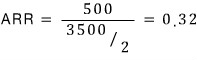
Let’s check that average investment. Depreciation is 700 a year, so the average book value in each year is:
- Year 1: opening 3500, closing 2800; average 3150.
- Year 2: opening 2800, closing 2100; average 2450.
- Year 3: opening 2100, closing 1400; average 1750.
- Year 4: opening 1400, closing 700; average 1050.
- Year 5: opening 700, closing 0; average 350.
The average of those five is (3150+2450+1750+1050+350)/5 = 1750. Exactly half of 3500, yep!
ARR is easy to calculate and convenient to use. But the calculation uses accounting profit rather than cash flow. And here’s the poison: it doesn’t consider the time value of money. That is said to be a truly fatal weakness, however handy the arithmetic might be.
2. Payback period
The payback period is how long it takes the project’s cash inflows to recover the initial investment. We start the clock when the initial investment goes out, then ask how much longer it takes until that amount has come back in.
Under this method, shorter is better! The reasoning is that recovering the money sooner can improve the firm’s liquidity. We don’t have to wait as long to get our money back.
Especially when the future is uncertain, getting that liquidity back quickly has its appeal!
Example 8.2
| Year | 0 | 1 | 2 | 3 | 4 |
|---|---|---|---|---|---|
| Cash flow | -5000 | 1000 | 2000 | 1000 | 3000 |
From the initial 5000 investment, 4000 has come back after 3 years, leaving 1000 still to recover. If year 4’s cash arrives evenly through the year, that last 1000 takes 1/3 of year 4. So the payback period is 3 + (1/3) years = 10/3 years.
The company sets its own cutoff. Shorter than that? Pass. Longer? Fail. Give it an F, heh.
But this method ignores everything after the payback period. Those later cash flows could change which project we’d prefer! And, like ARR, it ignores time value. Bye!
3. Net present value
Net present value (NPV) is the present value of the project’s future cash flows, discounted at an appropriate rate, minus its initial investment cost.
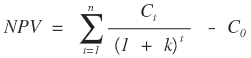
Here, k is the minimum required rate of return, or cost of capital. This is the minimum return that must be realized through the investment. We’ll deal with cost of capital in Chapter 13, so don’t worry that we’ve suddenly dropped an unfamiliar name into the calculation.
We’ll play the “find the right k” game in Chapter 13. We’re still in Chapter 8, so just get the gist for now.
Here, let’s assume we don’t consider risk and think of k as the risk-free interest rate. If there’s no other risk, investors don’t demand a risk premium, the compensation for bearing risk, from the firm. So in that simplified case, the minimum required rate really is just the risk-free rate.
Example 8.3
| Time 0 cash flow |  |
 |
 |
 |
|---|---|---|---|---|
| -1000 | 500 | 300 | 400 | 200 |
Here k=0.05. The time 0 cash flow is -1000; in the formula, C_0 is the positive cost of 1000 that we subtract.

The NPV is about 258.4. Positive NPV? Pass. Negative NPV? Fail. Zero means the project just earns the required return.
Now, as you can probably catch from the formula, suppose the cash flows are already known and fixed. Then the thing we’re changing to get a different NPV is k. In other words, we can extract the relationship between k and NPV! Still assuming those cash flows are known, of course.
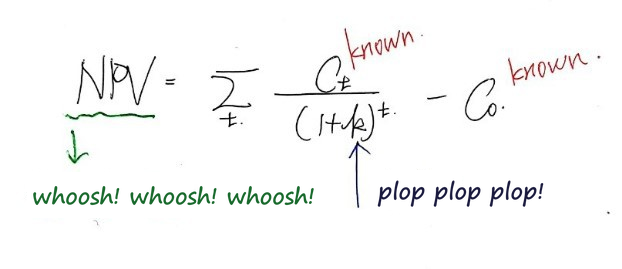
We already know all those C_t and C_0 values in the formula. Try a different k and the corresponding NPV will pop out. Whoosh, whoosh! Right?
Pair each k with the NPV that comes out of it. Now we’ve got ordered pairs, and the axes look like this:
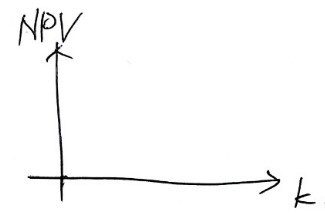
Plot those pairs on the axes, and we get:
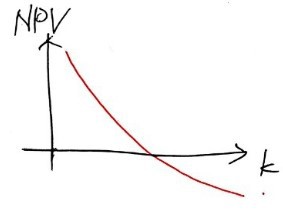
It comes out like this! For the conventional pattern we’re using here, an initial outlay followed by inflows, the curve crosses NPV = 0 at a particular k. That k is what we call the internal rate of return (IRR).
Internal rate of return! Why is it called that? I’ll mention it in a moment.
4. Profitability index
The profitability index (PI) divides the present value of future cash inflows by the initial investment cost:
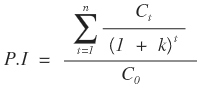
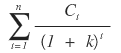
Doing the arithmetic is easy enough, but let’s dig into what the result means. Here’s the money I’m investing,  . For every 1 of it, how much present value do I get back? That’s the question behind this per-1 measure.
If the present value per 1 is 0.57, we invest 1 and get only 0.57 in present value. Not even enough to cover the outlay: a signal to reject it. A PI above 1 means positive NPV; exactly 1 means break-even at the required return.
But can NPV and PI point us in different directions?
Let’s evaluate projects A and B. Here, too, the amounts are in units of 10,000 won.
| Project | |
 |
NPV | PI |
|---|---|---|---|---|
| A | 400 | 720 | 320 | 1.8 |
| B | 300 | 600 | 300 | 2.0 |
Say A and B look like this. Then NPV judges A better (320 against 300), but PI judges B better (2.0 against 1.8). Oh my god~ What’s the root cause of a gap like this?
Their investment scales differ. To evaluate A and B properly here, we have to match their scales. B’s is 100 short: 1,000,000 won. So that both invest 400, put B’s leftover 100 in a risk-free asset or a bank deposit while B runs. That deposit just earns the discount rate, so it adds zero NPV: B’s total NPV stays 300, and its combined PI becomes (600+100)/400 = 1.75. That’s below A’s 1.8, so the gap is gone: both methods now pick A.
The per-unit ratio depends on how much we’re investing. It isn’t the same thing as the total value added.
5. Internal rate of return
We’ve already met IRR: the discount rate k that makes NPV 0. In other words:

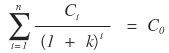
We derive the k that satisfies this equation and call that value the IRR. Of course, C_t and C_0 are assumed to be known, just as before.
As we’ve mentioned in other economics and finance topics, solving this sort of equation can be pretty painful. Especially if n gets a little bigger, doing it by hand is hardly inviting. But we learned the bisection method and Newton-Raphson method in financial engineering: methods for solving difficult equations like this. So we’re not worried!
Once we’ve found the IRR, how do we decide whether the project passes?
For an initial outlay followed by inflows, a high IRR has this flavor: “I can still earn a positive NPV even if the cost of capital gets pretty high!”
Cost of capital, as we said before, is the minimum return shareholders and creditors require from the firm. A high project IRR means it can withstand a higher required return; a low IRR means it cannot withstand one as high. So a higher IRR sounds better. But the first comparison we need is with that required return.
For those conventional cash flows, accept when IRR exceeds the required return, and reject when it falls below. Equality is break-even.
But don’t fail one project simply because its IRR is lower than another’s. Both might clear the required return, and the higher percentage needn’t create more value.
Of all these investment-evaluation methods, NPV and IRR are two of the most widely used. Both consider time value, which the first two methods ignored.
Still, using both can lead to opposing rankings. Just as with NPV and PI, one calculation can favor one project while the other favors its rival. Now let’s see under what circumstances that happens, and what we should do about it. We’ll untangle that before we leave this chapter.
Different investment scales and cash flows
First, consider projects with different investment scales and cash flows. They don’t start from the same investment amount, and they don’t produce the same cash inflows, so their rankings can differ.
Let’s say each project lasts 1 year and the discount rate is 10%.
| Project |  |
 |
|---|---|---|
| A | 500 | 800 |
| B | 1000 | 1500 |
Let’s take a peek. Do the calculations:
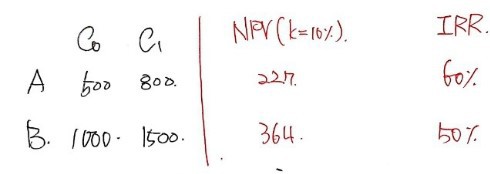
It comes out like this. IRR ranks A first: 60% versus 50%. But NPV ranks B first: about 364 versus 227. Both clear the 10% required return, yet the methods disagree about which is better.
Why does this kind of selection discrepancy happen? It’s surprisingly easy to see when we draw the k-NPV curves together.
Why do the rankings differ?
Draw both NPV curves on the same axes and we can see it:
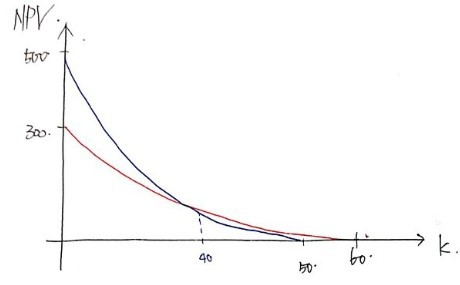
Ah, it’s hand-drawn. Please bear with me.
If k=45%, the NPV ranking would agree with the IRR ranking. But at our actual discount rate, B adds more net present value.
When choosing between these mutually exclusive projects, focus on the larger net present value at the appropriate discount rate. IRR is a percentage; it doesn’t tell us how much value the project adds.
Ugh, so NPV was the point, and IRR was interfering from the side!
There’s another way to look at the cash flows. Rewrite the NPV equation in terms of the project’s final year:
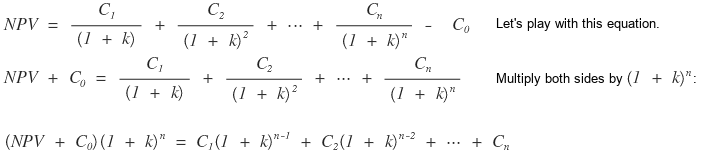
If the receipts are compounded to that year at k, we get this terminal-value interpretation:
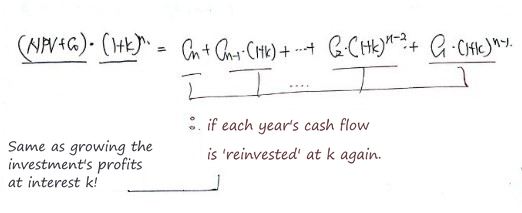
Set NPV to zero and do the same algebra at the IRR, R:
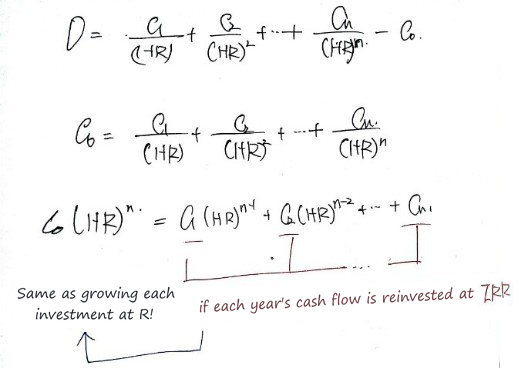
We can read those terms as reinvesting receipts at k or at R, respectively. But calculating an IRR doesn’t promise that later receipts can actually earn R! The IRRs differ from one project to the next, so why would the money conveniently be reinvested at that same R again?
Those reinvestment opportunities might not turn up at all. That’s the snag in reading IRR as a compounded return we can simply count on.
So use NPV at the appropriate required return to keep the comparison straight.
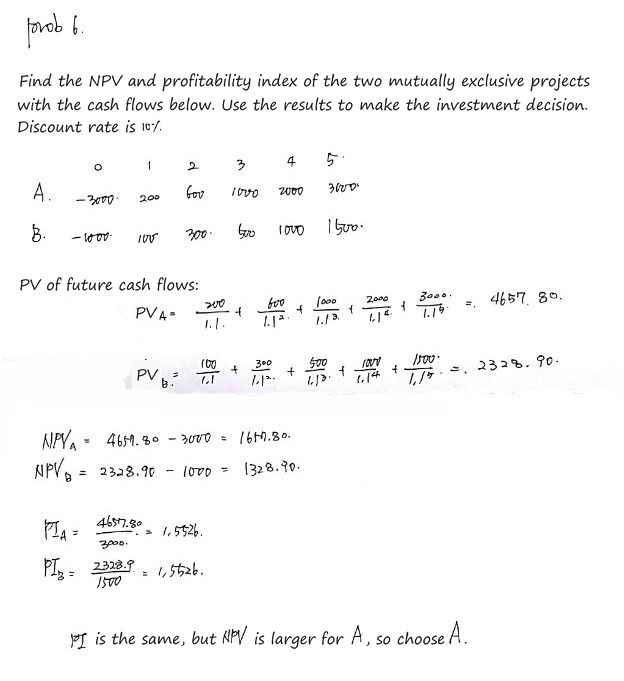
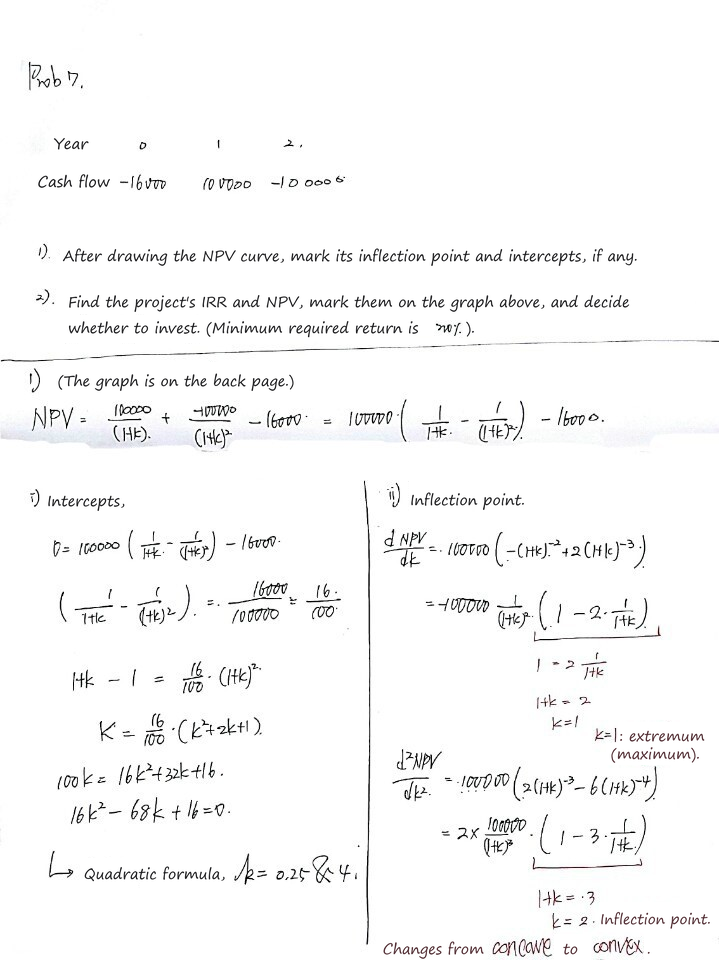
The notes finish with some worked problems that put these comparisons to use.
The last project has a later cash outflow, so it can have more than one IRR. Keep the NPV at the given required return in charge of the decision.
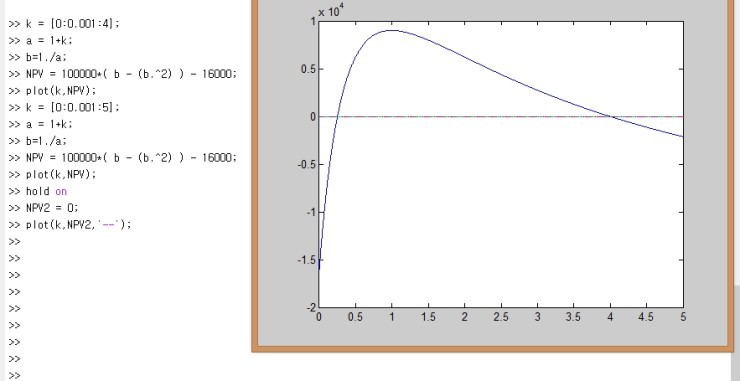
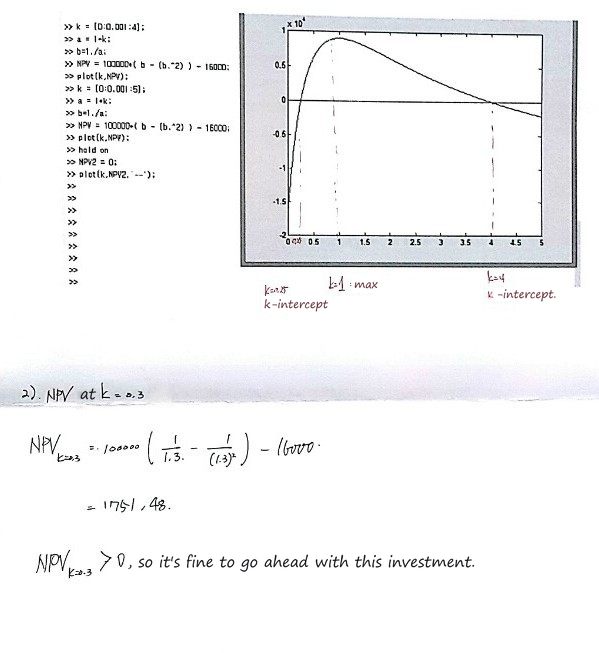
Heads-up. The figures here are the original notes, slips and all. A few things to watch for:
- In the two pictures that work out the average rate of return, the average annual profit is written as 500; it should be 560, since $(200+500+800+600+700)/5 = 560$. The final result is right: $560/1750 = 0.32$, while $500/1750$ would only be about $0.286$.
- In worked problem 6, $PI_B$ divides by 1500, but B’s initial investment is 1000 (the cash-flow table and the $NPV_B$ line both use 1000). So $PI_B = 2328.90/1000 \approx 2.33$, not 1.5526: PI actually favors B while NPV favors A, the scale conflict from section 4. For mutually exclusive projects we go with NPV, so A is still the choice.
Comments
Discussion happens via GitHub Discussions. You'll need a GitHub account to comment.