Efficient Frontier — Markowitz
We dive into the Markowitz efficient frontier — plotting every possible portfolio combo in expected return vs. standard deviation space to find the best bang for your risk buck.
The content below covers material from my undergrad days. You might think this is derived in a way that’s meant to be intuitive, but there’s also a version that’s derived more mathematically rigorously. After understanding it intuitively with the content below, if you want to handle it a bit more mathematically, you can always go tackle the more mathematical version :-)
(As a bit of a spoiler, if you understand it intuitively, you can’t even guess that the Efficient Frontier has the form of the “hyperbola ($\frac{x^2}{a^2} - \frac{y^2}{b^2} = -1$)” that we studied in high school. But in fact, the efficient frontier is a hyperbola :-) )
Every stock in the world
Previously I looked at a portfolio made up of two stocks. This time I’ll increase the count a bit. By how much? lol Don’t be surprised: it’s “every stock in the world.” lol
That feels like an elementary schooler going “my dad is 100 years old!!!!!” lol Anyway, for convenience I’ll call the count $n$.
Alright alright alright… here right in front of us we have $\text{stock}_1$ through $\text{stock}_n$………………
How many portfolio cases can we make using these as ingredients??????
→ Answer: a crazy ton.
And to make matters worse, $w_1$ through $w_n$ can be varied contiiiinuously. So there’s going to be an insane number of them T_T
Plotting countless portfolios
In any case, the portfolio’s expected return and return standard deviation are

calculated like this, right??? Then, for each individual stock

let’s think of values like these as all given, and here, let’s think about considering all that crazy ton of cases for  . Of course, the condition
  is satisfied, naturally.
So what is it exactly that I’m saying I’ll consider all of? We take the equation that’s computed like this

and plug in all the different weights  we can think of —

in this case,

in this case,

in this case, countless cases you simply can’t count……!!!!!!
We bundle the expected value and the standard deviation that come out in each case into ordered pairs like  :
: 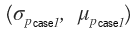 ,
, 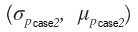 ,
, 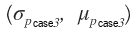 , ~~~~~~ and what I’m saying is that we’ll collect the countless data points that come out like this.
Gathering all that countless data
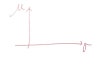
let’s plot countlessly many points on this coordinate axis, one by one by one. If we actually plot them
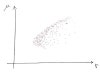
(Actually, I explained the logic here as above, but it seems like a lot of books explain it by continuously adding stocks to the portfolio one by one. But I think it should be fine to explain it this way too, so I said it like above, but I’m slightly worried that there might be an issue here T_T If there is, please do point it out!)
They say if we plot everything as points on this coordinate plane it looks like this (Constructing an Efficient Frontier on Finance Train).
The dominance principle
Now, let’s think about the ‘dominance principle’ for a moment. At the same $\mu$ (return) level, that is, in this part here
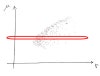
among the portfolios belonging to the same return, here, this one
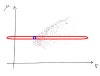
Is there anyone who would pick a portfolio on the right side, instead of the portfolio this blue dot points to??????????
The portfolio on the right side has the same return but higher risk, so if humans were told to pick from that red range, they’d probably pick the blue portfolio!
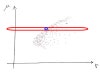
Of course the same holds at other return levels too. So let me put it this way: I collected just these blue ones, picked out the portfolios that dominate all the other portfolios, and bundled them into a set.
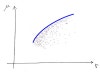
This line we call the
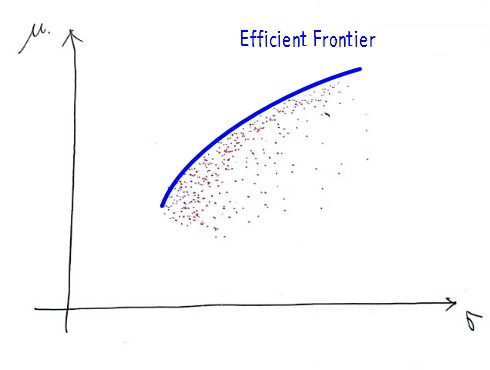
efficient frontier, and this efficient frontier means the most efficient portfolios among all the portfolios we can make by mobilizing every stock in the world.
This Efficient Frontier was devised by Harry Max Markowitz, the American economist who received the Nobel Prize in Economics in 1990, so it’s also called Markowitz’s efficient frontier!!!
That’s as far as the Markowitz efficient frontier goes.
So, for people, which portfolio among those blue lines is the most efficient to pick?
The answer is (as I said in an earlier post) “it depends on the person”, isn’t it?
(please refer to Portfolio Variance and Covariance Matrix (Corporate Finance I Studied #9))
Since the shape of each person’s utility indifference curve will be different, that is, since the degree to which they’re tolerant of risk will be different
the portfolio that maximizes utility on that curve will be different depending on the shape of each person’s indifference curve.
What Markowitz overlooked
But here’s the thing. Actually, we can maximize utility even more.
That is, Markowitz was overlooking one thing. If we think just a little more about the thing he overlooked, we can maximize utility even more.
What he overlooked — never mentioned once above — was the ‘risk-free asset’.
Above, risk-free assets weren’t considered, but in the world, risk-free assets like ‘government bonds’ clearly exist. Considering this risk-free asset, we can increase utility a bit more.
How do we increase it!!!!!!!
To understand this, we first need to take a quick look at how the expected return and return standard deviation of a portfolio that includes a risk-free asset are calculated. Hmm…. I agonized a lot over how to phrase this to connect with the earlier content…. I’ll explain it like this.
You know those optimal portfolios we derived above? Let’s call those portfolios “risky”. It means a portfolio containing only risky assets. Let’s say the expected return of this ‘risky’ portfolio is  , and the standard deviation of its returns is
  .
.
And to this ‘risky’ portfolio, we’ll add a ‘risk-free’ portfolio made up only of risk-free assets. The expected return of this ‘risk-free’ portfolio is  , and its risk is
  , but since its name is risk-free, its risk will be
  ~~
~~
So the expected return of this newly composed “risky + risk-free” portfolio

will be determined like this~~~~~ But this risk…. since  it’ll come out as

That is, the risk of a portfolio made up of a risk-free asset and a risky asset is proportional to the investment ratio of the risky asset.
Risky + risk-free on the coordinate plane
Let’s take the above story to the coordinate plane.
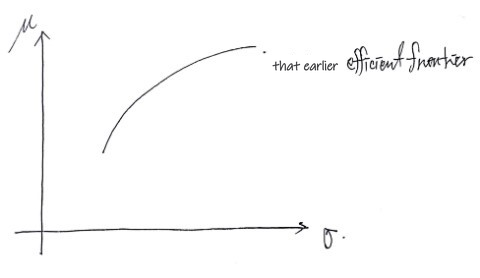
This is that efficient frontier from before, and here let’s pick one portfolio whose expected return is  and whose return standard deviation is
  . And we need to pick one risk-free portfolio too
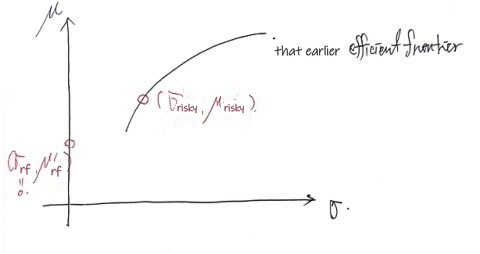
Let’s say we picked them like this!!
And now, for the many cases of $w_{\text{risky}}$, $w_{\text{risk-free}}$ investment ratios of the combined “risky + risk-free” portfolio, we’ll calculate each corresponding


First, simply, ① all-in on the risk-free asset ($w_{\text{risk-free}} = 1$ = 100%), zero investment ratio on the risky asset, and ② zero on the risk-free asset, all-in on the risky asset ($w_{\text{risky}} = 1$ = 100%): in these cases, that point will be plotted here.
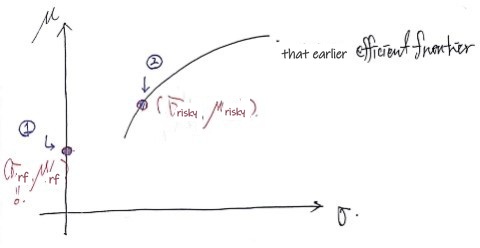
Obvious, righttt….?? lol
Yup yup, now then: let’s say $w_{\text{risky}} = w_{\text{risk-free}}$ = 50% = 0.5, so it’s invested 50% each. Using the equation we derived above..,,,,,,,,, we can calculate it, and a result that’s commonsensically obvious comes out.
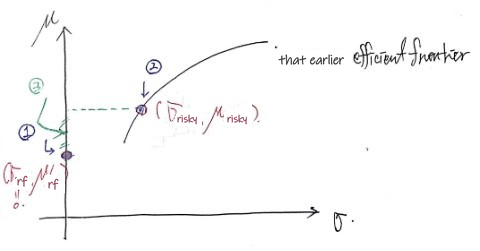
This is the explanation for point ③.
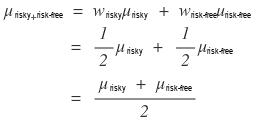
The ‘midpoint’ of $\mu_{\text{risky}}$ and $\mu_{\text{risk-free}}$ comes out as the result, so I plotted point 3 like that above.
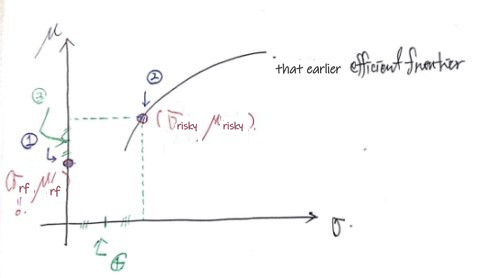
Point 4 works by the same principle.
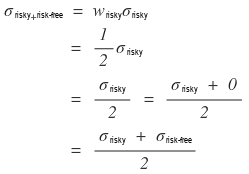
It can be made as the midpoint of the standard deviations of the risky and risk-free assets. So I marked point 4’s position like that
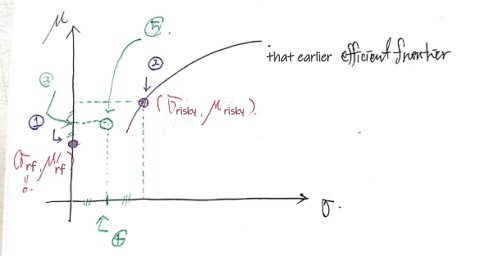
That is, when $w_{\text{risky}} = w_{\text{risk-free}} = 0.5$, the point that represents the identity of the ‘risky + risk-free’ portfolio is this point 5 here.
So then, let’s just try the case when
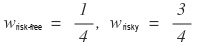
and the case when
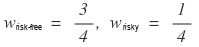
……. Let’s just do it, then; when it’s
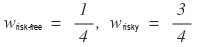
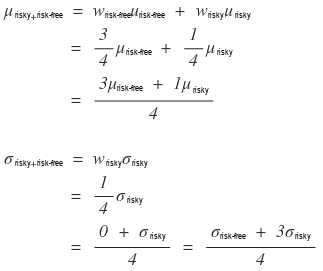
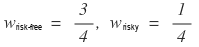
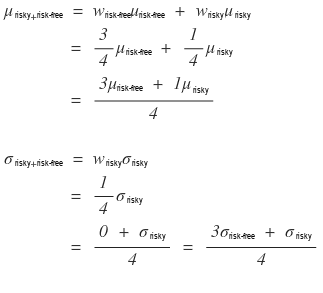
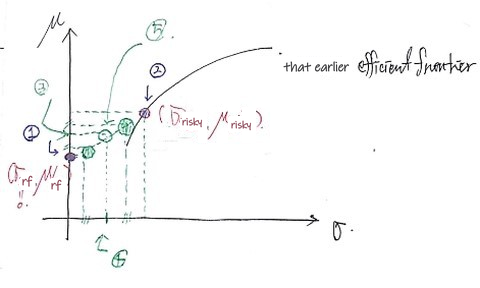
For the above two cases, I’ve colored the identity of the “risky + risk-free” portfolio with green dots!!!!! After dividing into 4 parts, a weight of 3 on risky & a weight of 1 on risk-free; after dividing into 4 parts, a weight of 1 on risky & a weight of 3 on risk-free. I think if you think about it this way, it should make sense that the points are plotted at the locations of those green dots.
In conclusion, if we consider all $w_{\text{risky}}$ & $w_{\text{risk-free}}$ and build a set of $(\sigma, \mu)$ for the “risky + risk-free” portfolio, then unlike the shape of Markowitz’s efficient frontier
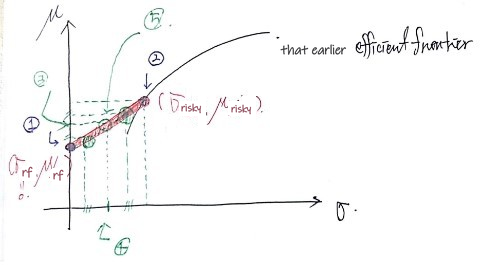
it becomes a straight line.
The Capital Market Line
Then let’s go over one term. The “straight line” that can be achieved by combining risky and risk-free assets, like just now, is called the “Capital Market Line (CML)” (strictly, that name is for the line through the market portfolio; with any other risky portfolio it’s a capital allocation line, CAL).
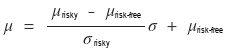
Since this capital market line unconditionally passes through the point  and the point
  , we can also derive it formally. The line passing through two points: first, its slope is
 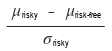 and its y-intercept is
  , so following the equation

exactly, we can write it as follows!!!!!
Ah… but here’s the thing.
I drew the red line only up to that point above, but actually the red line isn’t limited only up to there,
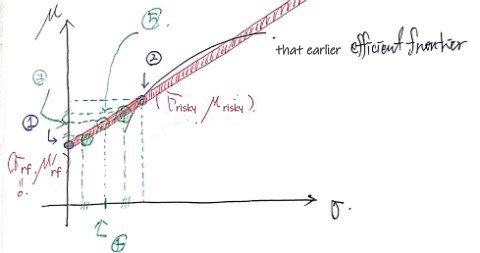
the extension line is also possible. If you borrow more money at the risk-free rate (borrow more) and put your investment ratio in the risky asset above 100%, then the extension of the line is also possible???? That’s why.
The New Efficient Frontier
Now, by the way, up to the point of deriving this line, what;;;;; for;;;;;;; do you remember why I derived this line…? Yeah…. to find a ‘portfolio set that maximizes utility more’ than the efficient frontier is why I’ve been doing stuff like the above, and given that we’ve discussed this, this line is the “risky + risk-free” portfolio set that maximizes utility more.
Why?!?!?!?!?!?!?! Can a “risky + risk-free” portfolio that’s shaped like this maximize utility more?
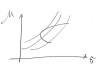
Before, when we weren’t considering the risk-free asset, the most efficient portfolio set we could choose was only this black line, and under this scope we kept maaaaximizing our utility function and we could pick 1 portfolio that maximizes the utility function the most~ The logic was something like this.
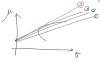
But, once we additionally consider the risk-free asset, we found out that the portfolio set we can form with the world’s (financial) investment assets is not only Markowitz’s efficient frontier, but lines 1, 2, 3, and 4 can allllll be portfolios that exist in the world, so now there are even more cases where I can bring my utility function up against it.
But, while 1, 2, 3, 4 are all possible, there’s no need to try them all, and there’s no need to try with Markowitz’s efficient frontier either.
Because line 4 ‘dominates’ the efficient frontier, lines 1, 2, and 3.
In other words,
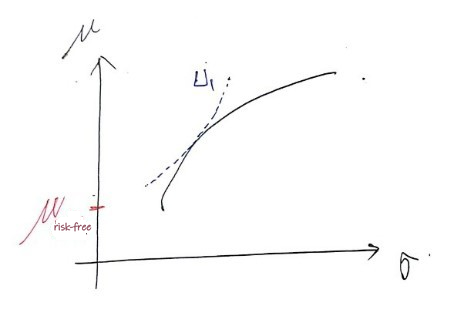
before considering the risk-free asset, we’d have achieved the maximum utility $U_1$ using some portfolio that maximizes utility on Markowitz’s efficient frontier like this, but once we consider the risk-free asset
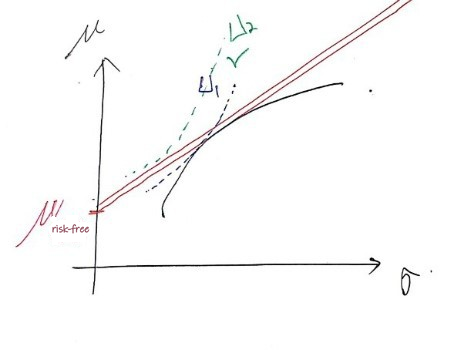
we can find a portfolio that maximizes utility with a larger $U_2$ than that, that’s the deal~
So now in the picture above, you can erase everything other than line 4, it doesn’t matter.
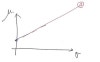
Erase everythinggg and leave only this line, and to distinguish this line from Markowitz’s efficient frontier, we call this line the “New Efficient Frontier”. (They also call Markowitz’s efficient frontier the ‘previous efficient frontier’ in contrast with this~)
I feel like I explained super easy content at needlessly great length…
Anyway…. now the long-awaited CAPM. I’ll continue in the very next posting! hehe
Heads-up. The figures here are the original notes, slips and all. A few things to watch for:
- In the first risk formula of the risky + risk-free mix, the cross term needs a factor 2: $2w_{risky}w_{rf}\sigma_{risky}\sigma_{rf}\rho$. It vanishes anyway because $\sigma_{rf} = 0$, so the result $w_{risky}\sigma_{risky}$ stands.
- Under $w_{rf} = \frac{1}{4}$, $w_{risky} = \frac{3}{4}$, the worked lines are those of the other case: they should read $\mu = \frac{1}{4}\mu_{rf} + \frac{3}{4}\mu_{risky} = \frac{\mu_{rf} + 3\mu_{risky}}{4}$ and $\sigma = \frac{3}{4}\sigma_{risky}$, which the last line already has.
Comments
Discussion happens via GitHub Discussions. You'll need a GitHub account to comment.