Capital Asset Pricing Model (CAPM)
We pick up where Markowitz left off, toss in a risk-free asset, find the one tangent point that becomes the Market Portfolio, and see why the S&P 500 basically fits the bill.
Now the content here is CAPM (Capital Asset Pricing Model).
But before getting into CAPM proper: when we were discussing the Efficient Frontier in the immediately previous post, there were some things I didn’t mention, a few things I deliberately saved to talk about here. I’ll mention those before going in.
Everything is already determined
First, all the stocks that exist in the world are already determined. This means the (Previous, Markowitz) Efficient Frontier is already, already determined. Let’s say it’s determined like this.
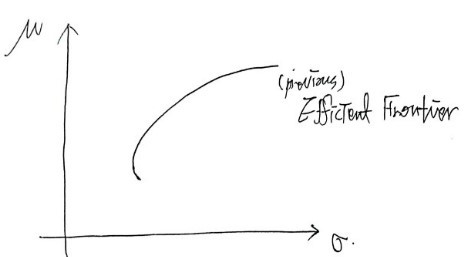
But, after we derive the Efficient Frontier like this, we also thought about a risk-free asset, right???? And since this risk-free asset is also already determined as one that exists in the world,
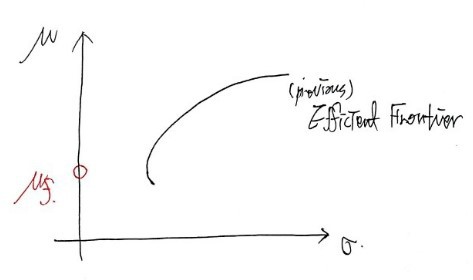
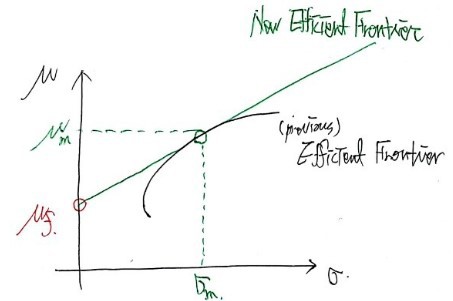
I’ll say the risk-free rate of the risk-free asset is determined like this. Then the New Efficient Frontier created by this predetermined efficient frontier and the risk-free interest rate will also be determined.
Um.. so here’s how the New one was derived: we said there’s a Frontier that maximizes each individual’s utility more than the Efficient Frontier does, and that Frontier, we could say, is the one where the straight line drawn from that point is ’tangent’ to that curve — that’s what maximizes human utility. And the line drawn from this point that’s tangent to that curve is uniquely determined, right???? It’s already determined as 1.
The Market Portfolio
That is, some portfolio that belongs to the Efficient Frontier and builds the New Efficient Frontier, with an expected return and standard deviation of return of  , is uniquely determined — that’s what I’m saying.
We’ll call this portfolio the Market Portfolio!!!!
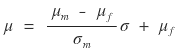
Then this New Efficient Frontier can be expressed in equation form like this :)
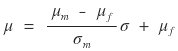
Ah but, the $\mu$ and $\sigma$ without subscripts that are being decided now are the expected return and standard deviation of return of the “risky + risk-free” portfolio, right???? So I’ll use the subscript $p$ to make the meaning more firm.
But here’s the thing: would it even be possible to construct such a portfolio?????
Finding one would be hard. Agh!!! But!!! There’s something similar to that!!! No no, something that can be seen as similar in form: the composite stock price index — things like the S&P 500, or, here in Korea, the KOSPI 200!!
Why!! The composite stock price index can’t be said to move by reflecting the movements of all individual stocks in the world, but still, it’s an index that bundles together the really big ones and represents the overall movement of that bundle. So thinking of the expected return and standard deviation of return of the composite stock price index as 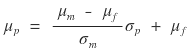 … that’s the majority opinion, and there are actually companies using this exact principle, so it seems hard to call it an outlandish assumption.
CAPM and its assumptions
Then now we can head to CAPM (Capital Asset Pricing Model). First, as it’s written in English, CAPM is the Capital Asset Pricing Model. So it can be described as “a model that predicts the expected return commensurate with the risk of an asset (when the market is in equilibrium, where supply and demand match)”.
That is, for an individual asset we want the expected return $\mu$ that goes with its standard deviation of return $\sigma$, and to say ‘for an individual asset’ more directly, I’ll write $\mu$ and $\sigma$ with the subscript $i$ as I explain. And what are we going to predict it with? As mentioned above, we’ll predict it based on the composite stock price index.
Uengh…T_T what’s this all of a sudden…T_T
Before anything else, there are assumptions embedded in the model above, so I’ll mention those first.
- All investors participating in the market decide whether to invest or not using $\mu$ and $\sigma$ as measures, and all investors are risk-averse investors.
- The market is a perfect capital market. (No transaction costs like taxes, fees, etc.), and also individual investors are so numerous that each individual cannot affect the market price.
- All investors have the same probability distribution for future asset returns (homogeneous expectation)
- All investors can freely borrow and lend at the risk-free rate of return.
- The investment period is a single period.
- All publicly tradable financial assets are investment targets. (Excluding non-financial assets such as human resources)
- The market is in equilibrium
From the New Efficient Frontier to CAPM
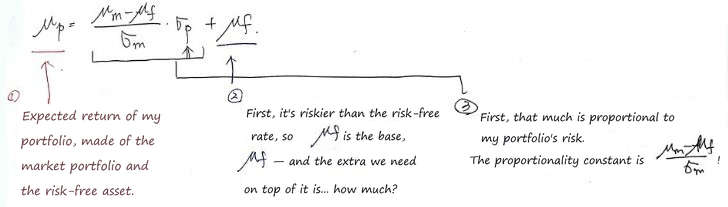
And now I’ll rewrite the New Efficient Frontier equation from before.
The meaning of this equation can actually be viewed like this, right???? You can read it in the order of 1, 2, 3 haha
So my question is as follows.
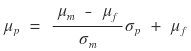
Since the expected return and standard deviation of return of a portfolio composed of risky and risk-free assets are determined like this, for the return and risk (standard deviation of return) of an individual asset
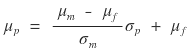
If we shing! plug in the risk of the individual asset as input, then $\mu_i$ pops shing~ out — couldn’t we just use it like this~~~?
This is my question.
But here’s the thing. That equation with the subscript $p$ above was the New Efficient Frontier, and its target was the “efficient portfolio”. And the risk of an efficient portfolio is actually such that non-systematic risk totally flies away thanks to the diversification effect, and the only risk left is systematic risk (things like war, financial crisis — the overall… absolutely unremovable risk). That is, since the risks of individual assets “can be eliminated”, attention shouldn’t be focused on them; attention should be focused on how an individual asset’s risk is affected as the systematic risk changes.
So 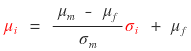 it shouldn’t just go in pow! with only the name changed.
  This guy has to be adjusted by “how sensitively does it respond to the risk of the market portfolio that has only systematic risk (that is, to the systematic risk)” and then plugged in.
Therefore, not this one:

but this one:
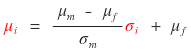
That is, we adjust 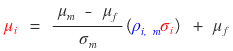 by its correlation coefficient with the market portfolio and then plug it in — that’s my conclusion.
This equation is exactly CAPM.
If I tidy the equation up a bit,

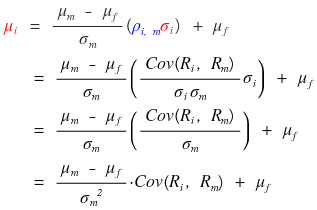
written like this, I feel like we can sense more directly what CAPM is trying to say!!!!
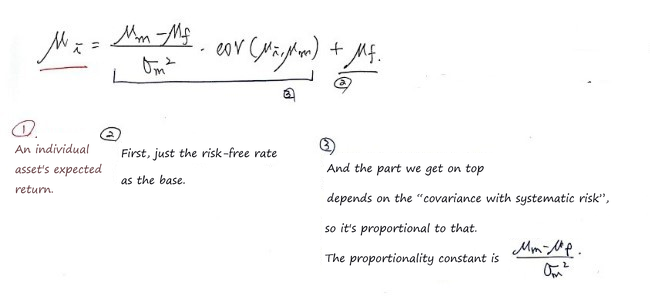
(The notation is wrong. Please read what’s inside Cov as R, not $\mu$!)
Beta
Here I’ll introduce the “stock’s beta”. The covariance of an individual stock with systematic risk, normalized by  , is called the stock’s beta
  , they say.

Um, then 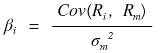 would be 1, right???? That is,
 can be said to mean “how sensitive is it to systematic risk????”, using
  as the benchmark.
So here’s that equation from before:

It’s CAPM, all right, but when we meet CAPM elsewhere, rather than using this equation,

this one is directly used a lot!!!!
The Security Market Line
One more thing!!!! Taking the x-axis as the individual asset’s beta and the y-axis as the individual asset’s expected return, and drawing the above equation
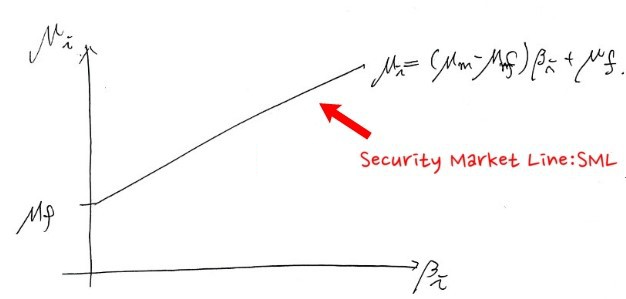
is called the Security Market Line: SML!!!!!!
What does the SML mean?????
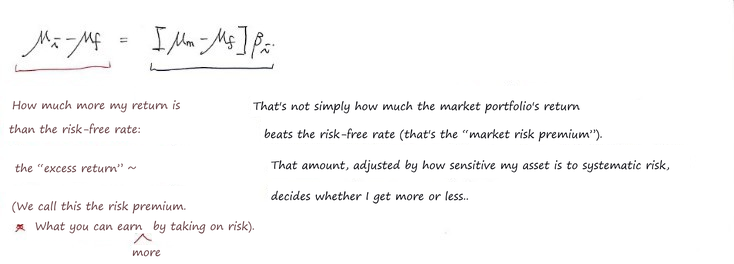
With the characteristics of an individual stock $\text{stock}_i$, once its sensitivity to the systematic risk that (at the time) exists in the world is determined, the predicted $\mu_i$ goes up in a straight line with beta.
It can also be said like this.

Two ways to use CAPM
Let’s briefly touch on using CAPM and move on. Apparently there are 2 ways to use CAPM, so this will be a post that introduces, just roughly, what those two ways are. The first can be named ex-ante CAPM.
Whatever I hold — an individual asset, a portfolio, whatever — to use CAPM I need  , the risk-free interest rate, and for that we can get a proxy by using the CD rate, or the government bond rate, or the deposit rate, and so on.
Then the market portfolio…. Above we said we’d substitute with something similar, like the S&P 500, S&P 100, KOSPI 200, KOSDAQ… something like that, right??? That is, find out the relationship (covariance) between the individual asset and that index, and use my asset’s return and risk (standard deviation of return)~~~
But you know? The principle seems… right, and it’s easy enough, but actually… there can be many cases where it doesn’t make sense… If someone says those proxies ‘can’t be trusted’, well…. there’s nothing to say. So the second method can be named ex-post CAPM.
Anyway, let’s first organize the use of ex-ante CAPM, where we mobilize any values we can bring in. To start with,

what changed in this equation is that it became $p$ instead of $i$. Because we got the conclusion above that we can also predict the return of a portfolio composed of several individual assets, not just an individual asset, I changed it like this.
Then, the values we have to estimate from the values scattered widely in the world add up to 3 fellas:  the risk-free interest rate,
  the expected return of the market portfolio, and
  the beta of the portfolio I hold. As mentioned earlier, for the risk-free interest rate we said to use government bonds or the deposit rate or such things, and for the expected return of the market portfolio we said to substitute with the expected return of the composite stock price index.
How do you extract the expected return of the composite stock price index?????
We can calculate it by drawing up scenarios that predict the composite stock price index through a probability distribution, and then computing the expected value of the return from them. Like this.
Suppose the current stock price index is 1000, and the risk-free interest rate is 2%.
| Scenario | Probability | Index |
|---|---|---|
| Boom | 50% | 1100 |
| Status quo | 30% | 1000 |
| Recession | 20% | 980 |
These are the probability of a boom, the probability of staying the same, and the probability of a recession — and if it’s a boom we expect the index to be 1100, if it’s a recession we expect it to be 980. Let’s say we predict the future like this.
Then, next to it, I’ll write out a table that calculates the ‘return ( )’ at each of those times once more, in red.
| Scenario | Probability | Index | Return |
|---|---|---|---|
| Boom | 50% | 1100 | 100/1000 = 10% |
| Status quo | 30% | 1000 | 0/1000 = 0% |
| Recession | 20% | 980 | -20/1000 = -2% |
So we can compute the expected return.

Well, something like this?
Then now we also have to estimate the portfolio’s beta. If the stocks in the portfolio are $\text{stock}_1$ through $\text{stock}_n$, we estimate each stock’s $\beta_i$ and then

we have to calculate it like this as the last step.
For now, let’s say there’s only stock A in the portfolio, so stock A’s beta is the portfolio’s beta.
Then the table that contains our own predictions for the future of stock A should be written like this.
| Scenario | Probability | 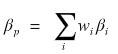 |
 |
 |
|---|---|---|---|---|
| Boom | 50% | 10% | 15% | 2% |
| Status quo | 30% | 0 | 5% | 2% |
| Recession | 20% | -2% | -5% | 2% |
Looking at this table, we can calculate the ’expected’ return ($\mu$) for each.  This is obvious.
  This one we calculated before.
  This one, if you do it, comes out like this.
  But since we need to find beta, let’s say we’ve found this too.
Now the portfolio’s beta — ah, since right now there’s only one stock —
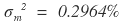
can be found like this, rightttt.
Argh, then we also have to find the covariance. But since we have a definition for covariance, it’s not that hard a calculation.
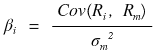
Therefore beta is $\frac{0.00402}{0.002964} = 1.356$. Something like this, we can find it this way.
Having estimated it like this, the expected return of the portfolio containing stock A that I hold is

and when we plug in and substitute, it comes out as $0.02 + 0.026 \times 1.356 = 0.055256$ — like this, we can calculate it.
Then we can drawww the Security Market Line
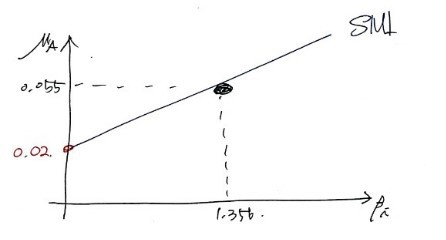
like this — and that’s it for ex-ante CAPM.
Ex-post CAPM
But there are people who say the discussions we’ve had so far can’t be trusted. Because the tables about the future…. can’t be trusted…..? So now the ex-post CAPM story comes up, and I’ll take a really light look at how it’s handled.
Ex-post CAPM just mobilizes past data that has come and gone (using a regression model) to estimate the beta value backwards. Clearly the value $\beta$ is supposed to represent the ‘sensitivity’ between the market portfolio and my portfolio. So, using historical data over some period, when  was some value, at those times
  was what — pair them up as ordered pairs and then stamp points like crazy on a coordinate plane like this,
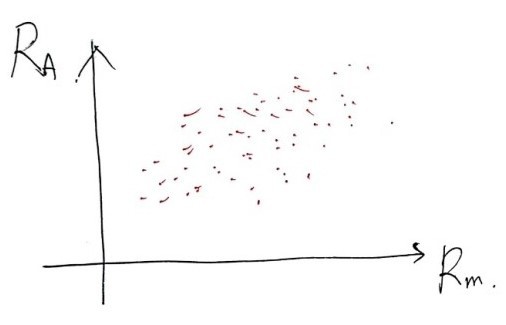
gathering the past data and having a look at it, suppose the points got plotted like this.
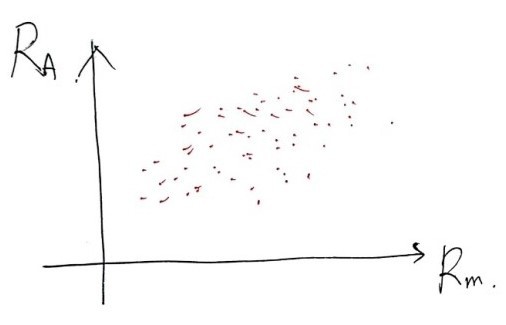
Then (through regression analysis) we pull out one ‘straight line’ where the error is smallest, and the slope of that line is used directly as the portfolio’s beta.
In our data, the x-axis is $R_m$ and the y-axis is $R_A$. So if you think of $x$ in Linear Regression in Finance (Derivatives I Studied #3) as $R_m$ and $y$ there as $R_A$, you can confirm that the slope of the green line in the figure above becomes the definition of beta:
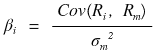
Suppose we’ve found the portfolio’s beta like that.
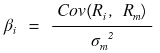
We also have to ram in these two things for CAPM to be complete, and this equation

rewritten like this, pulling out a ton of historical risk-free interest rate and excess return data, estimating the $\mu_A$ value, which is the average value of $R_A$, (after judging whether using the estimated beta value is reasonable or not~) — that’s how ex-post CAPM gets completed~
Heads-up. The figures here are the original notes, slips and all. A few things to watch for:
- In the handwritten formula for an individual asset, the covariance is between the returns, $Cov(R_i, R_m)$, as the text says; $\mu_i$ and $\mu_m$ are expected values, numbers without a covariance.
- In the two portfolio versions of the equation, the beta should be the portfolio’s, $\mu_p = (\mu_m - \mu_f)\beta_p + \mu_f$; the pictures keep $\beta_i$ from the single-asset line.
Comments
Discussion happens via GitHub Discussions. You'll need a GitHub account to comment.