Capital Structure Theory and the Modigliani-Miller Theorem
We break down capital structure theory: the traditional view, MM (1958) without taxes, the modified MM theory (1963) with corporate tax, and why bankruptcy costs give firm value a peak.
No intro. Diving in.
A company’s capital structure often gets used interchangeably with financial structure, but strictly speaking, they say, they’re not the same thing. Financial structure is about “how and with what funds the money was raised.” Capital structure is about “the composition of the capital the company is actually using.”
OK, let’s gooo!
So let’s say capital splits into two buckets, equity capital and debt capital (that’s how we did it before). Equity capital includes common stock, retained earnings, and even preferred stock. We’ll focus on long-term, interest-bearing debt here. That is not every non-current liability — deferred tax and operating provisions, for example, are not borrowing. Companies can also use short-term financing; this chapter is concentrating on their long-term financing mix.
“Capital structure theory.” The whole motivation behind capital structure theory is this belief that there’s some optimal capital structure out there that maximizes firm value, and finding it is the ultimate goal.
Firm value — we said this last chapter — you take the future cash flows the company is going to receive, discount them at an appropriate rate, sum up the present values, and that’s firm value. And the discount rate? That’s the company’s cost of capital. And we said the cost of capital we use is the weighted average cost of capital. So firm value $V$ looks like this:
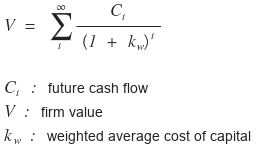
Here the cash flows must be free cash flows available to all capital providers, after operating taxes and before financing payments. Holding those cash flows and the investment plan fixed, a lower appropriate WACC means a higher firm value. Right? So capital structure theory wants to find the capital structure (how much to hold as $S$, how much to hold as $B$~~~) that minimizes the weighted average cost of capital.
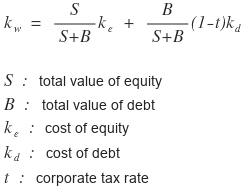
Here $S$ and $B$ are the market values of equity and debt. Change the mix of capital, and the weighted average cost of capital can change. Right???
OK so — how do we find the $S$, $B$ that minimize  ????
????
There are three theories about this.
- Traditional capital structure theory
- MM theory (1958)
- Modified MM theory (1963)
Let’s take them down one at a time, starting with number 1.
1. Traditional Capital Structure Theory
Traditional capital structure theory is actually pretty simple. Imagine a company with a not-very-high leverage ratio ($B/S$). Even if it nudges that ratio up a liiittle bit~~, the distrust from outside is gonna stay roughly where it was, right???
So at low leverage, when the firm cranks the ratio up a tick at a time, the creditors at the existing cost of debt capital  are NOT going to go: “Hey!!! Where do you think you’re going?!?!? You little rascals?!?! If you’re gonna jack up your leverage ratio, you’d better be paying us a bit more than !”
So up to some appropriate leverage ratio,  can stay flat. On the other hand,
  — that one is not flat. It rises right alongside the leverage ratio. That’s because, you could say, shareholders demand a risk premium.
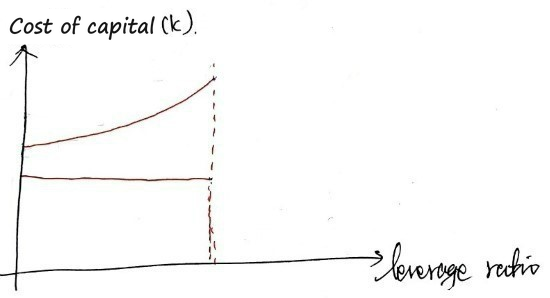
So up to some leverage ratio, for now stays put, and climbs.
But once you blow past that comfortable level, even the creditors start side-eyeing you: “Hey… you guys are getting a little risky here…..????” “I think we should be getting a bit more interest….?” — and they bump up their required return.
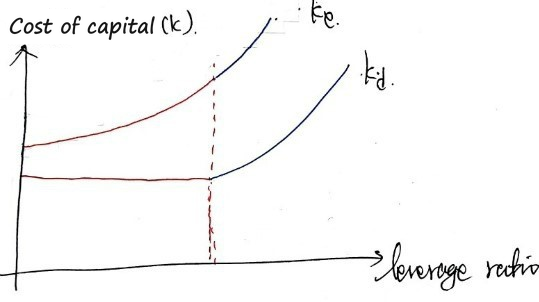
So past that point, both of them are going up. And now from here,  , weighted by each capital ratio, ends up drawn like this:
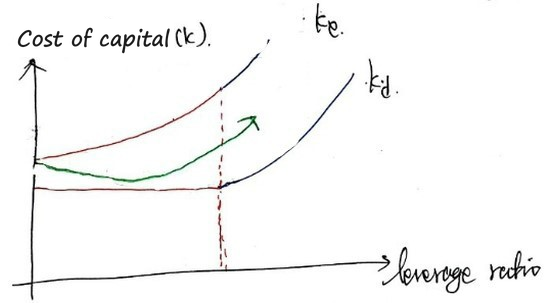
— that was the academic consensus at the time. So as you can see, there’s some minimum  .
.
(You might be going: WAIT. What?!? Why?!?! Hang in there for a sec. What this actually means is gonna get unpacked in the MM theory part below.)
That’s the traditional capital structure theory.
But in 1958, a paper dropped that pushed back on this — and that’s the MM theory. MM = Modigliani and Miller, the two authors’ initials.
(Technically it’s the Modigliani–Miller theorem. Feels like it should be translated as “MM theorem” rather than “MM theory,” but for whatever reason “MM theory” is what stuck. (sigh))
MM theory (1958)
The setup for the 1958 MM theory is a perfect capital market with no corporate tax. A perfect capital market means:
- No transaction costs or taxes whatsoever
- Infinite buyers & sellers
- All market info reaches everyone equally
- No financing frictions or distress costs; firms can change their financing mix without changing their operating cash flows
- Investors can reproduce corporate leverage by borrowing and lending on the same terms as firms
Those are the assumptions. OK, let me walk through what’s called MM’s 1st Proposition, step by step.
MM’s 1st Proposition: “In a perfect capital market with no corporate tax, the value of a firm has nothing to do with that firm’s capital structure.”
Firm value is determined by the cash flows flowing into the firm — not by the capital structure. Capital structure is irrelevant.
The classic analogy, they say, is the pie. Picture a firm’s value as a pie. Whether more of this pie goes to shareholders or more goes to creditors — does that make the whole pie bigger or smaller? Flip it around like that and… yeah, kinda nothing to say lol.
But other people might have pushed back like this: “Hey!!! My good sir!!! What if two companies generating the same cash flows had different firm values — explain THAT!!!?!?”
To which MM said: “That’d be an arbitrage opportunity, but since we’re assuming infinite buyers and sellers, that arbitrage opportunity gets eaten up real quick and the market goes back to equilibrium.” (Meaning: whether the stock price goes up or down, it finds equilibrium.)
That’s the MM theory’s pitch. What does this actually mean? I have no idea either lol.
Let’s go to an example.
Ex. 14.1
Company X and Company Y generate the same cash flows. The table below shows expected cash flows by economic conditions. Company X has zero debt capital. Company Y has borrowed 1 billion won in debt capital. Interest rate is 10%. Say Company X’s equity value is 5.5 billion won, and Company Y’s equity value is 5 billion won. (The tables count in units of 100 million won.)
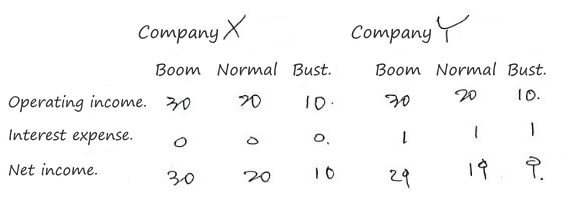
That’s the setup.
Now — since X and Y have the same cash flows, their firm values should be the same!!! Hmm, so for X or for Y, the only difference is how much of the cash flow goes to shareholders and how much to creditors. The total pie going to both groups combined is the same. Right? So same firm value.
Company X’s equity of 5.5 billion won is the entire firm value (no debt capital). But Company Y? Equity 5 billion won + debt 1 billion won = firm value 6 billion won.
In this situation, an arbitrage opportunity opens up. Say a shareholder holding all of Y’s stock sells all of it, borrows 1 billion won at 10%, and buys all of X’s stock. Sells for 5 billion, borrows 1 billion, buys stock for 5.5 billion, and 0.5 billion is left over???? 0.5 billion in your pocket. And looking at the cash flows that follow:
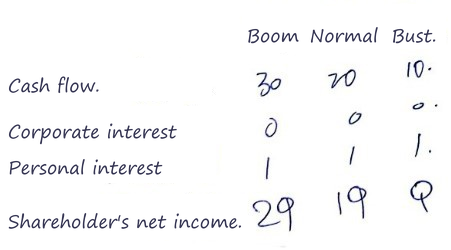
Doing it this way leaves you +0.5 billion compared to just sitting on all of Y’s stock???
For there to not be 0.5 billion left over????
The two firms would have had to be worth the same — X’s stock priced at Y’s stock plus Y’s 1 billion won of debt!
MM’s 2nd Proposition: With the cost of debt held constant, the cost of equity rises linearly with the debt-to-equity ratio.
→ What this means is — in the 1st Proposition, was constant, right??? Saying firm value stays constant all along is the same as saying stays constant all along, so the 1st Proposition is as good as saying is constant.
And since we’re assuming a perfect capital market with no taxes, goes like this:
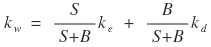
Let me rework the equation into a different form:
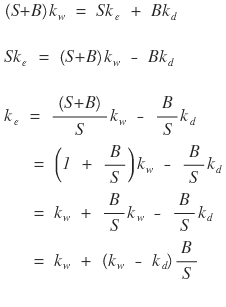
With the equation tidied up like this, if we read it,
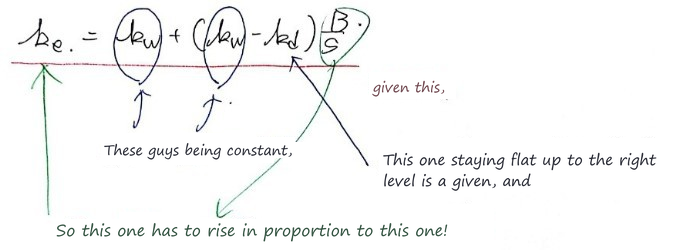
that’s what we can say. That is — if  is constant, then
  has to be linear while $k_d$ stays constant, which means
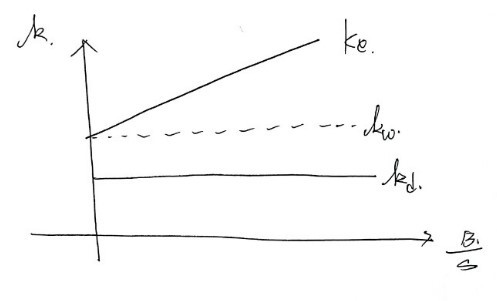
the graph gets drawn like this.
Reading the graph once more, the rise in exactly cancels out the lowering effect of the cheaper  — that’s what the picture says.
(After hearing this, I started to get a feel for what the traditional capital structure theory was driving at, you know?)
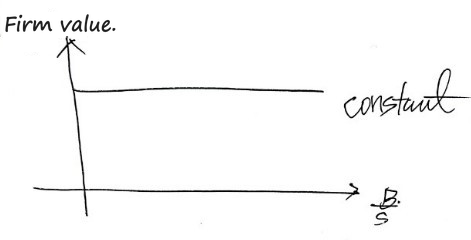
Oh, and the firm value graph — since we kept saying the pie is constant, constant, constant — well, you just draw it like this lol.
But it seems MM kept thinking about this. And in 1963, they revised their paper and re-did everything assuming corporate tax exists this time — and that’s the modified MM theory.
Modified MM theory (1963)
In the no-tax case, the cash flows generated by the firm split between creditors and shareholders. But when corporate tax shows up!!! It’s not just two parties anymore!!! It goes to three of them: shareholders, creditors, AND the government!!!
But how is corporate tax charged???
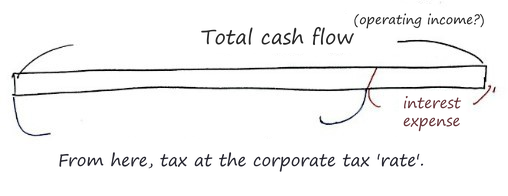
If the total cash flow (operating income) looks like the bar above, the corporate tax rate gets applied to the portion after you subtract interest expense. So from the company’s POV: the more you crank up interest expense, the more you can shrink the slice going out as corporate tax. Interest expense here is the slice going to creditors (I, the annual interest I from chapter 13).
Ahhh~~ if you push this to the super extreme — imagine an 80% corporate tax rate — you can really feel what’s going on.
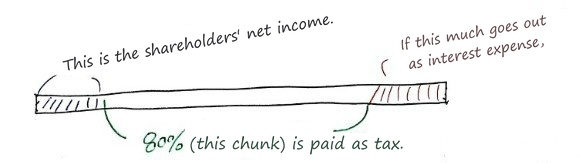
If creditors’ slice of the total pie is the shaded portion on the right, then from what’s left after that, 80% comes off, and the rest is the shareholders’ slice. The corporate pie was supposed to be shareholders’ slice + creditors’ slice, right? So the unshaded portion is gone, and only the shaded portions end up being the company’s pie.
But this company is fuming. Because it does NOT want to pay taxes!!! If you crank the debt capital ratio to the max, the money bleeding out as taxes gets cut down. So instead of equity, jack up the debt capital ratio enormously, generate the same operating income, and:
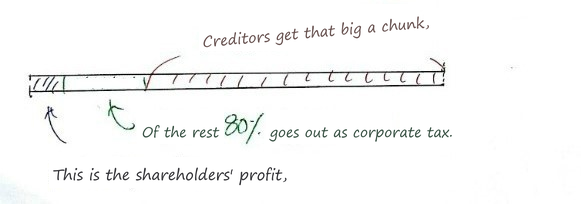
So when corporate tax is in the picture, the corporate pie can change depending on the $S$/$B$ mix. Let’s put the two bars side by side and compare:
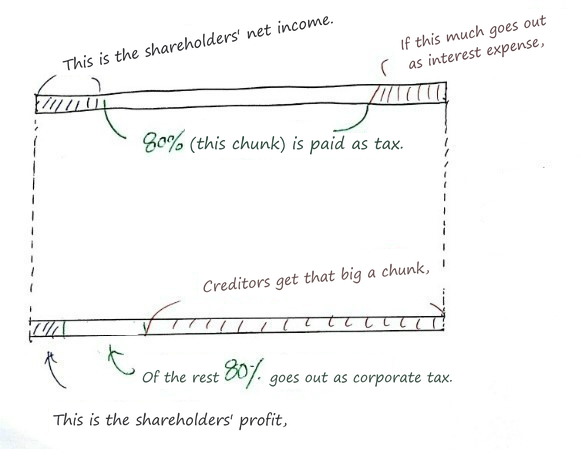
Big difference!! So it comes down to the tax-saving effect of having debt capital versus not having it.
How do we write this ’tax-saving effect’ as a number?
On its debt $B$, the firm has to pay the promised rate  as interest expense. From the total cash flow $C$, take away the interest expense of
  , and from what’s left,
  , $t$ of that gets taken as tax. So
  is paid in tax, and the shareholders’ profit left over is
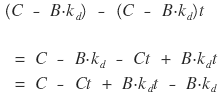
So the firm’s total pie, written as shareholders’ slice + creditors’ slice:
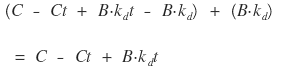
If there’s no $B$ in this picture, you can just plug in $B = 0$. Anyway, in a world with corporate tax, the pie of a firm exactly like the one above but with no $B$ in its capital structure is  . So the tax-saving effect is
  — that’s what it refers to.
But this is the tax-saving effect at the moment cash flow $C$ shows up. The present value of that is the firm’s “tax-saving effect at the current point in time.” And cash flow $C$ doesn’t happen just once — it keeps happening period after period. So every time $C$ shows up, a tax-saving effect of occurs, and the sum of the present values of every across periods is the “tax-saving effect at the current point in time.” Written out:
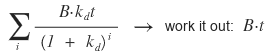
(One more time: this $t$ is the $t$ for tax, not for time (sigh).)
For this shortcut, assume a fixed debt amount $B$ is maintained forever, the tax rate stays constant, and every interest deduction can be used. We also discount the shield at $k_d$, matching its assumed risk to the debt. Under those assumptions, the infinite geometric series starting at period 1 gives $Bt$!
The tax-saving effect at the current point in time is $Bt$.
So if a firm running on equity only and a firm also using debt capital of amount $B$ have identical operating cash flows before financing effects, the difference in current firm value is
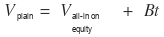
— and this formula right here is the 1st Proposition of the modified MM theory!!!
(If you think back carefully, the 1st Proposition of the original MM theory was $V_{\text{plain}} = V_{\text{all-in}}$… heh. You can connect the dots like that.)
OK now onto the 2nd Proposition… hmm..
The 2nd Proposition in the no-tax case came from playing around with
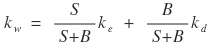
this equation, so this equation can also be called the 2nd Proposition of the original MM theory. Let’s say

Heh;. Here, the “firm pie” would be the same as the pie of a firm that went all-in on equity, so call it  , the all-in-on-equity firm’s pie. So:

(plain firm’s shareholders’ slice) + (plain firm’s creditors’ slice) = (all-in-on-equity firm’s shareholders’ slice) — that’s what the equation was saying. And in the no-tax world this holds, but we now know it doesn’t hold once corporate tax shows up.
So first, let me write the left side — the plain firm’s shareholders’ slice and its creditors’ slice in a corporate-tax world, with the tax the interest saves taken off. Left side:

Now the right side is where it gets tricky. In the corporate-tax world, the shareholders’ slice of an all-in-on-equity firm would be  . And if we write the firm value $U$ of the all-in-on-equity firm in the corporate-tax world using $S$ and $B$ from the left side:

— compared to the firm on the left, we tack on $-Bt$ to subtract out the tax-saving effect.
Bottom line: instead of this equation:

the corrected version is:

OK, let’s tidy it up:
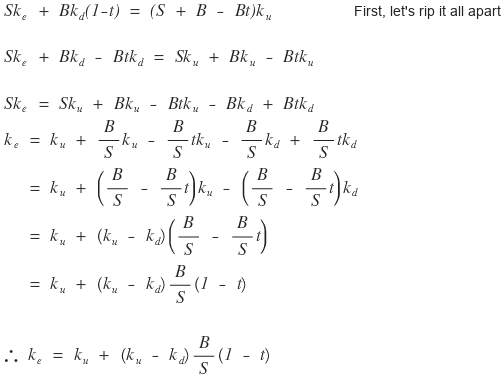
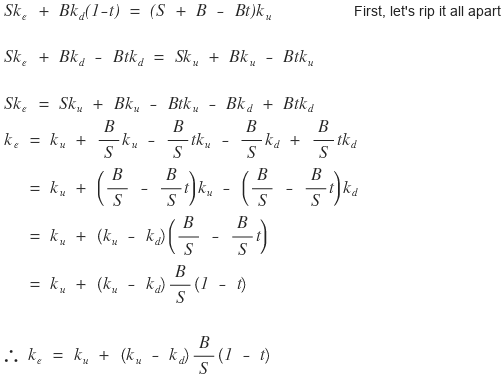
That’s the 2nd Proposition of the modified MM theory~!!!
There’s also a 3rd Proposition heh.
That equation is, in the corporate-tax case, a relation between an all-in-on-equity firm and one that isn’t. And I’ll mash that together with

the formula for the weighted average cost of capital in the corporate-tax case. Oh honestly, this is;;;; way too tedious to type out…. Sorry lol.
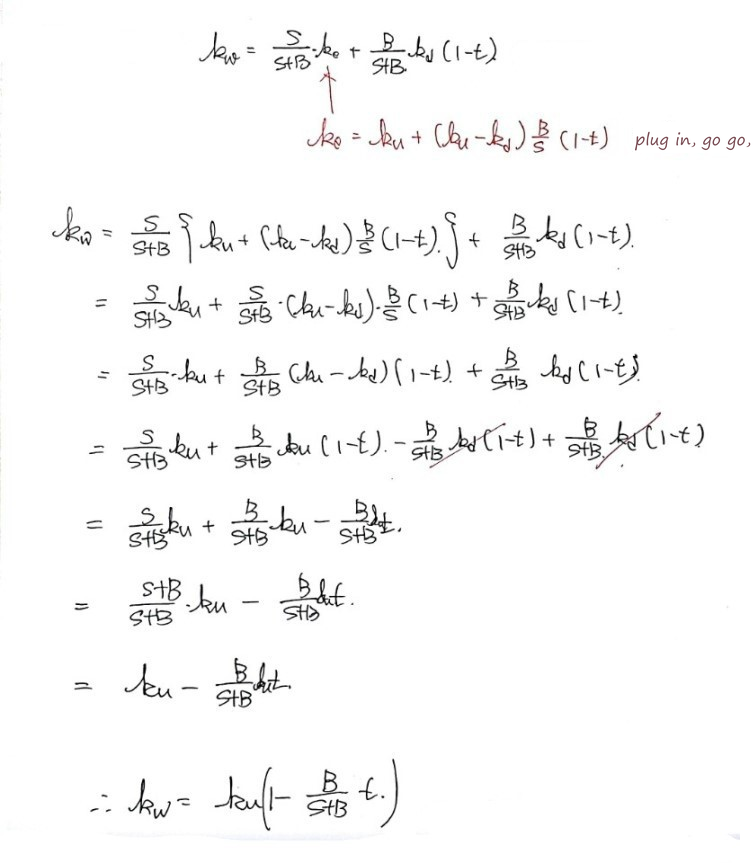
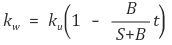
This equation is called the 3rd Proposition of the modified MM theory. What this equation is saying — it’s packed with the meaning “the weighted average cost of capital decreases in proportion to the debt ratio (debt / total assets = $B/(S+B)$)”; and as a graph, that content looks like:
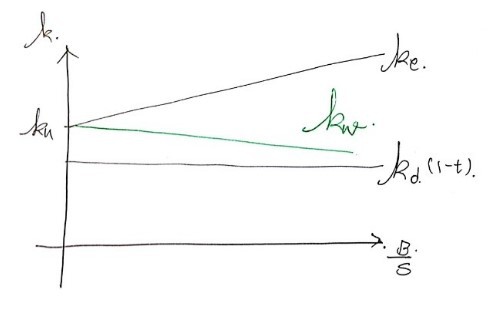
— like this! hehehe. Drawing it like this, you can capture the whole story. Which is to say: under these tax-only assumptions, more debt keeps adding value. We have left out the costs and limits that make this conclusion break down at high leverage!
And that’s actually where MM theory’s content ends.
But honestly — does that even make sense??? Are all the great companies in the world right now firms that have gone all-in on debt capital???
Nope, right??? So really, after MM theory, you have to keep extending the theory further and further out. But of those further extensions, I’m only going to handle one — and not in detail. Pretty much just an intro and then I bail. The financial management class for 2nd-years at my school ended right here…! hehehe.
(As a double-major student…. taking a class with 2nd-years when I am as old as a fossil was brutal (sigh) ah…..)
Bankruptcy cost
Alright, alright, alright! Let me draw a graph about firm value.
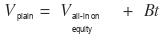
This is the graph for this formula:
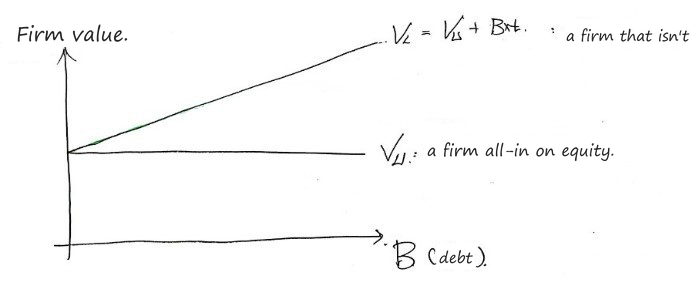
(Notice the x-axis is $B$.)
Now — as the debt ratio keeps creeping up and up, that gnawing feeling of “ughhhh~~ I think they’re about to go bankrupt~~” can get stronger and stronger, right??? But say the firm actually does go bust!!! Just like that.
What happens? Well, the court decides — rehabilitate or liquidate — whatever’s better, and some follow-up stuff happens. Either way, there’s gonna be a cost. That cost is called Bankruptcy Cost (I’ll write it as BC. — not B times C.).
So instead of evaluating firm value as  , let’s evaluate it as
  — that’s the idea.
If the firm goes bust, some value gets eaten up by those costs. But today’s value should reflect how likely the costs are and when they occur, not just the worst case. In  , the cost deduction needs to be valued on that basis.
But — how do you actually measure BC…..lol. How are you supposed to know how much cost you’re gonna incur when the firm goes bankrupt? So to write the formula above more sensibly,

writing it like this feels more reasonable. Here expected BC means the present value of expected financial-distress costs. That can include costs before formal bankruptcy too. And this ’expected BC’ — the more debt there is, the bigger and bigger and bigger~~ it gets, right??? Because that means the chance of going bankrupt is growing.
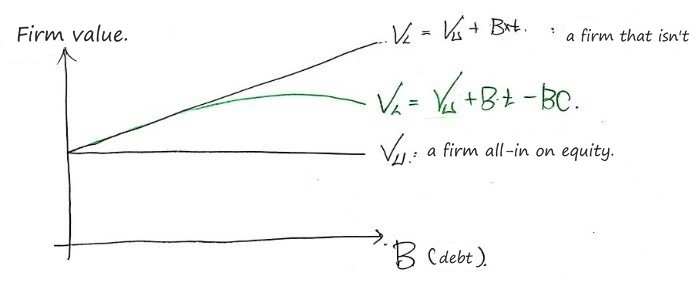
Even if we draw the graph like this??? it’s just the words above turned into a picture, so nothing weird about it. But that ‘firm value curve’ in the middle? It’s the simple trade-off picture: at first the tax benefit wins, but later the extra distress costs win. Under that pattern, the curve has an interior maximum.
That is — in this trade-off picture, there is a capital structure that maximizes firm value.
So with that, somewhat abruptly, we slap a period on it — and that’s where the major-required financial management class for 2nd-years at my school ended. It was rumored to be the hardest financial management class at our school lol. Like a double-major student would have any business knowing that lol. I just had to take it because the double major required it, so I crammed in whatever fit my schedule (sigh).
Anyway, it was a super fun semester of financial management, and just watch me ever study finance stuff again lol. I’m REALLY never doing this again, not even if it kills me lol.
It’s so damn hard for real;;;; (sigh)
Heads-up. The figures here are the original notes, slips and all. A few things to watch for:
- In the formulas with the bankruptcy cost, BS is the same cost the post and the green curve call BC: the firm value is $V_U + Bt - BC$, and with the cost uncertain, $V_U + Bt - \text{expected } BC$.
- Read BC (BS in the small formulas) as the present value of expected financial-distress costs. It is not the undiscounted loss in the worst-case bankruptcy scenario. The hump-shaped curve is the illustrated trade-off case, not a guarantee for every firm.
Comments
Discussion happens via GitHub Discussions. You'll need a GitHub account to comment.