Introduction to Derivatives
Kicking off a derivatives series with a skim of Hull Chapter 1 — futures vs. options, hedging vs. speculation, and the quiz-first study method.
OK so I’m taking a derivatives course this semester, and the textbook is John C. Hull’s Options, Futures, and Other Derivatives — looks like the entire course was basically built around “let’s figure out what derivatives even are.”
Same plan as always: read the book, organize as I go, flesh out the bits that need fleshing out… that’s the plan, anyway. So yeah — I made yet another category for this (T_T) and whether it actually keeps going, who knows. Let’s at least start.
Chapter 1. Introduction. Skipping it entirely feels a little wrong, but going through it line by line would be a total waste of time, so — let’s just lightly skim it as “terminology review.”
For this whole derivatives series I’m going to do something slightly weird: hit the little quiz at the end of each chapter first, then write up the content. (That’s how I’m going to study, too.) The quiz isn’t really a problem set — it’s more like “hey, here are the most basic concepts and most basic terms,” so it’s perfect for figuring out in advance what kind of vocabulary is about to come at you before you actually crack the chapter open. Anyway, let’s go fast.
The Chapter 1 quiz
Quiz 1. What’s the difference between a long futures position and a short futures position?
Long futures = a promise to buy a specific asset at a predetermined price at a specific point in time. Short futures = the opposite — a promise to sell a specific asset at a predetermined price.
Quiz 2. What’s the difference between hedging, speculation, and arbitrage?
a. Hedging. A trade that takes a specific position in the futures or options market in order to offset price-fluctuation risk on an asset you’re already exposed to.
b. Speculation. A trade that takes a position in the futures or options market purely to make a profit, deliberately taking on fluctuation risk.
c. Arbitrage. Taking positions simultaneously in two or more different markets to lock in a profit.
Quiz 3. What’s the difference between (a) taking a long position in a futures contract at a futures price of $50, and (b) taking a long position in a call option with a strike of $50?
a. The investor has to pay $50 in the future. No choice. They have to buy the asset.
b. With the option, they hold the right to buy. They don’t have to exercise it if they don’t want to.
Quiz 4. An investor enters a forward contract to sell 100,000 pounds at $1.40 per pound. If the exchange rate at maturity is (a) $1.39 per pound and (b) $1.42 per pound, what’s the profit or loss in each case?

Quiz 5. Suppose you sell a put option on a stock — strike $40, maturity 3 months. Current stock price is $41, and one put contract gives the right to sell 100 shares. What’s your obligation, and what’s your profit/loss as the stock price moves?
You’re the seller of the put. So if the counterparty exercises their right to sell, you’ve promised to buy 100 shares at $40 per share.
The option only gets exercised when the stock is below $40.
Like, say it’s exercised when the stock is $30 — you’re stuck buying $30 stock for $40. That’s a $10/share loss, $1,000 total.
In exchange for taking on that “I might lose a bunch in the future” risk, you collect the option price upfront from the buyer. That’s the deal.
Quiz 6. You think a stock is going up and want to speculate. The stock is at $29, and a 3-month call with strike $30 is trading at $2.90. You have $5,800 to play with. Come up with two strategies and estimate profit/loss for each.
Strategy 1: buy 200 shares of the stock. Strategy 2: buy 2,000 options (20 contracts).
If the stock rises enough, strategy 2 wins by a lot. (Not for every rise: at exactly $30 the stock still makes $200 while the calls expire worthless and lose the whole $5,800. The calls only pull ahead once the stock passes about $33.33.) Say it rips to $40 — strategy 2 makes $2{,}000 \times (\text{\textdollar}40 - \text{\textdollar}30) - \text{\textdollar}5{,}800 = \text{\textdollar}14{,}200$. Strategy 1 only makes $200 \times (\text{\textdollar}40 - \text{\textdollar}29) = \text{\textdollar}2{,}200$.
If the stock falls, though, strategy 1 is the safer one — smaller absolute loss.
Quiz 7. What’s the difference between the OTC market and the exchange market?
The OTC market is where two participants can hammer out whatever contract they want with each other — it’s a network of banks, fund managers, and corporate treasurers connected by phone or computer.
The exchange market is organized. Traders meet in person or over electronic systems, and the contracts you can trade are defined by the exchange itself.
Market makers quote bid and ask prices — the ask is the price the market maker is willing to sell at, the bid is the price they’re willing to buy at. (Yeah, the answer flipped them in the original, but that’s the right way around.)
OK, now the actual chapter content.
The actual content
Futures contract. A contract that obligates the buyer or seller to buy or sell an asset at a predetermined price on a specified date.
→ Heads up — the exchanges that trade these things? There are so many of them. Currently under CME Group: the Chicago Board of Trade (CBOT), the Chicago Mercantile Exchange, the New York Mercantile Exchange. Then CME Group itself, NYSE Euronext, Eurex, the Tokyo Financial Exchange.
(Random aside: Chicago is this kind of marooned city in the upper Midwest of the US, surrounded by basically nothing but farmland lol. So historically they grew tons of agricultural products there, and the locals were like “we’ll die if we don’t start doing financial trading on top of these crops” — and the financial trading they built around those crops just kept growing and growing until present day, which is why Chicago has these absolutely massive exchanges. Oh and that’s also why economics blew up there — the University of Chicago econ department is supposed to be ridiculous??? There’s apparently a whole “Chicago School” thing? Or so I hear lol.)
Long and short. An investor who agrees to buy the asset is said to have “taken a long futures position.” An investor who agrees to sell the asset is said to have “taken a short futures position.” The price they agree on is the futures price, and the thing it’s contrasted against is the spot price — and honestly I don’t think the spot price needs much explanation, because the “price” you usually have in your head when you say “the price” is the spot price.
Forward contract. A contract to buy/sell an asset at a specific price at a specific future date — so far, basically the same vibe as a futures contract. The difference: futures trade on an exchange, forwards trade over-the-counter (OTC).
What does that difference actually buy you?
Two things, really. One: mark-to-market (daily settlement). Exchange-traded futures get settled daily; OTC forwards don’t. That’s a huge deal because with daily settlement your gains and losses land in your account every single day instead of all at once at the end, so you may have to put up cash along the way (margin calls), and the timing of the money changes.
Two: credit risk. Trading on the exchange comes with what’s basically a credit guarantee built in — the clearinghouse stands between the two sides and collects margin every day, so the risk that the counterparty defaults becomes very small (small, not zero). OTC, on the other hand, is just a private contract between two parties, so credit risk is real.
Option. Splits into call options and put options, and both call and put options are rights. Like, “the right to speak up.”
A call says: “Hey! I’m buying at the price we agreed on!” A put says: “Hey! I’m selling at the price we agreed on!” The right to say each of those things, respectively.
The thing the right is about — that’s the underlying asset. The agreed-on price is the exercise price (or strike).
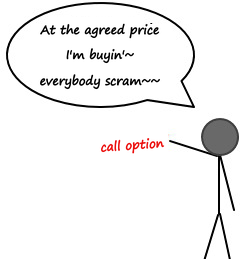
lol
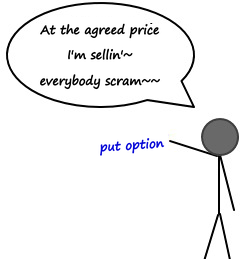
If you’re holding a call option, you don’t sweat the underlying asset price ripping upward — you can just exercise the call and buy at the strike. (Master of the price you can buy at!!! Shout that as you exercise it.)
Conversely, if you’re holding a put option, you don’t sweat the price tanking — even if it falls off a cliff, you can exercise the put and sell at the strike instead of at the cratered market price.
(Honestly — I really didn’t want to type up the same explanation I already wrote over here, so I copy-pasted… heh. Sorry.)
Call Options & Put Options (Financial Engineering Programming #1)
European vs American options. A European option is the kind you can only exercise exactly at maturity. An American option is the kind you can exercise any time up to and including maturity.
Oh — and the market participants split into three buckets: hedgers, speculators, arbitrageurs. Click instantly?
- Hedgers: literally as the name says — people who want to avoid risk.
- Speculators: people who are willing to eat risk and want to take on big risk.
- Arbitrageurs: people who want a locked-in profit by taking offsetting positions.
How each of these actually pulls off their goal — we’ll figure that out bit by bit as we go.
And that’s already Chapter 1. Honestly I skipped basically everything and just hit the basics, because Chapter 1 is full of these absurdly tiny, simple toy examples and… yeah (T_T). So I’ll just work through 2 problems and bounce. (sad face)
Problems
Prob 1. A trader takes a short position on a forward contract for 100 million yen. Forward exchange rate is $0.0080 per yen. What’s the trader’s P/L if the rate at maturity is (a) $0.0074/¥, (b) $0.0091/¥?
Short on the forward means this person is committing to sell yen (i.e., buy dollars with their yen) at $0.008/¥.
a. Rate becomes $0.0074/¥ — did yen get more expensive or cheaper? The price of 1 yen went down, right? So the yen weakened. (You could equivalently say the dollar strengthened, but thinking about both at once gets confusing — easier to just keep your eye on the price of “1 yen” in the denominator and ask whether that went up or down.)
Normally you’d be receiving $0.0074 per ¥1. But we locked in a forward at $0.008 per ¥1, so we’re getting more dollars than we’d get at spot. Profit.
(Re-interpreting: the yen actually fell, but we’d locked in a forward at a yen-stronger price than where it landed, so we win.)

b. Same logic, flipped. The yen rose. But we locked the forward in on the yen-weaker side… (T_T) so we lose.
Numbers:

Prob 1.21. A trader takes a short position in a cotton futures contract when the futures price is 50¢/lb. One contract is 50,000 lbs. P/L when price is (a) 48.20¢, (b) 51.30¢?
Short side promised to sell at 50¢/lb.
a. Market lands at 48.20¢/lb. Good thing we made the contract — we get to sell at a higher price than the market.
$(50\text{¢/lb} - 48.20\text{¢/lb}) \times 50{,}000\text{ lb} = 90{,}000$ ¢ profit.
b. If we hadn’t promised, we could’ve sold at 51.30¢. But the contract has us locked at 50¢, so we lose. (T_T)
$(50\text{¢/lb} - 51.30\text{¢/lb}) \times 50{,}000\text{ lb} = -65{,}000$ ¢. Loss.
Wait — doesn’t this feel a little weird?
Like — the price you agree on at the moment of the contract… by the time we get to “now” with trading actually happening, that price gets used like: “Hey, here’s how far off your prediction was ^^” — and the amount by which your prediction missed becomes your profit or loss.
Yeah, yeah, yeah — I think it was sitting with this exact thought that finally made the concept of hedging click for me.
All your attention, all your gaze, gets pinned on the contract price. We go “Hey! We made a promise at this price~~~!!!!” and then it’s that very price we use as the reference point to measure P/L from.
Try imagining you don’t have a contract. It’s January. You’re like, “Ahhh~~~ I’ll buy gold in June~~~”.
From January through June, do you have any way at all to even roughly bracket where the gold price is going to land?
Zero idea… right??? That’s a huge amount of risk.
But once you have a contract — which is essentially a “buy in advance” function — your gaze gets pinned to some fixed price. And measuring P/L as the distance from that pinned point — that, I think, starts to feel kind of reasonable.
Comments
Discussion happens via GitHub Discussions. You'll need a GitHub account to comment.