Options: Practice Problems
Working through options pricing problems — lower bounds on calls and puts, why an American call is always worth at least its intrinsic value, and why put-call parity only works exactly for European options.
Quiz 10.1
List the six factors that affect the price of a stock option.
$S_0$, $k$, $r$, $\sigma$, $T$, $D$ — stock price, strike price, risk-free rate, volatility, time to maturity, dividends.
Quiz 10.2
What’s the lower bound for the price of a call on a non-dividend-paying stock? 4 months to maturity, $S_0 = \text{\textdollar}28$, $k = \text{\textdollar}25$, $r = 8\%$ per year.

Quiz 10.3
What’s the lower bound for the price of a European put on a non-dividend-paying stock? 1 month to maturity, $S_0 = \text{\textdollar}12$, $k = \text{\textdollar}15$, $r = 6\%$ per year.

Quiz 10.6
Why is an American call always worth at least its intrinsic value? And does the same hold for a European call?
An American call can be exercised at any time, and if it gets exercised, the option holder gets the intrinsic value.
So an American call’s value has to be at least its intrinsic value.
A European call, though, can be worth less than its intrinsic value. For example, say the stock pays a big dividend during the life of the option: when the dividend gets paid, the stock price drops. A European call can only be exercised after the dividend has been paid, so its current value can end up below its intrinsic value.
Quiz 10.8
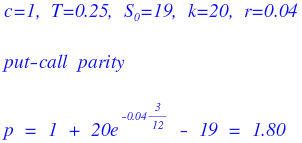
A non-dividend-paying stock is at $19, and a 3-month European call on it costs $1. The strike is $20 and the risk-free rate is 4% per year. What’s the price of a 3-month European put with a $20 strike?
Prob 10.8
Why can’t the logic we used to derive put-call parity for European options give a similar result for American options?
I tremble to report this, but… with European options, the call and the put each get exactly one chance to be exercised, and it’s right at maturity! But American options can each be exercised whenever you like, so we have no way of knowing when each one will be exercised…..
What else is there to say, Your Highness….. Please, have mercy…. Your Highneeess~
Prob 10.9
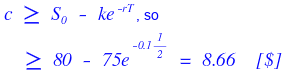
What’s the lower bound for the price of a call on a non-dividend-paying stock? $S_0 = 80$, $k = 75$, $T = 6$ months, $r = 10\%$.
Prob 10.10
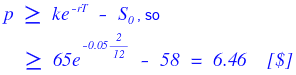
What’s the lower bound for the price of a European put on a non-dividend-paying stock? $S_0 = 58$, $k = 65$, $T = 2$ months, $r = 5\%$.
Prob 10.11
A European call on a dividend-paying stock currently sells for 5. The stock is at 64, the strike is 60, $T = 4$ months, $r = 12\%$. A dividend of $0.8 is expected in 1 month.
What arbitrage opportunity does an arbitrageur have here?
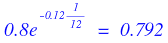
The present value of the 0.8 that arrives in 1 month:
Do we need the call’s lower bound too? The lower bound of a call is:
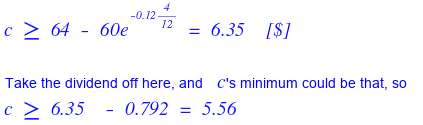
Whoa, the minimum of $c$ is that much, and the call is selling at 5?!?! The call is undervalued!!!
I have to buy that undervalued call right now!!! So let’s buy one call, and short that stock.
Right now my money is $64 - 5 = 59$. Take off the present value of the dividend that goes out in 1 month, and I’ve got $59 - 0.79 = 58.21$. In 4 months, my 58.21 will have turned into
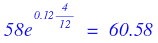
that’s what I’ll have by then, you see.
If the stock is above $60 at that point, I trigger the call, buy at $60, give the stock back, and I’m just straight up 0.58 richer. If it’s below $60, the more it drops, the more I gain. heh heh
Prob 10.12
A European put on a non-dividend-paying stock costs $2.5. The stock is at 47, the strike is 50, maturity is 1 month, and $r = 6\%$.
What’s the arbitrage opportunity?
Let’s work out the put’s lower bound too:
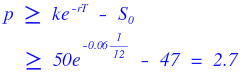
Oh my… Jesus Christ… the option is undervalued T_T
So let’s buy the undervalued put, and buy one share of the stock right now too.
What I’ve spent in total is $-2.5 - 47 = -49.5$, so I borrowed that much to pull this off… In 1 month, that borrowed money turns into
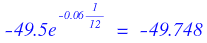
so what I owe has swollen T_T But no worries!
I can trigger my put and sell the stock I’m holding for at. least. $k = 50$!!!
So $50 - 49.748 = 0.25$ of profit comes right along with it, and that’s the worst-case scenario. If the stock shoots way up and I can sell at the market price of 23890213890 instead of the strike of 50, my profit can grow to infinity ^^
Prob 10.14
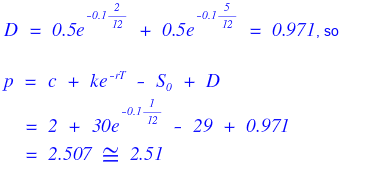
A European call with 6 months to maturity and a strike of 30 is priced at 2. The stock is at 29, and dividends of 0.5 are expected in 2 months and in 5 months. The yield curve is flat, with a risk-free rate of $r = 10\%$. What’s the price of a European put with 6 months to maturity and a strike of 30?
They gave us the call price and made a point of saying it’s European, so it looks like they want us to estimate the put price with put-call parity. But we have to account for the dividends.
And “the yield curve is flat” just means the risk-free rate stays at $r = 10\%$ no matter the maturity.
So I’ll estimate the put price with the dividend-adjusted put-call parity. Simple… The only mildly annoying part is working out the present value of the dividends, $D$.
Prob 10.16
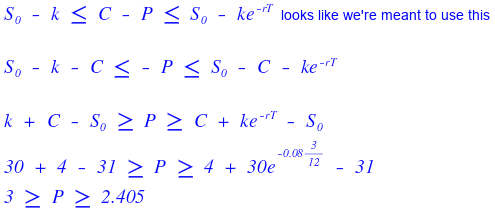
The price of an American call on a non-dividend-paying stock is 4. The stock is at 31, the strike is 30, maturity is 3 months, and $r = 8\%$. What are the upper and lower bounds on the price of an American put with the same underlying stock, maturity, and strike?
Heads-up. The figures here are the original notes, slips and all. A few things to watch for:
- In the picture right after the 58.21, the amount that grows for 4 months is $58.21$, not $58$: $58.21\,e^{0.12 \times 4/12} \approx 60.59$.
- In the picture of the borrowed 49.5, the money grows over the month, so the exponent is positive: $-49.5\,e^{0.06 \times 1/12} = -49.748$.
- In the dividend put-call parity picture, the option has six months to run, so the strike is discounted with $30e^{-0.1 \times 6/12}$, not $30e^{-0.1 \times 1/12}$; that is what gives 2.507.
Comments
Discussion happens via GitHub Discussions. You'll need a GitHub account to comment.