Options Trading Strategies (Part 1): Spreads — Bull Spread, Bear Spread, Box Spread, Butterfly Spread, Calendar Spread
We finally stop staring at one lonely option and start building real portfolios — covered calls, protective puts, and every spread you'd want to know.
Up to now we’ve been looking at exactly one option. Just one, naked and alone. So now that we know what a single option is all about, from here on the question is:
OK, so how do we actually use these things?
That’s basically what this post is about. We’re going to look at the special portfolios you can build out of options, and they fall into roughly 4 buckets:
- Option + zero-coupon bond
- Option + underlying asset (a stock, here)
- Two or more options of the same kind → Spread
- Two or more options of different kinds → Combination
Option + zero-coupon bond
So first: if you hold an option and a zero-coupon bond, what kind of security can you build? A “principal-guaranteed security,” apparently. But this one is kind of… way too obvious. Here’s why:
A zero-coupon bond pays exactly its face value at maturity, right??? So if you “invest” only as much as that face value — which comes back to you at 100% at maturity (as long as there’s no default) — then of course you’ll get your principal back, and that’s why it counts as “principal-guaranteed.”
But hold on. Say I put in 100, and three years later things have gone to hell, but I still get 100 back because it’s principal-guaranteed. So I haven’t lost anything, I’m just right where I started?????
NO NO !! Putting in 100 and getting 100 back three years later is actually a loss.
I should’ve at least earned the risk-free rate. Why am I getting it back as-is? What is this, a safe?
OK so. A bond with face value 100 obviously can’t be sold for 100 three years before maturity. Let’s say it’s discounted and you buy it for 80. Then you put the remaining 20 into options. So you’ve invested 100 in total, right????
At maturity the bond pays its 100 face value, and since 100 is what you invested, that’s what “principal-guaranteed” means. (OK, now I actually get it.) In the worst case your principal is safe, and any chance of things getting a bit better comes not from the bond but from the stock — the option on it, that is~~~
Alright, let’s stop here and move on. What I actually want to dig into isn’t even #2 — it’s #3 and #4, so…
Stock + option
This time, the second one: stock + option!! What you get by adding a stock and an option goes by the names covered call and protective put.
I mentioned before that the meaning of “naked option” would really sink in here: it’s not a situation where there’s just one lone option — it’s an option that’s covered or protected by some stock!!!! You with me?????
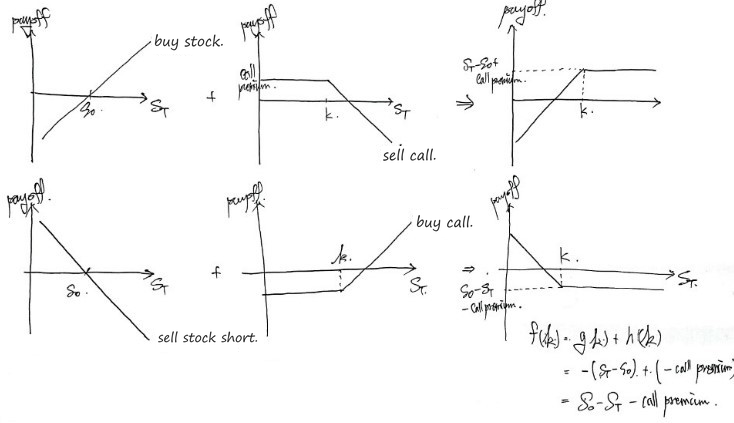
OK, from here on I’m going to put everything in graphs…. First, let’s say the portfolio is buying a stock + selling a call (same underlying, of course). For each of them we can draw a payoff graph against the stock price. Let’s draw each one:
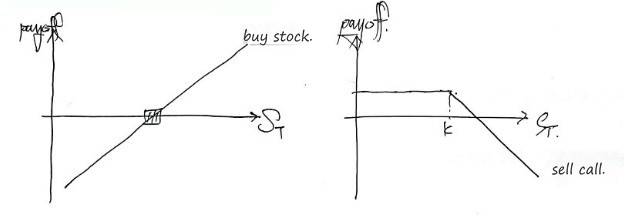
(On the left graph, the $S_T$-intercept is $S_0$, but I didn’t label it…. you all know that, right? heh kikiki)
We know each one is drawn like that, and since the portfolio holds both, the portfolio’s payoff is just the two graphs lumped together (the underlying being the same, after all):
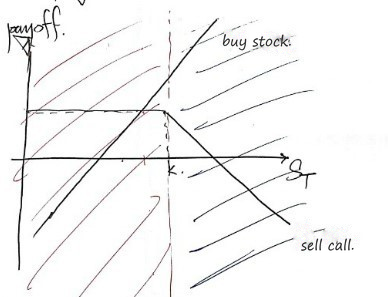
I want to draw the portfolio’s payoff by lumping both together, but since the option payoff is nonlinear, I can’t just add them with one simple formula, $f(x) = g(x) + h(x)$. So I have to split the domain into a few ranges and do the function sum range by range. But both graphs have slopes of just 0 or ±1 with respect to $S_T$, so this is easy!!! Very easy.
In the picture above, the left part is red (you can’t see the color, T_T sorry). In the red region (left of $S_T = k$), the summed function has slope 1, and in the region to the right of that (the blue one), the summed function has slope 0…..
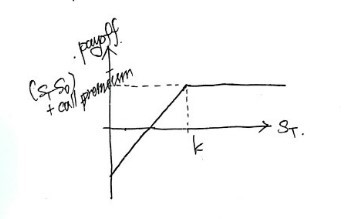
So it ends up looking like this!!!! (I don’t know if everything I want to say will get across in words, but let me try.) In the red region, the portfolio’s payoff is the original “buy stock” graph shifted up by the +call premium. The second region has slope 0, so it’s a straight line parallel to the x-axis.
But at what level is it flat? How do we find that?
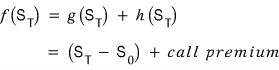
That’s why I wrote the flat level down like that;; heh heh heh
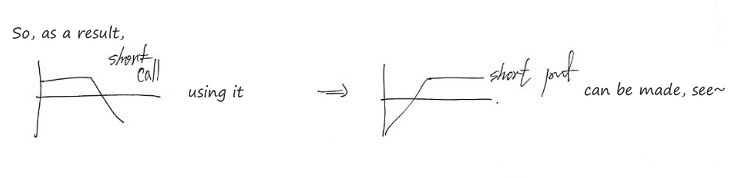
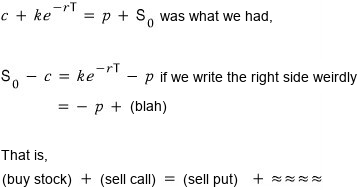
That’s what I’ve been sitting here going on about…. And why does $S - c$ end up looking just like a (short) $p$? You can also confirm that with put-call parity….
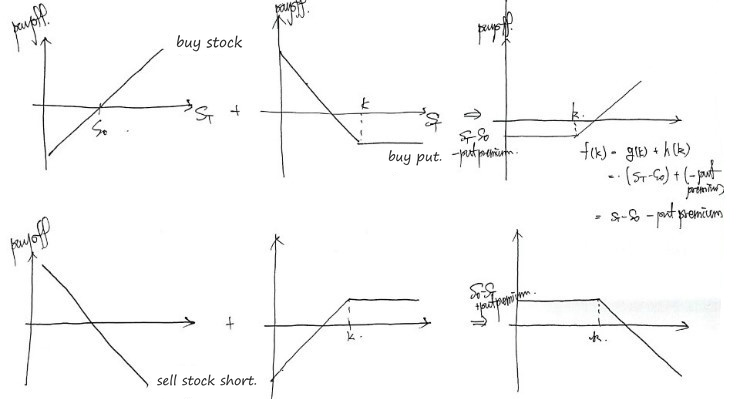
OK then — the long and short payoffs of a covered call (which looks like a put built out of stock + call), and the long and short payoffs of a protective put (which looks like a call built out of stock + put) — I’ll just draw them all at once and be done with this part…!!!
Now you might be wondering:
Why not just buy or sell a plain call or a plain put? Why bother bundling a stock with an option to make a covered call or a protective put?!
Hmm…. lots of reasons to use these, but if I give just one: before buying a brand-new option, you can use the option you already hold to make a different type of option this way??? Something like that?
Spreads
Now let’s look at the spread: a portfolio made by combining two options of the same kind! We’ll learn 5 kinds of spreads: bull spread, bear spread, box spread, butterfly spread and calendar spread.
① Bull Spread
Apparently one of the most-used spread techniques out there. It’s two options of the same kind, and the two are: buy the option with the (relatively) lower strike & sell the option with the higher strike. That’s the combination. (Same maturity and underlying, of course~)
So let’s draw the payoff at maturity of each of those on one set of axes:
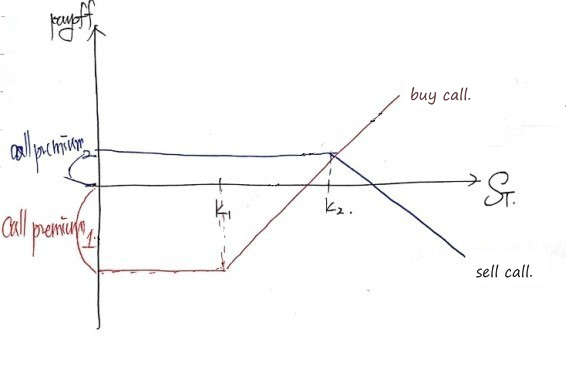
Both are the same kind, so let’s say they’re calls. I bought the lower-$k$ call and sold the higher-$k$ call. And now the function sum!
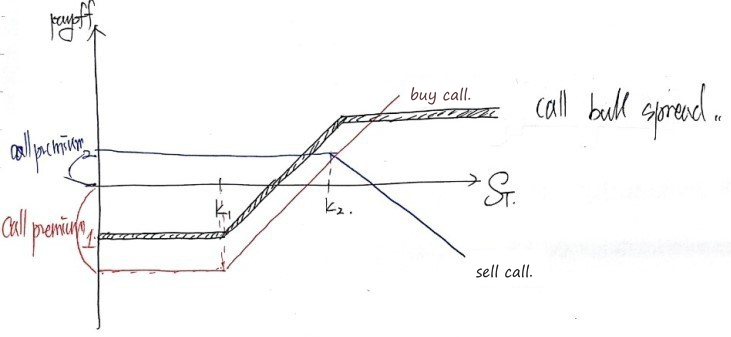
Anyone object that it comes out like this? Pretty obvious, right??
But there’s one thing here that’s not obvious. I kind of arbitrarily drew the price of $\text{call}_1$ bigger and the price of $\text{call}_2$ smaller. Hmm, but this is actually true. Why? Because the lower the strike, the higher the call’s price. Obvious!!
(For anyone who starts reading from here, let me throw in a simple example so it sinks in. Imagine I’m selling you the right to buy the pen GD park used, for 25 million won. What would be a fair price???? lol. Now it clicks, right?)
OK, good. Now, in the picture above I never said at which level the flat horizontal parts sit. Let’s work that out!! If we plug $k_1$ and $k_2$ into the bull spread function, we can see where the upper and lower levels of the payoff are.
Real talk, please cut me some slack today; typing this stuff into the equation editor is such a pain. I’ll come back later and replace the patched-in photos with proper equation-editor versions, I promise.
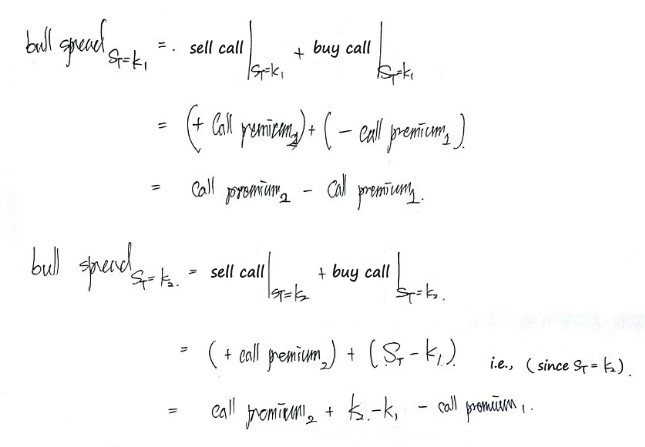
(In the second-to-last line of the equations at the bottom, I forgot to write $-\text{call premium}_1$.. T_T)
Can you read it OK?? So that’s how the upper and lower levels get set.
And what about when  is between
  and
and  ?
?
Since we haven’t plugged in  yet, we can just say

heh heh heh
OK, now let’s do the same thing — buy the lower-strike option & sell the higher-strike option — but with puts instead of calls.
Of the two puts, I buy the lower-$k$ put and sell the higher-$k$ put, and without overthinking anything, I’ll draw the payoffs of both at maturity on one set of axes.
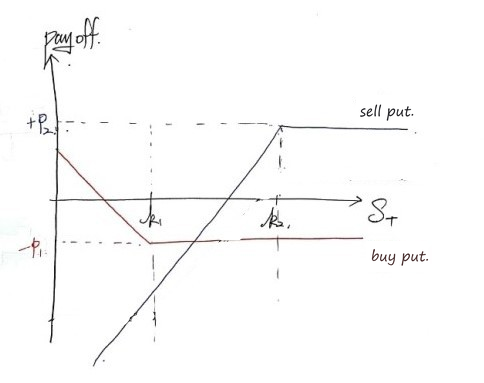
I just bought and sold the puts exactly as instructed above, no thinking. (Same underlying and maturity, of course… my mouth hurts from saying it T_T)
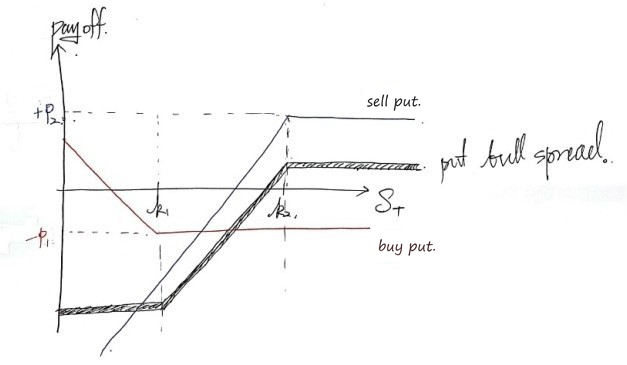
If we just slam the two payoff functions together as a function sum, the picture comes out like this. Anyone object?! Obvious, right?! And then we coolly write “put bull spread” next to it and we’re done. heh heh kikiki
Let’s look at the size of the premiums first. The right to sell ramen for 50 million won — is that cheap or expensive????? Since the only thing that could ever happen to it is getting exercised, it’d be insanely expensive. So the put with the higher strike $k$ is the one I drew as more expensive!!
And just like before, let’s find the upper and lower levels of the put bull spread. Should be easy. Starting with when  , we work out:

And let’s look at when  too.
too.

In the middle?!?! In the middle, we haven’t plugged in that condition yet, so

it’ll be that, I guess~~~~~~
② Bear Spread
Now let’s look at the bear spread. Bear is the opposite of bull: it’s a position you get by buying the option with the higher strike & selling the option with the lower strike. And without overthinking it, let’s start with calls: sell the call with the lower $k$, buy the call with the higher $k$, and stack their payoffs on one set of axes.
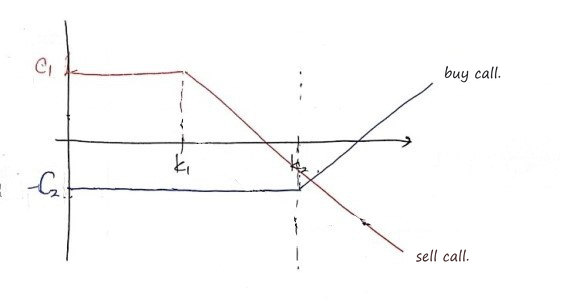
Something like that will do~~ And again, the right to buy at a lower $k$ has to be priced higher, which is why $c_1$ is the bigger one~~ so $c_1 \gt c_2$.
And then, again with no thinking, we just slam them together with a function sum! (Do try it yourself;)
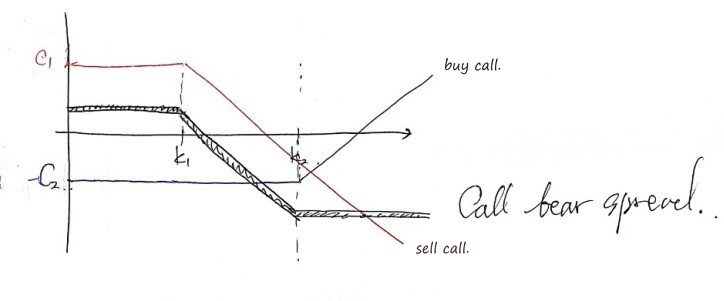
Anyone object?! Good good good.
Now then, let’s work out the upper and lower levels again. This time I’ll just write the formulas.
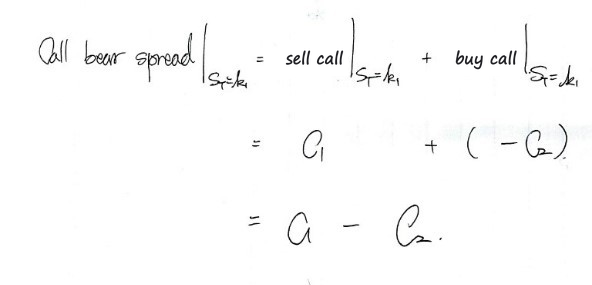
That’s the upper level~~
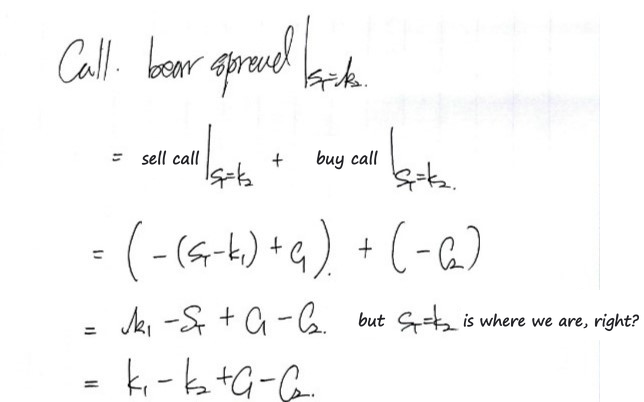
And this is the lower level~~~ And here’s how the straight line in the middle is derived~
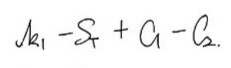
It’s just before plugging $k_2$ in for $S_T$~~~
Let’s goof around with puts too?! Don’t forget: a bear spread is buy the high-strike option & sell the low-strike option! This time I’ll put everything into one picture!!!
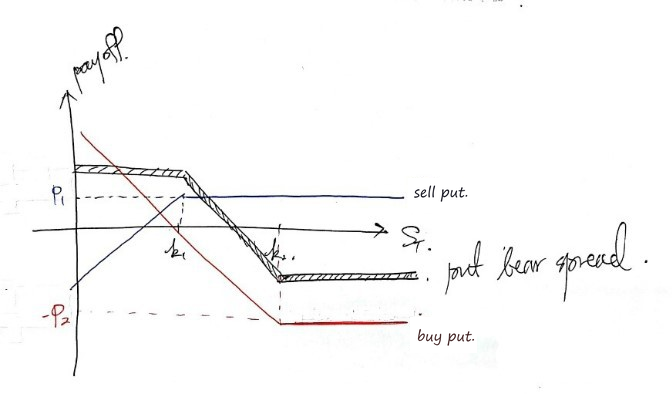
Like this!!!!! And once we pin down the function for each segment:
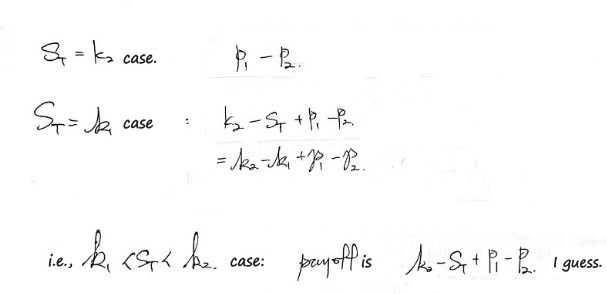
Kyuryu kyuryu~~~~~ did I get away with too much there???
③ Box Spread
Now, the box spread!!!!! What’s a box spread!!!! Simple!!!


Easy, right!!!!
But there’s a catch: you have to combine call bull + put bear. Combining put bull + call bear would be pretty much useless!!! Why? Because if you combine those, that straight-line payoff ends up negative. Remember how the lower $k_1$ is, the pricier the call gets and the cheaper the put gets? That’s why it comes out that way.
So only call bull + put bear works as a box spread. No exceptions!
Now let’s bring back the call bull spread and the put bear spread we drew earlier.
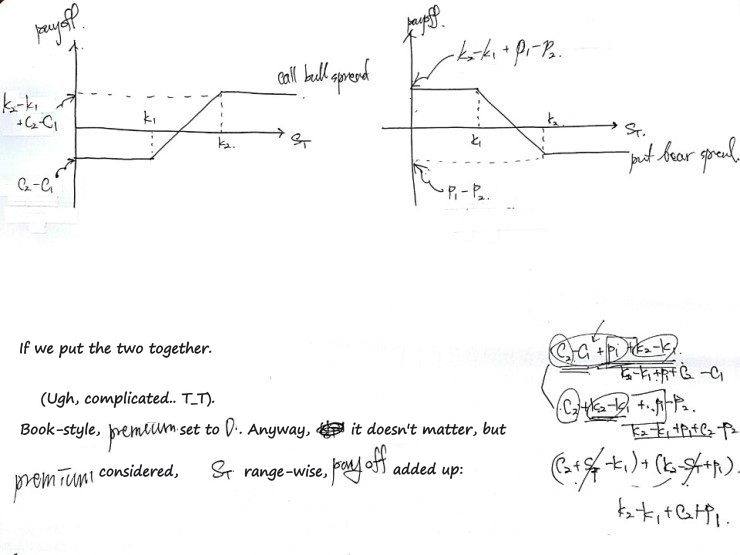
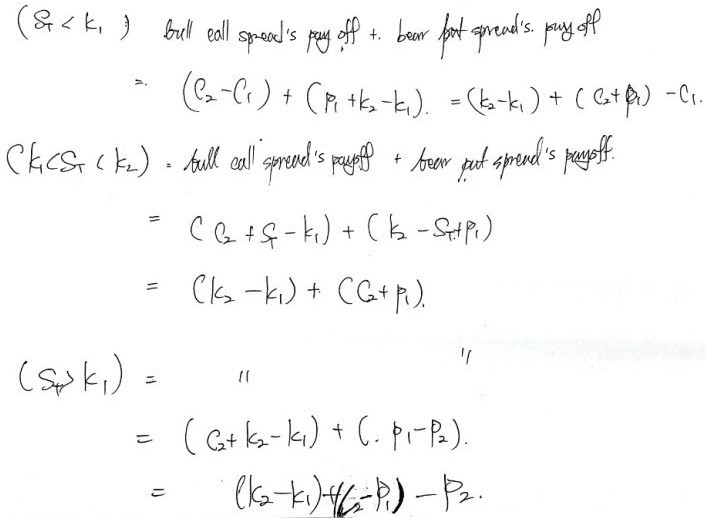
④ Butterfly Spread
The bull, bear and box spreads from before needed 2, 2 and 4 options respectively, but they needed only two strikes: $k_1$ and $k_2$. The butterfly spread we’re about to look at needs three strikes, $k_1, k_2, k_3$, and four options in total. Well, it’s still a spread, so it’s built from options of the same kind — 4 of them. Let’s go!!
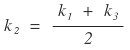
The strikes are  and the condition that has to come with it is
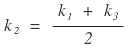
You need this condition!! $k_2$ has to sit at the midpoint of the other two.
Let’s call the call prices $c_1, c_2, c_3$. (The lower the strike, the pricier the call, so $c_1 \gt c_2 \gt c_3$.) And then: buy one $c_1$, sell two $c_2$, buy one $c_3$. With those 4 call options in total we can build a butterfly spread. First, let’s put the payoff of each at maturity on one set of axes:
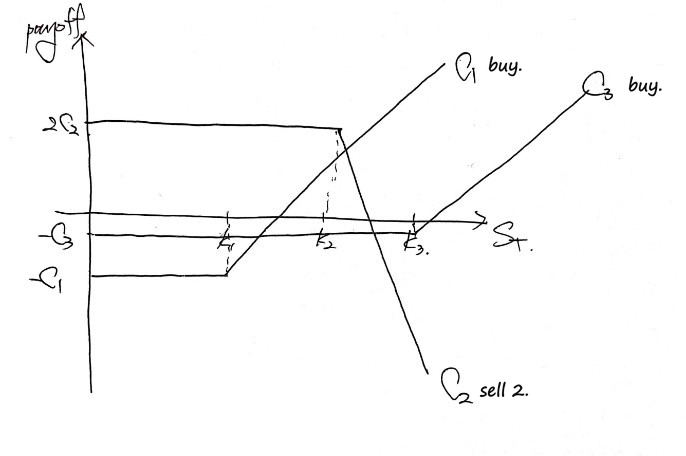
Like that!!!!
Drawn this way, the function that’s the sum of these 3 functions is easy to come up with.
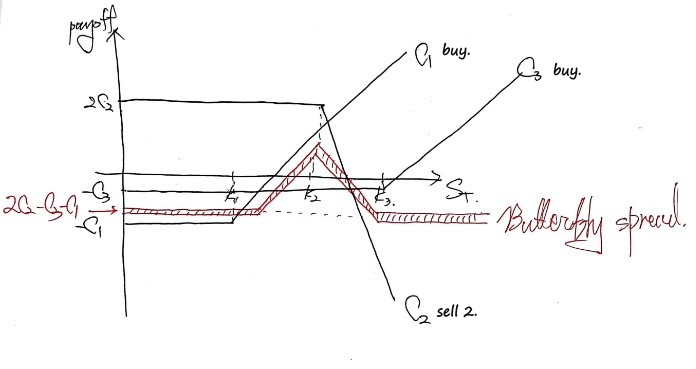
It gets drawn like this, and why it gets drawn like this is easy to see if you think about it this way:
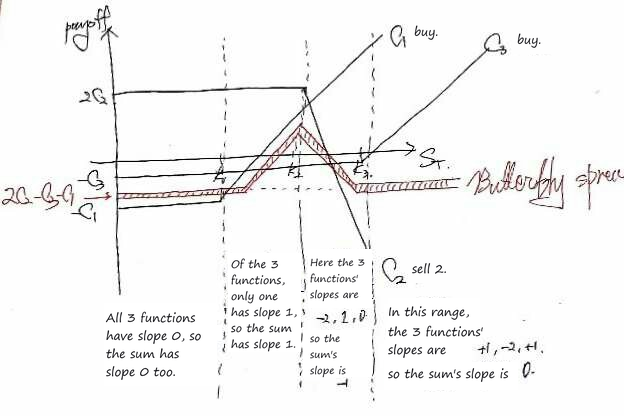
But hold on!!
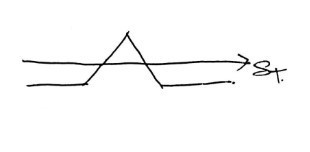
I drew it so that everything sits below the x-axis and only that one boing! part that pokes out is a profit (+). Of course, if my payoff looked like
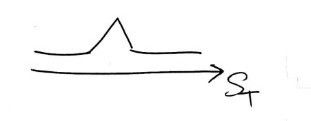
this, that’d be amazing!!! Guaranteed steady profit, plus a bit more in a certain range — how great is that! But the person on the other side of that position
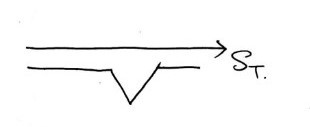
would be taking on a product with this kind of payoff. And would any investor accept a payoff like that?? I’d say it would never sell, not in a million years.
So for the product to have any liquidity — i.e., for lots of people to buy and sell back and forth — the shape at the very top is the one that makes sense.
So the picture I drew above “as if it were obvious” is not a wrong picture, hehe. I spun a whole yarn about something pretty obvious. Anyway, by drawing the graph we found the lower level of the butterfly spread. Now let’s pin down that pointy part and move on.
When the price at maturity is in this range, 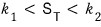 , the call options
  are scrap paper. Plain garbage. The price is below their strike, so why would you exercise the option to buy at that strike?

I wrote them in order: what comes from $c_1$, from $c_2$, from $c_3$. And if we plug  into this formula, we can find the $y$-coordinate of the peak, right? The peak is

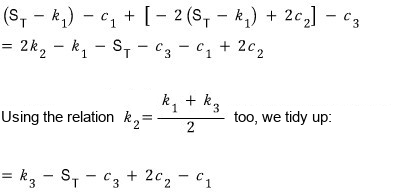
Let’s also consider 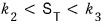 . In this range, only $c_3$ is scrap paper. So I think we can tidy it up all the way to
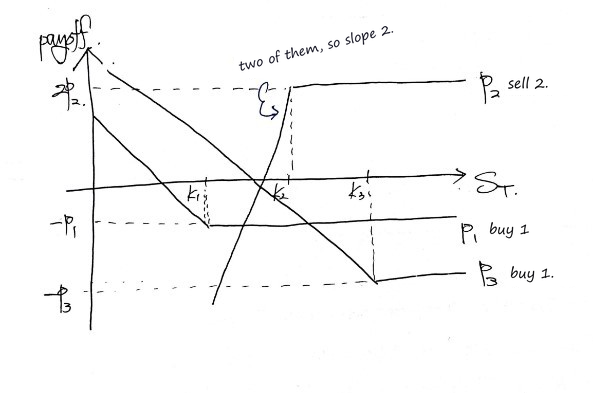
Butterfly can also be built from 3 put options.
Same condition again:
For puts, the higher the strike, the higher the option price, so $p_1 \lt p_2 \lt p_3$. And: buy 1 of $p_1$, sell 2 of $p_2$, buy 1 of $p_3$. First, let’s draw the payoff functions at maturity against the stock price $S_T$ on one set of axes:
Yep yep yep yep, easy~~~ Add them up and:
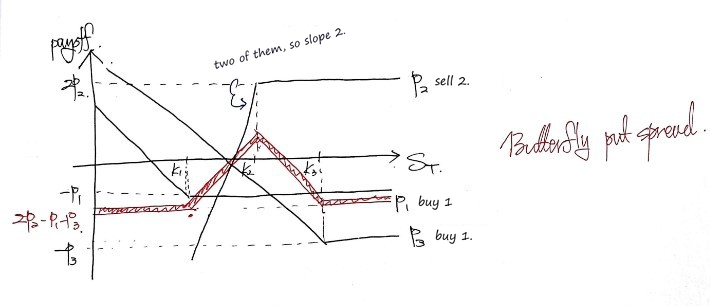
Yep yep yep yep, this one’s easy too. The straight line at the bottom level is already done, so let me pin down the jagged bit in the middle and move on.
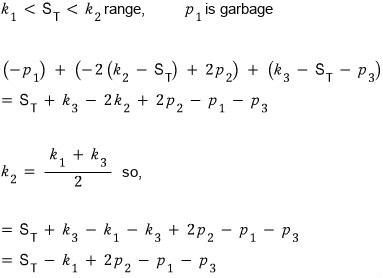
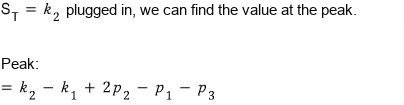
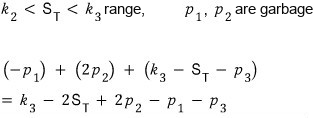
Up there, to be honest…. I figured it out the complicated way, but there’s actually a way to nail it all down in one shot.
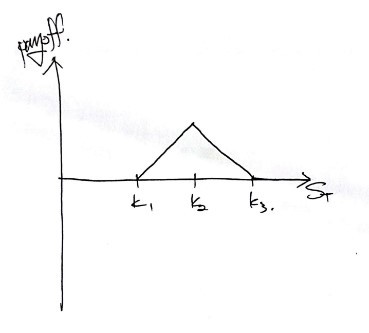
You think of the premium as 0 (zero) and draw it like this. Once it’s drawn, deriving the function for each line, range by range, is way too easy, because we already know the $x$-intercepts.
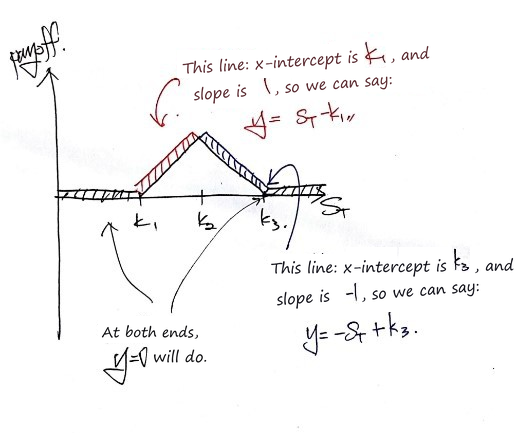
Right?!?! And after nailing all of them down like this, if we shift everything equally along the $y$-axis by 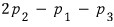 (that number is negative, so that’s a shift down),
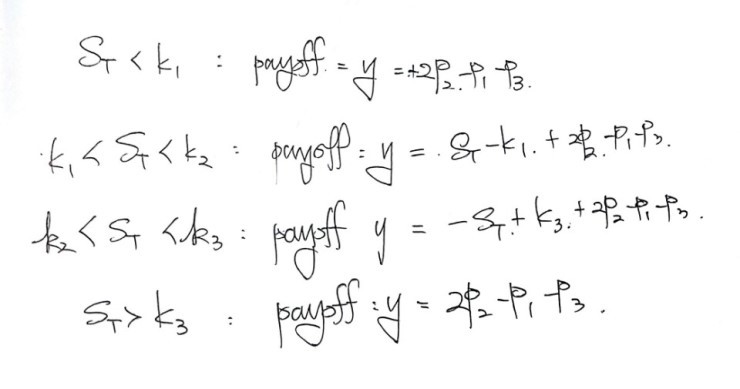
we can pin down the function on every range, simply. That’s how it was.
Oh, and a quick, even shorter comment on the butterfly spread.
In the end, the choice of an investor using this spread is

one of these two, right????? Then the investor who picks the former is one who expects future stock price volatility not to be big, and the investor who picks the latter is one who expects future volatility to be big????? OK OK OK OK
I can already hear the math majors loading their guns at me. Plausible~ plausible~
⑤ Calendar Spread
This time, the fifth one: the calendar spread. A calendar spread breaks just one of the earlier rules — the same-maturity rule. Up to now the options “obviously (?)” had the same maturity, right? Now we’re using options whose maturities are not the same (but the strike is the same!!!!!).
Hmm…. so when we use two options: if the longer-maturity one were European, we couldn’t exercise it when the shorter-maturity option expires — that would be a problem. So:
- the shorter-maturity option should be European
- the longer-maturity option should be American
So let’s look at two combinations:
- short-maturity European call + long-maturity American call
- short-maturity European put + long-maturity American put
Conclusion first: its payoff graph looks similar to a butterfly spread’s. We’ll see how it’s similar little by little.
First, the payoff of the short-maturity European call and the long-maturity American call — and note this payoff is evaluated at the European’s maturity!!!! In other words, the American call’s payoff is drawn as a call value curve that takes time value and present-value discounting into account.
Looking at the two profit curves,
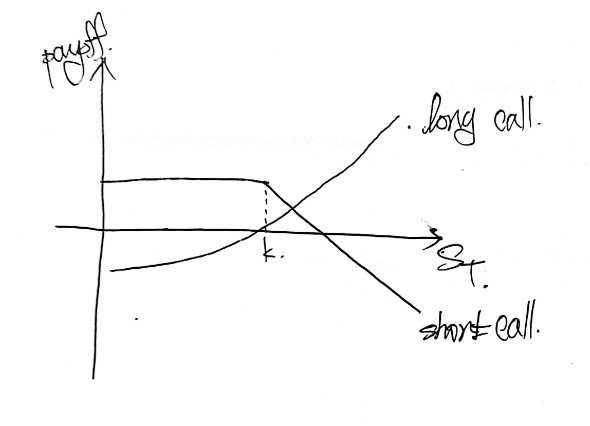
it’s like that, right!?!? And if we very roughly add them up, the graph of the sum would look something like this:
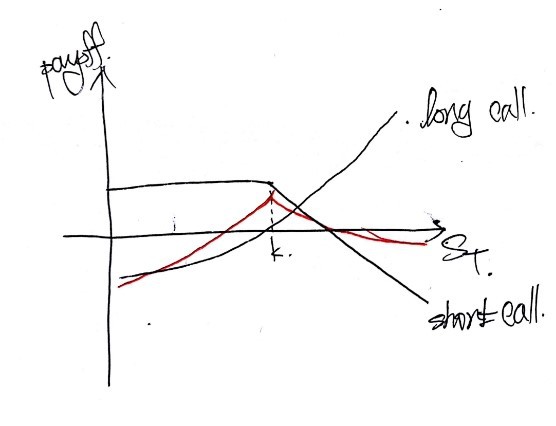
I’ve been going on and on above about how it gets drawn like this.
But if someone asks you to explain why it’s drawn like this, what do you say?
Shouldn’t we say it’s because of the time value?
Time value is biggest at $S = k$, so the sum is biggest there too.
(Another way to see why the sharp point is at $S = k$: the long call’s derivative is continuous over every range, but the short call’s derivative is discontinuous at $S = k$. So the summed function’s derivative is discontinuous at $S = k$, too. I think you can put it that way as well.)
Now, what if, when picking $k$, we pick one that’s even more in the money (ITM)???
The call premium goes up, of course, but more importantly, the time value of the American call gets bigger. So when the peak of the European-and-American sum is at a more ITM $k$, the long call rises more,
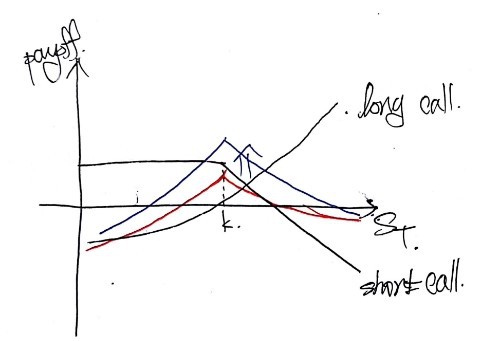
so the peak goes up like this, and the range where you profit at the same time gets wider, they say. This is called a bullish calendar.
I used this as my source: http://www.minyanville.com/trading-and-investing/how-to-trade/articles/SPY-time-time-value-price-options/7/31/2013/id/51068
The bearish calendar spread is the opposite, right? You just use two puts, a short-maturity European put and a long-maturity American put, and you can build the same kind of payoff as above. I’ll just slap a rough graph down and move on.
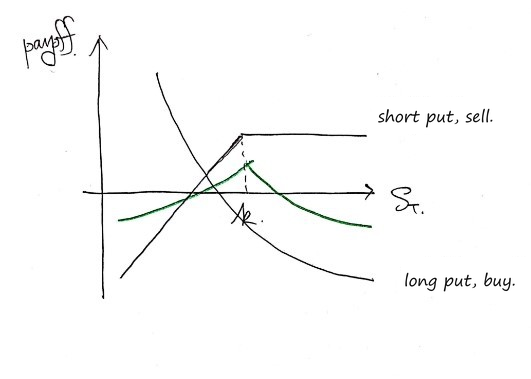
And with that, we’re done with spreads~~~~~~~~~~~~~~~~~~~~~~ That got way too long…. I’ll cut it here~
Heads-up. The figures here are the original notes, slips and all. A few things to watch for:
- In the put bull spread lines, the sold put contributes $-(k_2 - S_T) + p_2$ when $S_T \lt k_2$, so the middle range is $(S_T - k_2) + p_2 - p_1$, and at $S_T = k_1$ the payoff is $k_1 - k_2 + p_2 - p_1$ (below zero, as in the graph), not $k_2 - k_1 + p_2 - p_1$.
- In the two box-spread pictures, the sums leave out some premium terms: in every range the payoff is $(k_2 - k_1) + (c_2 - c_1) + (p_1 - p_2)$. In the second picture, the third range is $S_T \gt k_2$, not $S_T \gt k_1$.
- In the call-butterfly line for $k_2 \lt S_T \lt k_3$, the two sold calls give $-2(S_T - k_2) + 2c_2$; the picture writes $k_1$ inside the bracket, but the next line already uses $k_2$.
- In the put-butterfly line for $k_2 \lt S_T \lt k_3$, the payoff is $k_3 - S_T + 2p_2 - p_1 - p_3$, with one $S_T$, not $2S_T$.
Comments
Discussion happens via GitHub Discussions. You'll need a GitHub account to comment.