Options Trading Strategies (Part 2): Combinations and Practice Problems
Wrapping up options combinations — straddles, strangles, strips, and straps — and figuring out which one to pick depending on your vol view and your wallet.
Alright, this time I’m wrapping up combinations: strategies built from two or more options of different types. Three option combinations on the menu:
- Straddle
- Strip & Strap
- Strangle
1. Straddle Combination
Same strike, same expiration. Call and Put. You buy both!! OK so let’s just lump both payoffs at expiration onto the same axes~
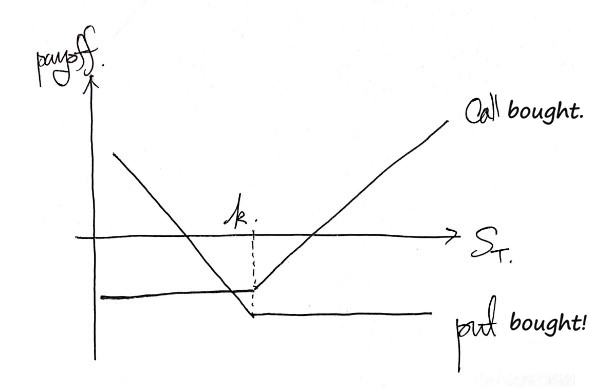
Yeah, something like that.
Quick note — I drew it with $p$ a bit pricier than $c$ here, but really:
- when $k$ is large → $c \downarrow$, $p \uparrow$
- when $k$ is small → $c \uparrow$, $p \downarrow$
So depending on where $k$ sits, you could have $c \lt p$ or $c \gt p$… it can flip around. Bottom line: which one is more expensive doesn’t seem to matter.
Anyway — so what’s the sum of those two functions???
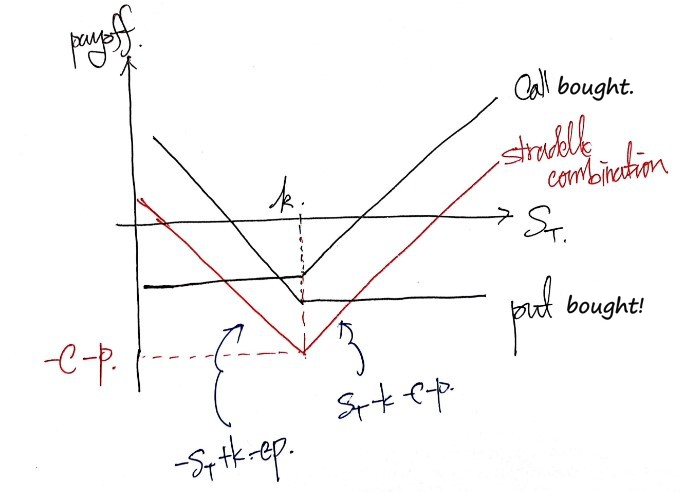
But if $S_T$ at expiration lands somewhere near $k$, the person sitting in the bottom straddle position (that’s its name — buying $c$ & $p$) takes a big loss… So:
- Investor expecting high volatility ahead → takes that bottom straddle.
- Investor expecting low volatility ahead → takes the opposite position, the top straddle.
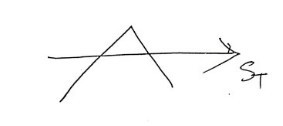
Because that’s how it’ll look! hehehehe
3. Strangle Combination
This time we’re still buying a call and a put, but a call and a put with different strikes $k$.
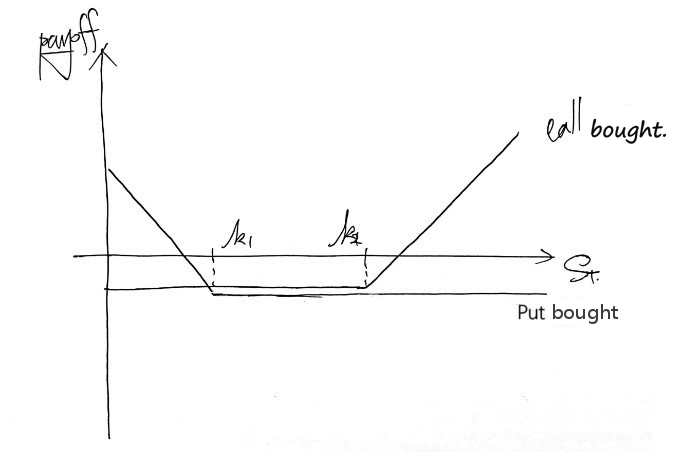
What you build by combining them like this is called a strangle combination, and — aaaaaaaa — I need to draw the sum.
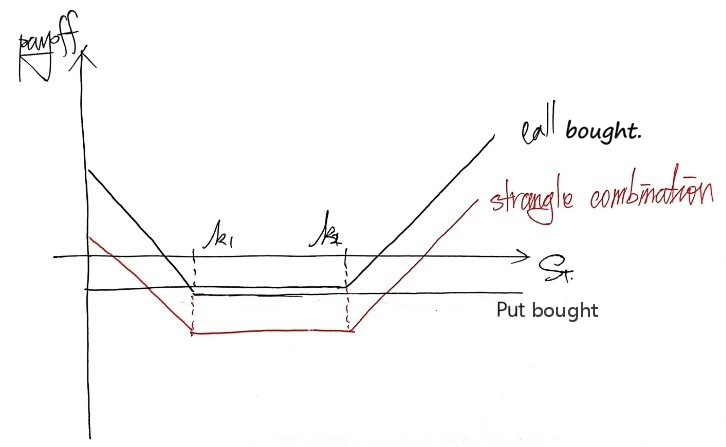
Drawing this stuff is a piece of cake by now~~~~
Anyway: in a strangle, you set the call’s strike higher than the put’s strike (the direction where both the call and the put get cheaper). That pushes the profit zones a little farther out.
But hold on — think about it for a sec.
If you’re an investor expecting high volatility…
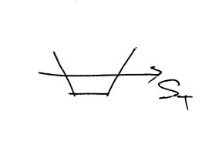
instead of a profit curve like that,
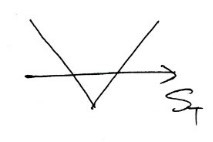
wouldn’t you rather take this one — so that if vol really does blow up like you’re betting, you make the bigger profit?!?!?!?!
In other words, the strangle is, so they say, the strategy for broke folks who expect big volatility but don’t have much cash.
- Expect high vol + got money → Straddle, go go.
- Expect high vol + broke → Strangle, go go go.
Side note: the names feel completely backwards to me. Why the pointy one is called “Straddle” and the saddle-shaped one is called “Strangle”…. I don’t know either.. T_T
2. Strip & Strap
OK, back to the straddle.
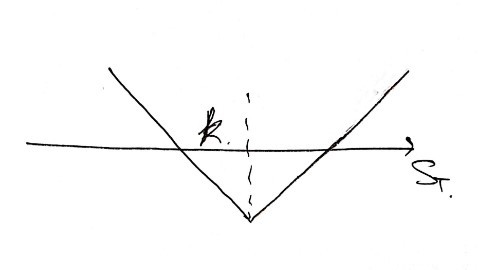
We said someone expecting high vol takes that position above, right??? But!!! Suppose you expect high vol, sure, but you also expect the move to be bigger in the upward direction. If you’re truly, enormously confident about that, then rather than a straddle like the one above,
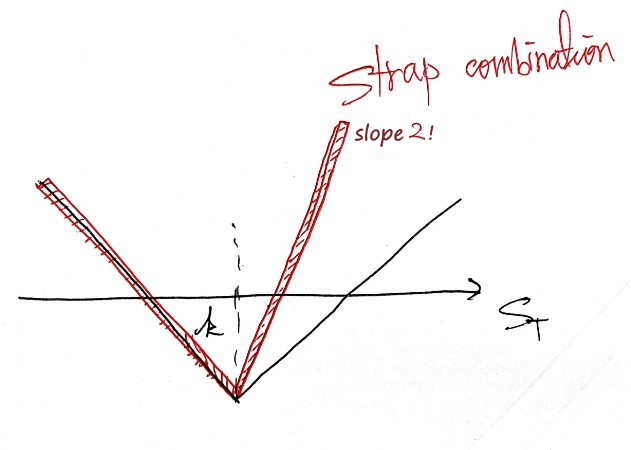
a Strap shaped like this seems like the better pick.
How do you build it????????
Just buy 2 Calls instead of 1 when you buy the call!!!!
Flip it around — if you’re sure vol will be big but the move will be bigger on the way down, buy one more Put when you buy the options, so 2 Puts instead of 1,
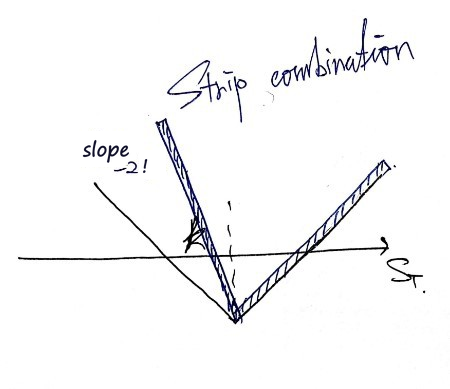
and give the left side of the graph slope $-2$, like that. That seems better. This one’s called the Strip combination, they say~
And with that, Chapter 11 is all done. heh
Quiz
Quiz 1. What is a protective put? Which call-option position is it equivalent to?
A protective put = long stock + long put. By the following put-call parity, it’s equivalent to a certain amount of cash + a long call:

Quiz 2. Explain two ways to build a bear spread.
Way 1 — with calls (same expiration, different strikes): sell the call with the lower strike, buy the call with the higher strike. Way 2 — with puts (same expiration, different strikes): sell the put with the lower strike, buy the put with the higher strike.
Quiz 3. When does it make sense for an investor to set up a butterfly spread?
A butterfly uses options at 3 different strikes ($k_1, k_2, k_3$). You buy the butterfly when you expect the underlying to close near the middle strike $k_2$.
Quiz 4. 3-month calls with strikes 15, 17.5, and 20 cost $4, $2, and $0.5 respectively. Explain how to build a butterfly with these, and make a table of how its profit changes with the stock price.
Buy 1 call at strike 15 and 1 call at strike 20, and at the same time sell 2 calls at strike 17.5. Initial cost: $(4 + 0.5) - (2 \times 2) = 0.5$.
The profit table against the stock price at expiration… is sooo tedious…
- $S \lt 15$: $-0.5$
- $15 \lt S \lt 17.5$: $(S - 15) - 0.5$
- $17.5 \lt S \lt 20$: $(20 - S) - 0.5$
- $S \gt 20$: $-0.5$
Quiz 5. How do you build a reverse calendar spread?
Buy the shorter-expiration option and sell the longer-expiration option.
Quiz 6. Strangle vs. straddle — what’s the difference?
Both are built from a call + a put.
- Straddle: the options have the same strike and the same expiration.
- Strangle: same expiration, but different strikes.
Quiz 7. A call with strike 50 costs $2; a put with strike 45 costs $3. Explain how to build a strangle with these two, and describe the profit pattern of the strategy.
- $S \lt 45$: $(45 - S) - 5$
- $45 \lt S \lt 50$: $-5$
- $S \gt 50$: $(S - 50) - 5$
Practice problems
Prob 11.8 Using put-call parity, explain how the initial investment of a bull spread built from puts relates to that of a bull spread built from calls.
Bullish call spread: buy the lower $k$, sell the higher $k$ → $-c_1 + c_2$. Bullish put spread: same deal → $-p_1 + p_2$. Those are the initial cash flows. So what we spend is those with the sign flipped:
- Calls: we spend $c_1 - c_2$
- Puts: we spend $p_1 - p_2$, right? (That one is actually negative, since $p_2 \gt p_1$: the put version pays you up front.)
OK now, from put-call parity we can pull out this “equation”:
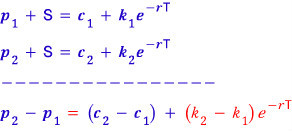
Now imagine the red term up there isn’t there. If a positive (+) term suddenly disappears, the equality is going to break,
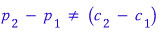
like this. Then one side will be bigger and one smaller.
So which one’s bigger?
There was a (+) term on the right and it disappeared, so the right side must have gotten a bit smaller, right?
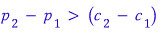
But what we want to compare isn’t “2 minus 1”, so multiply both sides by $-1$, which flips the inequality:
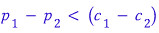
Yep yep yep — the bull spread with puts costs a little less up front.
In other words, the call version has 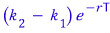 built in as a risk-free amount growing at the risk-free rate, and you can see the put strategy as having that risk-free growth left out.
Prob 11.10 Puts with strikes 30 and 35 cost 4 and 7 respectively. Explain how to build a bull spread and a bear spread with them, and make tables of their payoff and profit patterns.
Honestly, this is all stuff we’ve already done. First, a bull spread means buying the option with the small $k$ and selling the one with the big $k$, so let’s just draw the profit curve straight away:
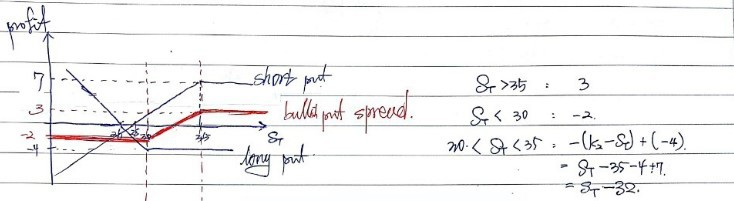
And drawing the bearish put spread too:
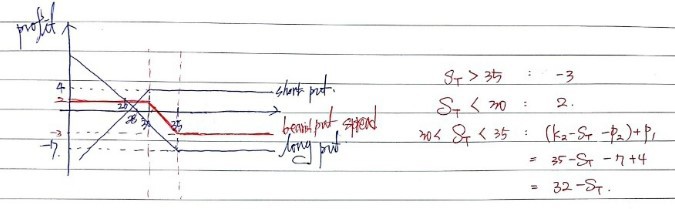
Can’t we just do this much and move on? Once you draw it yourself, finding those points is nothing, so try it once and there’s nothing to worry about~
Prob 11.12 A call with strike 60 costs 6. A put with the same strike and expiration costs 4. Fill in the straddle profit table. For what range of stock prices does the straddle lose money?
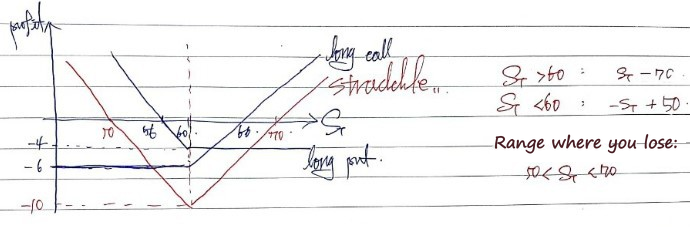
Ultra easy, desu…
Prob 11.14 An investor doesn’t know which way the stock is moving but is convinced it’s going to move big. List six strategies they can use, and explain the differences.
From everything we’ve covered:
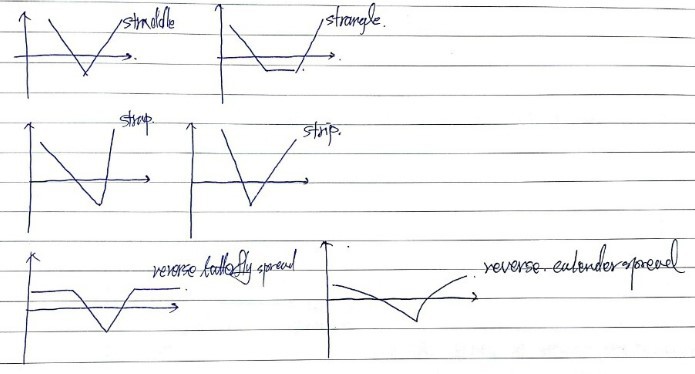
there’d be these six.
Prob 11.15 Using options, build a forward contract on a stock with a given delivery price and delivery date.
For convenience, let us write the call premium as $c$, shall we. First, the forward’s profit at maturity $T$ would look like this, I daresay:
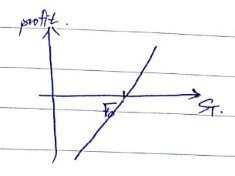
That shape, you see, can also be built with a long call & short put. Take two European options with the same maturity $T$ & the same strike $k$, go long the call and short the put,
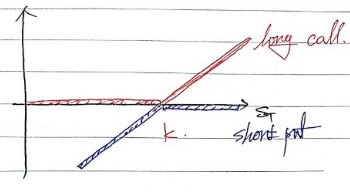
and this is what you get, my friend. The sum of the two would be the same as the forward’s payoff curve at maturity $T$, I daresay.
In other words, with these two options you can design a forward whose forward price is $F = k$. Ho ho ho ho.
Heads-up. The figures here are the original notes, slips and all. A few things to watch for:
- In the bull put spread picture, the line for $30 \lt S_T \lt 35$ should start $-(35 - S_T) + 7 + (-4)$: the sold put’s $+7$ appears only in the next line, and the result $S_T - 32$ is right.
Comments
Discussion happens via GitHub Discussions. You'll need a GitHub account to comment.