The Greeks
Why you'd hedge at all, three gloriously dumb hedges, then the real thing: delta hedging, gamma-neutral portfolios, and all five Greeks of a European option derived from Black-Scholes by hand.
What we’re covering today: hedging.
Hey!!! You did it, didn’t you?!?! — Nope~~ I didn’t do it~~~
Not that “did it” — I mean hedge, hedging… (Say “hedge” in Korean and it sounds just like “you did it, didn’t you.”) Sorry.
OK so~~~ here’s something I heard from someone actually working in the field. Say you sold some option for 100,000 won???? Now, with the conditions given right now (the stock’s volatility, the risk-free rate and so on — apparently each company pulls these out by its own manual), you work out the theoretical value of the option you sold, and it comes out to 80,000 won.
So from the company’s point of view, that’s a 20,000 won margin over its model value. Nice!!! But it isn’t a guaranteed realized profit. A perfect, correctly priced replication could lock in a margin in the ideal model; in real trading, hedging costs and model errors can eat into it before expiry.
So from this point on, the financial engineer’s goal becomes “protect the 20,000 won,” apparently.
How??? “With a hedging strategy.”
So that’s the context we’re learning hedging in. The most basic hedge is actually delta hedging, and that’s what I want to focus on. But before that, let’s run through a few dumb hedges first.
Dumb hedge, Episode 1: do absolutely nothing
Dumb hedge number one: “do nothing.” You just go ahead and do absolutely nothing. Fiercely. But surprisingly, this has an upside: the extra hedging cost is zero???
May the energy of the whole universe come to me~~~ the gain at expiry will be maximized~~~~~~ and to maximize it even more, I shall bear no hedging cost whatsoever~~~~~ That’s dumb hedge number one.
Dumb hedge, Episode 2: full scaredy-cat mode
What’s number two!!! I’ll call it the total scaredy-cat strategy. If you sold a call option, you have to hand over the stock at expiry, right? So you buy that stock in advance.
But selling a call and then buying the stock… what is this;;;;; isn’t that just making a covered call??? A picture makes it easy.
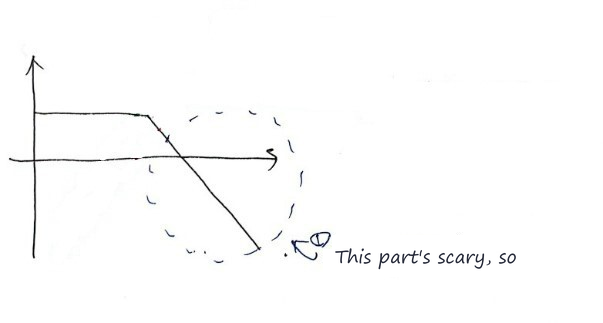
This zone here, where you can take a loss, is scary, so —
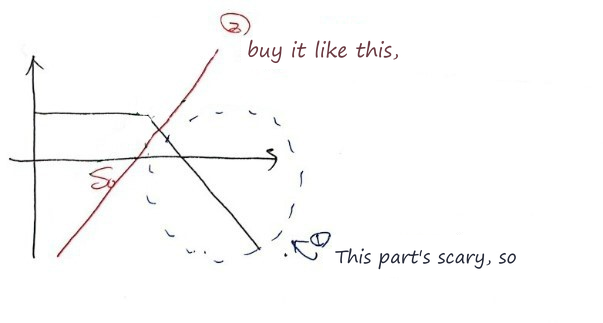
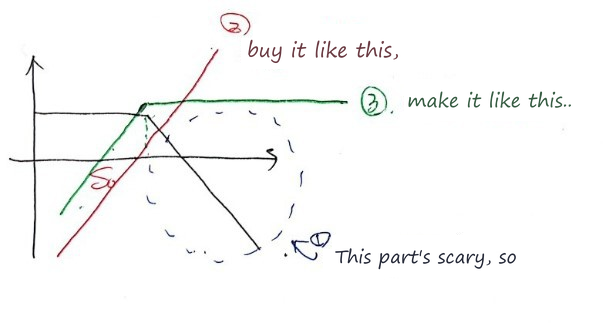
Sure, you’d go for this when you think the price is likely to rise~~~. In the “scary part” you’ve blocked the loss, but the part that wasn’t scary has turned into a place where you have to eat risk. lol Anyway, that was method number two.
Dumb hedge, Episode 3: chase the price across k
On to method three. The third dumb method: buy the stock only while the price is above k. When the stock price crosses above k, you swiftly buy the stock,
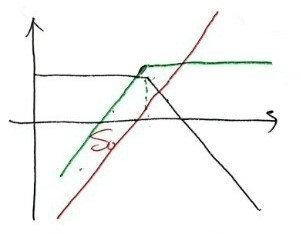
swiftly turning things into the green line. Then the price keeps moving~~~ and boing!! if it drops back below k, you swiftly sell the stock again,
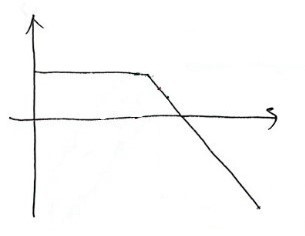
and set it up like this. It looks as if this guy could flatten the profit curve into a horizontal line… probably the most scaredy-cat strategy of them all. lol But those sketches are snapshots of positions, not a record of the cash spent buying and selling along the way. Crossing k is no guarantee of a flat final profit, even before trading costs: jumps and the timing of the trades matter too.
Its biggest drawback: if the stock price goes back and forth and back and forth and back and forth around k, the transaction costs will probably bankrupt you before you ever “protect the 20,000 won.”
OK so what’s delta hedging then?!?!
So then, what’s this delta hedging I mentioned?!?! Not a dumb method — a somewhat clever one?!?
Hmm. It doesn’t need to be that clever. All you need to know is differentiation. These days the entire nation knows differentiation!!!! Its definition is

this!!!!
Ahh, I’d love to ramble on about differentiation for a looong time, but I already rambled about it once: Differentiation Fundamentals for Finite Difference Methods (Financial Engineering Programming #16).
So: x-axis S, y-axis “value.” And the function name… let’s call it $c(s)$. Say $c(s)$ is the current value of a call option, and the current stock price is $S_0$. Then — nice — using the definition above, the rate of change of my call option’s value with respect to a change in S, at the current stock price, can be written like this:

What the formula is saying: from where the stock price is now, $S_0$, when it moves by thiiiiis much, how much does my call option’s present value move? The formula means that ratio.
Phew… this stuff is really hard to say in words. Let me switch to pictures. Differentiation: it’s better to look at this with the “instantaneous rate of change” idea loaded up.
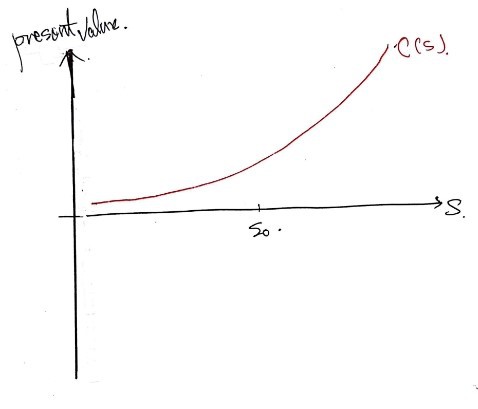
This picture, I mean.
It’s the intrinsic + time value curve of a call option. I took the call option’s value as the example. hehe
So what ratio is the “ratio” the formula above is talking about?
It’s… it’s… it’s… it’s…
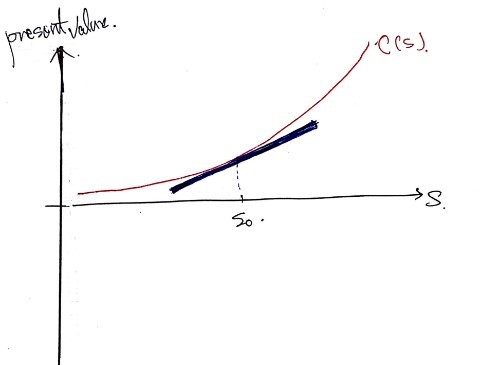
the slope of this line! That’s the ratio.
So if the stock price is sitting at $S_0$ and a move of thiiis much~~~!~!!~~!!!!! happens, the option price changes at the ratio of that slope, right??? But the option value is nonlinear (not a line), so there’s an error. That is,
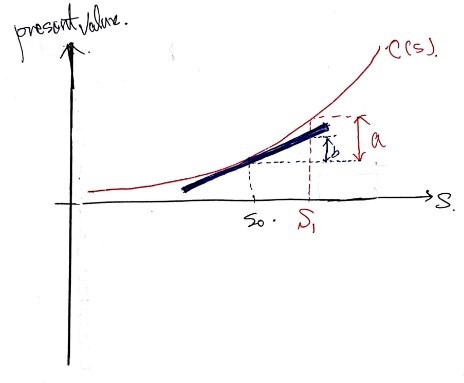
when it zips!!! to $S_1$, the value changes by $a$ — that’s the real change in the option value — but the prediction from the first derivative says “it’ll change by $b$” (pretty close to $a$).
Now suppose you feel like “I don’t want to budge from my value at $S_0$!!!” (just like “protect the 20,000 won”). You want to keep the value $C(S_0)$, and say you know the first-derivative value $C'(S_0)$.
What do you do~~~ Sell as many shares as that slope. Why?
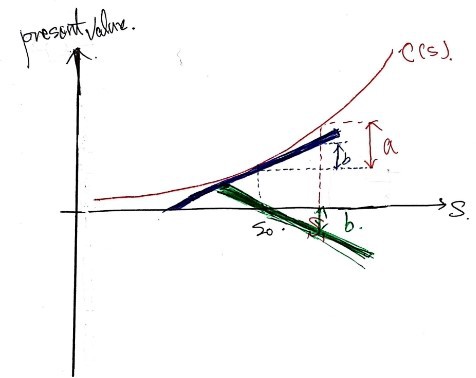
Draw the graph of selling stock at the current price $S_0$, slope-many shares: it’s a line through the x-intercept $S_0$. One share would give a slope of size 1, but since it’s “as many as the slope,” draw the line through $S_0$ with minus that slope, like the picture above, and that’s exactly what you get!!!!
So what does this mean? We have option $c$, and we’ve sold the stock (say we short-sold it). If the stock price suddenly jumps from $S_0$ to $S_1$, the call we hold changes by $b$ (almost the same as $a$), and the stock changes by $-b$.
So the total change in my portfolio’s value is (almost) 0. And of course, when the price falls, by the same logic the portfolio’s value change is (almost) zero too.
When we built a risk-free portfolio with $c$ back in Binomial Option Pricing Model: Basics (Derivatives #15),
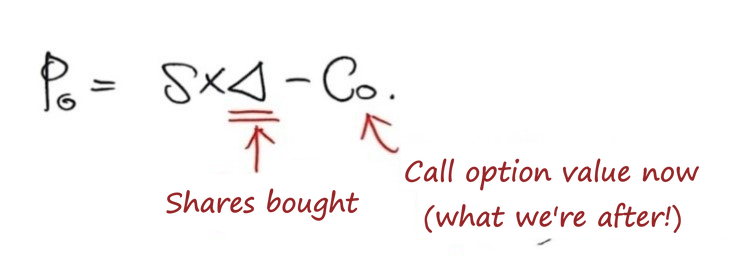
— doing it something like this — we wrote the number of shares to buy for the risk-free portfolio as the Greek letter delta, remember? Δ was the hedge ratio.
Alright alright alright. Let me differentiate both sides with respect to S.
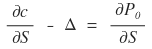
For this local hedge, we want the first-order sensitivity to S to be zero. That’s the condition we’re using here; delta neutral by itself doesn’t mean every risk has vanished!!!!

Now you get why we wrote that number as Δ back then. Ahhhhhhhhhh.
So we call the first-derivative coefficient delta. To delta hedge, take the stock position that cancels the option position’s delta: short delta-many shares against a long call, or buy them against a short call. That’s a hedge against small stock-price moves, with the other inputs held fixed.
That’s what we call delta hedging — and what we went through above was delta hedging.
Now let’s look at it continuously. Holding $c$, say the stock price is  and then changes to
  ,
,  ,
,  ,,,,, and so on. While the price moves like that, the question is how to delta hedge!
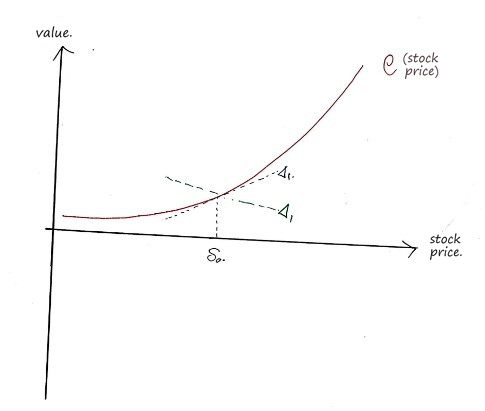
First, when the stock price is  , we’ve sold
  shares of stock. But then, when the price moves to $S_1$,
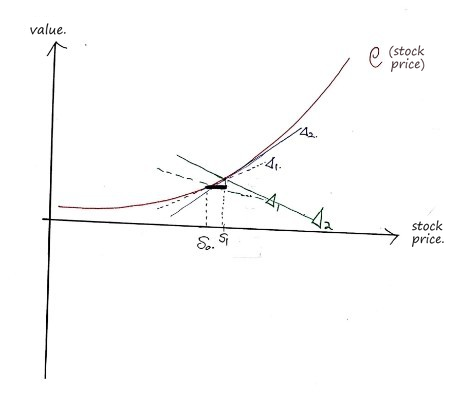
the call’s gain and the stock’s loss nearly cancel, as the thick black line is trying to show. Nearly!!! The slope is cancelled, but for a finite move the curve still leaves a residual, roughly $\tfrac12\Gamma(\Delta S)^2$ when the other inputs stay fixed.
And since the price has moved to $S_1$, I swiftly change the number of shares I’ve sold from  to
to  .
.
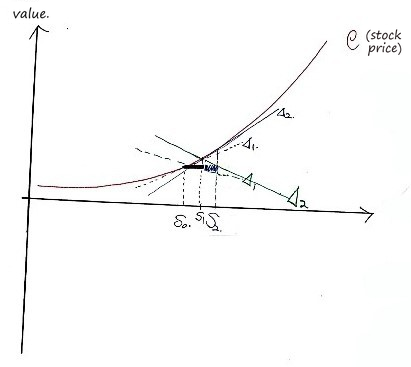
Now the hedge is reset at $S_1$, so another small move is approximately cancelled again. That’s what those extra lines next to the black one are meant to show!!!!! It isn’t a promise for wherever the price goes; time passing, volatility changes and financing still matter.
So we keep computing the option’s delta and adding minus that delta in stock to the portfolio, keeeeping the portfolio’s delta at 0.
That is, delta hedging means making the portfolio’s delta 0. People say it’s delta neutral.
Every asset has a delta. Each has a value you get by first-differentiating with respect to S, so you can say it has a delta.
One share of the stock has delta 1 with respect to its own price. A linear contract also has zero gamma with its terms held fixed. Futures are derivatives too, though — so it isn’t stocks versus all derivatives! Options are the curved ones in these pictures, and their delta changes as the underlying price changes.
What we’re dealing with here is options, so let me actually calculate an option’s delta.
Say the red curve drawn above is “the present value of a European call option.” We can put a number on it with the BS formula. That is,
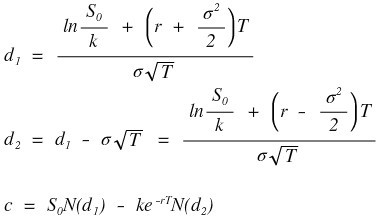
this formula — and what we need is its derivative. Just differentiate it with respect to S. The delta of a call option:
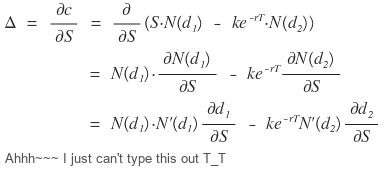
I’m sorry lol T_T The equation editor is going to wreck my personality. lol ugh ugh ugh I’ll upload photos instead.
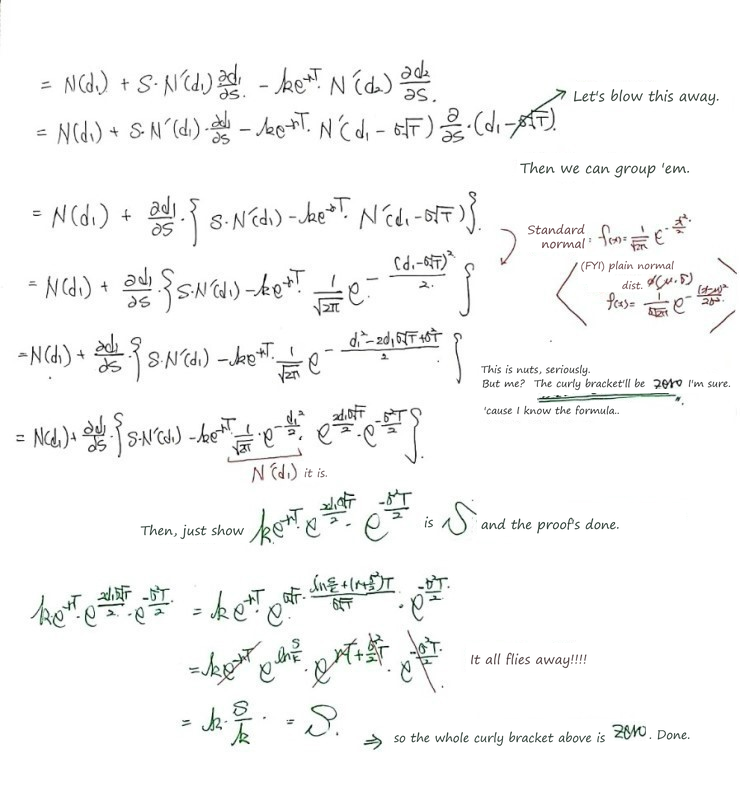
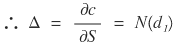
But as we saw in the pictures above, hedging with the first derivative can’t help being imperfect, right? Maybe if the stock price only ever moved in super tiny steps… but that’s not how it goes.
So approximating a curve with a straight line is kind of a stretch, and apparently people sometimes bring in the second-derivative coefficient for hedging too. Just as the first-derivative coefficient of the portfolio value was Δ, you can call the second-derivative coefficient the first derivative of Δ:  .
.
People write this as a capital Γ (gamma), apparently!!!!!
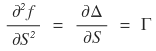
The gamma of a call is

And the gamma of a call and the gamma of a put are the same, you know??? That’s easy to check. hehehe

So just as we made the portfolio’s Δ zero, now we also have to make the portfolio’s Γ neutral. Let’s say we’ve already made it delta neutral by the procedure above, and talk from there.
Suppose that, working it out right now, delta is 0 and gamma is -3000. And suppose a call option with delta 0.65 and gamma 1.5 is being sold on the market.
Its gamma is 1.5, so if we buy 2000 of them to bring Γ to 0, their delta throws off the delta that was neutral: 0.65 × 2000 = 1300 of delta drifts away. So to neutralize that extra 1300 of delta again, sell 1300 shares of the stock.
Ahhh, and since a stock (not a derivative) is linear, its gamma is 0 — people seem to say stocks “have no gamma.” Anyway, that’s how you can neutralize both Δ and Γ. hehe kikikiki
But wait, S isn’t the only thing that moves
But the portfolio’s value doesn’t change only because of S. For options, of the 5 things that set the price — S, k, σ, T, r — everything but k keeps changing, so my portfolio’s value keeps moving too…. OK OK, those have Greeks too.
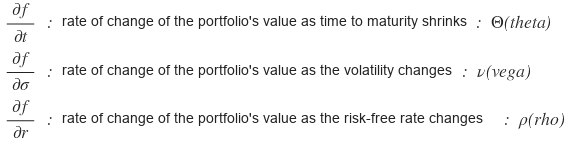
So the Greeks I’ve introduced come to five in total…. Delta, gamma, theta, vega, rho…
And how do we pull out their formulas???
Differentiate the BS formula. lol It’s just maddening… but doable.. heh heh
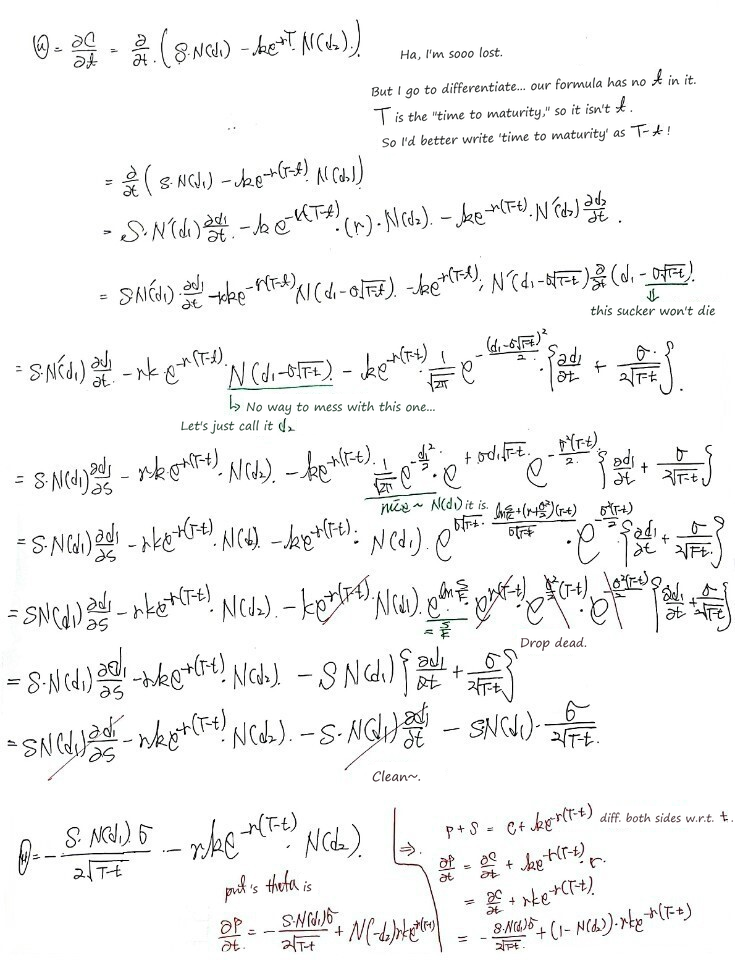
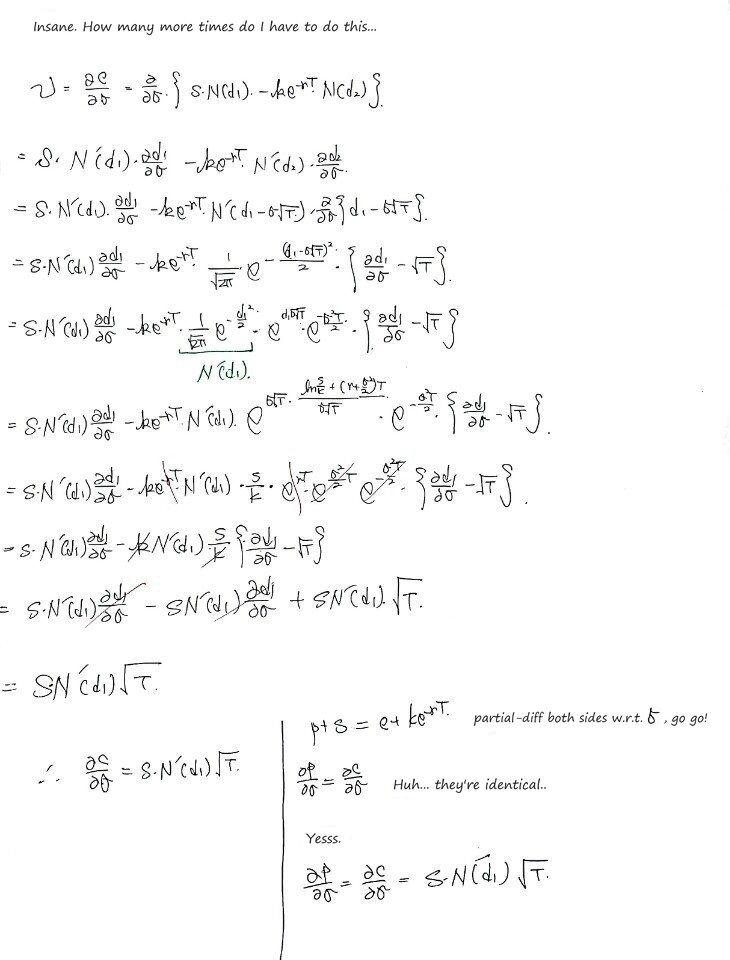
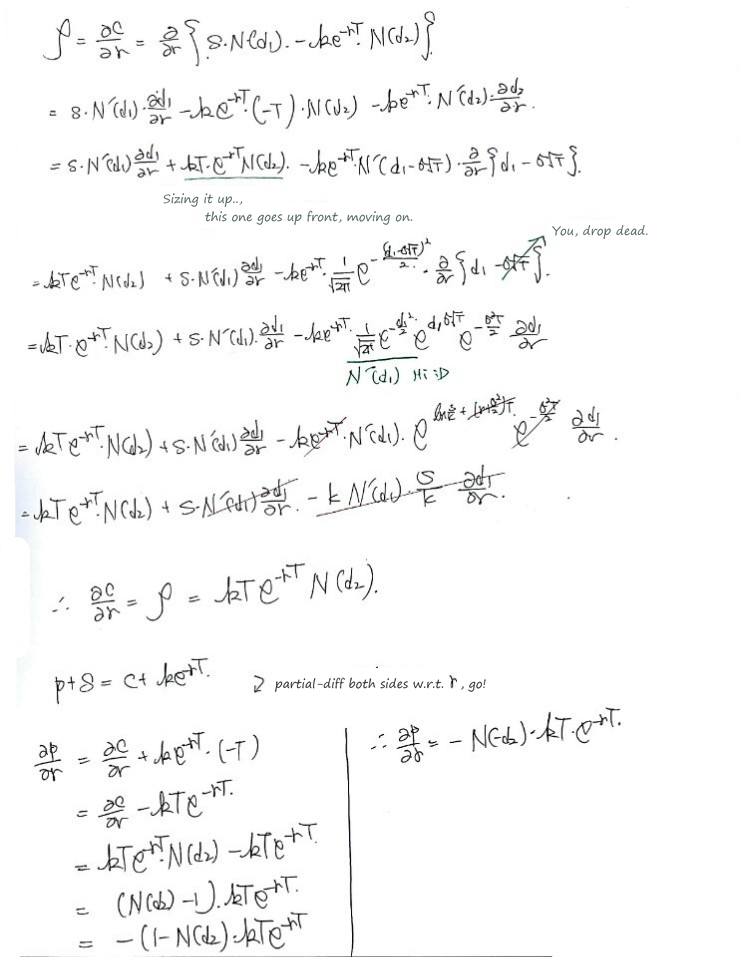
Hohoho — that’s all five Greeks checked. But what I checked assumes “no dividends.”
With a dividend yield, you can’t just replace $S_0$ with $S_0 e^{-qT}$ in these results, like we did in the earlier posts. hehehe You have to take the BS formula with $S_0$ replaced by $S_0 e^{-qT}$, differentiate it again with respect to S, and redo the Greek proofs. lol
Try it yourself ^^ It’s basically the same thing anyway, so it should be doable. Anyway, below I’ll post the formulas written out.
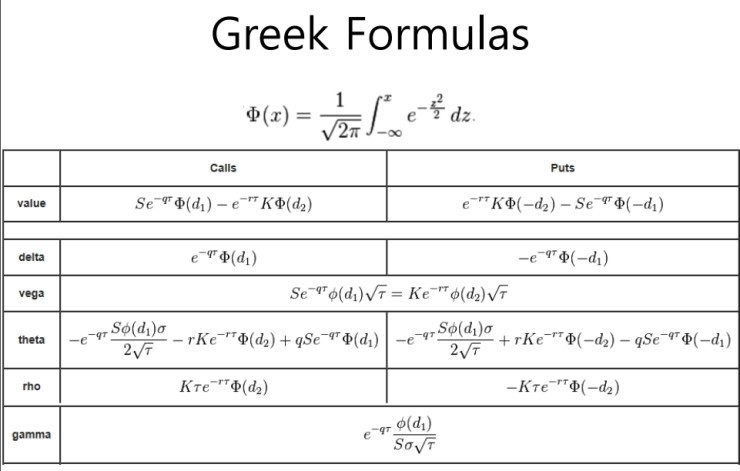
So then — does a portfolio manager have to neutralize all~~~~~ five Greeks???
Probably not. Probably impossible anyway. And even if it were possible, rather than paying that hedging cost, quitting the company might be the better move.
Here is the rough routine I heard about back then — an anecdote, not a rule for every trading desk:
- delta neutral: almost always
- gamma neutral: from time to time
- vega neutral (for changes in the volatility σ): once in a while
- rho (for changes in the risk-free rate r): watch the interest-rate exposure; market rates can move between policy decisions too
- theta neutral: really almost never… once in a blue moon???
Anyway, Δ and Γ are the focus of this introduction. A real desk’s hedge priorities depend on its positions and risk limits.
Rebalancing manages the changing exposure. Daily settlement on futures is a separate cash-flow mechanism; it doesn’t keep an option portfolio delta neutral for you.
The book doesn’t end here — there’s more — but I think reading it once is enough. I don’t feel the need to summarize it.
And with that, I’m wrapping up my derivatives posts. Now I’m going back to my own major. lol This really doesn’t seem like a field I should be dipping my toes into. lol
That was a long haul… I’ll just post some problem solutions and then bye-bye.
Zàijiàn!
Heads-up. The figures here are the original notes, slips and all. A few things to watch for:
- With $P_0 = S\Delta - c_0$, the hedge condition reads $\frac{\partial P_0}{\partial S} = \Delta - \frac{\partial c}{\partial S}$ (the picture flips the sign); setting it to 0 gives $\Delta = \frac{\partial c}{\partial S}$ as before.
- Differentiating $S\,N(d_1)$ needs the product rule: $\frac{\partial c}{\partial S} = N(d_1) + S\,N'(d_1)\frac{\partial d_1}{\partial S} - Ke^{-rT}N'(d_2)\frac{\partial d_2}{\partial S}$, the form the next picture continues with; the middle lines of the first picture write $N(d_1)\cdot\frac{\partial N(d_1)}{\partial S}$ instead.
- The put’s delta is $N(d_1) - 1$, not $1 - N(d_1)$; its gamma, $\frac{N'(d_1)}{S\sigma\sqrt{T}}$, is right.
- In the theta derivation, from the brace note on the factor is the normal density $N'(d_1)$, not $N(d_1)$, and the term that cancels has $\frac{\partial d_1}{\partial t}$, not $\frac{\partial d_1}{\partial S}$. So $\Theta_{call} = -\frac{S\,N'(d_1)\,\sigma}{2\sqrt{T-t}} - rKe^{-r(T-t)}N(d_2)$ and $\Theta_{put} = -\frac{S\,N'(d_1)\,\sigma}{2\sqrt{T-t}} + rKe^{-r(T-t)}\left(1 - N(d_2)\right)$.
Comments
Discussion happens via GitHub Discussions. You'll need a GitHub account to comment.