The Greeks: Practice Problems
Hull's Greek-letter problems by hand: how often a stop-loss writer trades, delta-hedging calls on silver futures, why a delta-hedged straddle loves big moves, the Greeks of a yen call, and portfolio insurance with index puts, risk-free assets or index futures.
Prob 17.9
The Black-Scholes price of an out-of-the-money call with $K=40$ is $4$. The writer wants to use a stop-loss strategy: buy the stock at 40.10 dollars and sell it at 39.90 dollars. How many times is the writer expected to buy or sell?
This stop-loss strategy is… uh… the one I said seemed the least manly of them all in the previous post. Dumb hedge number three.
Anyway, there’s a 0.1-dollar gap around $K$, so every time this guy hedges, he bleeds 0.1. (Try drawing it out, you’ll see.) That loss comes from the 0.1 timing gap, even though we’ve set commissions and other trading costs to zero.
For the exercise’s rough estimate, take the expected hedging cost as the 4-dollar option value and ignore discounting and the final gap around K. This is a cost estimate, not a rule to stop trading when the premium runs out!
So the estimate is $0.1 \times (\text{number of trades}) \approx 4$ dollars: about 40 trades, or about 20 buy-and-sell round trips.
Prob 17.11
What’s the $\Delta$ of a short position in 1000 European calls on silver futures? The options expire in 8 months, the futures in 9 months. The 9-month futures price is 8 dollars an ounce, $K=8$, $r=12\%/\text{yr}$, $\sigma=18\%/\text{yr}$.
First thing to flag: this is NOT a no-dividend setup. It’s a futures!!!
Hmm. So we want the BS formula, used the right way: the dividend version. And here’s the thing: since the underlying is a futures, we stick $r$ into the slot where $q$ usually goes. Because the futures price of an asset with no income is  , remember?
When there are dividends, the call delta is 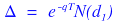 , with
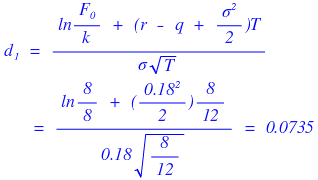
The underlying is “the futures” now, not the stock, so I’ll just plug it in like that, heh. Also, the maturity that goes in here is the option’s maturity, so $8/12$ goes in, naturally!

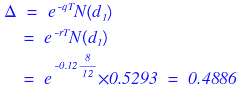
That’s the delta if you bought the call. So times 1000 gives 488.6, and the negative of that is the delta now that the calls are sold: $-488.6$.
Prob 17.12
Same setup as 17.11. To delta-hedge, what initial position do we need:
- in the 9-month silver futures?
- in silver itself?
- in 1-year silver futures?
Why is every sub-question “if” “if” “if” lol.
Anyway, the underlying right now is a futures, so unlike before I’m gonna think with $F$ wherever $S$ used to go. T_T In other words, the delta of the futures is $1$… So to delta-hedge with futures contracts: go long 488.6 contracts of the futures to cancel out the $-488.6$.
But if we want to hedge with spot silver instead, we need the delta of the spot. Our underlying is the futures, so I’ll think about it like this:  , i.e.
  .
.
And since the delta of S is how much S moves when the underlying (the futures) moves, like this?!?

How many of these deltas do we need to make the $+488.6$ that cancels $-488.6$?
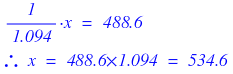
That many. If 1 contract is 1 ounce, then 534.6 ounces of spot silver does it. If a contract is 2 ounces, then $2 \times 534.6$ ounces, obviously.
For the 1-year futures: our current underlying is the 9-month one… hmm… let me write the current underlying as  lol.
lol.
The relationship between the 1-year futures and our underlying would be 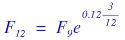 , right????? So the delta of the 1-year futures is
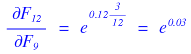
and how many of these deltas we need????
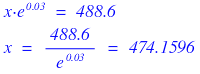
You can just grind it out like that~ These spot and cross-maturity calculations use the exercise’s simple carry model: constant deterministic rates, with storage costs and convenience yield ignored. Contract sizes have to match too.
Prob 17.13
A company uses delta hedging on a portfolio of long positions in currency calls and puts. When does it do best?
- a. The spot rate barely moves
- b. The spot rate moves a lot
They bought calls and puts….. so the option book has positive gamma in this model. It might be a straddle or strangle, but the question doesn’t say enough to give it that name. What matters here is the delta-hedged book, not the payoff of an unhedged bet on a big move!
Let’s start from the Black-Scholes PDE. The pictures use the no-dividend version; for currency options the drift term is $(r-r_f)S\Delta$ instead of $rS\Delta$. Once the whole book is delta neutral, that term drops out either way.

and in Greeks that’s
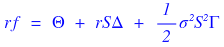
OK, now: they said it’s delta-hedged. So $\Delta = 0$, right????? So the company’s portfolio right now is
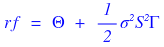
Ah, but let me write it with changes:
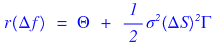
Whoops — we can’t just turn the PDE into that change formula! For a small move, with delta neutral and the other inputs fixed, use $\Delta\Pi \approx \Theta\,\Delta t + \tfrac12\Gamma(\Delta S)^2$. Long calls and puts have positive gamma in this model, right???????
So positive gamma makes the move itself help in either direction, through $(\Delta S)^2$!!!! That favors larger moves in this comparison. It doesn’t guarantee an overall profit: time decay, financing and hedging costs still have to be covered.
Done!
Prob 17.15
A financial institution has sold 1000 seven-month European calls on the Japanese yen. Spot is $0.8$ cents/¥, $K=0.81$ cents/¥, the US risk-free rate is $8\%$, the Japanese risk-free rate is $5\%/\text{yr}$, and the yen’s volatility is $15\%$. Compute and interpret the delta, gamma, vega and theta of the institution’s position.
OK: “domestic” here is the US (exchange rates are quoted per unit of foreign currency, and this one is quoted per yen, right?). And the underlying is the yen. So: $S=0.8$, $K=0.81$, $r=0.08$, $r_f=0.05$, $\sigma=0.15$, $T=7/12$. Just use the formulas with these.
First $d_1$ and $d_2$, let’s go:
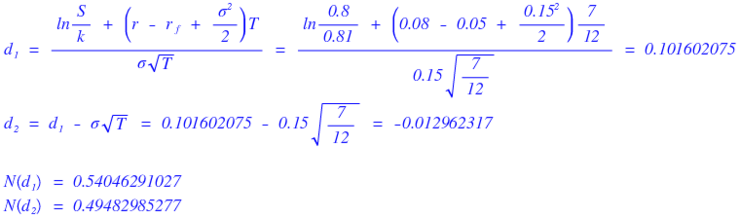
I really was going to type all of this out if I could, but this is just;;; T_T sorry sorry. Photo instead, here we go:
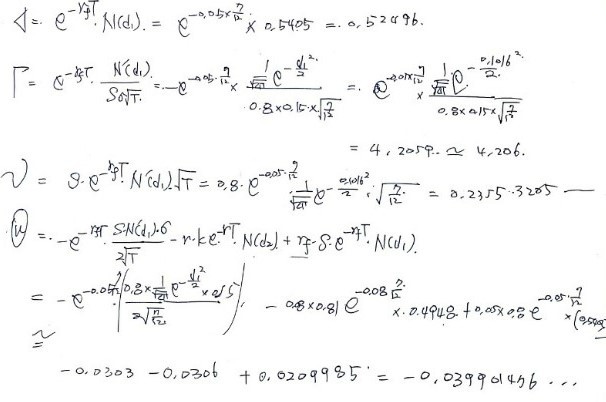
Wait — those are for one long call. We sold 1000, so multiply every Greek by $-1000$! Using cents for option values, years for time, and one yen of underlying per option:
- $\Delta \approx -524.928$: a 0.01-cent/yen rise lowers the book’s value by about 5.249 cents to first order.
- $\Gamma \approx -4205.929$: that same move lowers its delta by about 42.059.
- Vega $\approx -235.532$: a one-percentage-point volatility rise ($\Delta\sigma=0.01$) costs about 2.355 cents.
- Calendar-time theta $\approx +39.8885$ cents/year: one day passing contributes about 0.1093 cents, holding the other inputs fixed.
Tiny numbers because we’re counting one yen per option! If a contract covers more yen, multiply by that notional too.
Prob 17.17
A fund manager runs a well-diversified portfolio worth 360 million dollars that mimics the S&P 500. The S&P 500 is at 1200, and the manager wants to keep the portfolio’s value from dropping more than 5% over the next 6 months with a portfolio insurance strategy. $r=6\%$, portfolio dividend yield $3\%$, S&P 500 dividend yield $3\%$, index volatility $30\%$.
a. If the manager buys European puts, how much does it cost?
Variables first: $T = 6/12 = 1/2$, $q = 0.03$ (the index’s dividend), $\sigma = 0.3$, $r = 0.06$, $S = 1200$, $\beta = 1$ (it mimics the index; diversification alone wouldn’t establish that). That should do, I guess.
Question (a) is asking: when you buy puts to keep the portfolio from falling more than 5%, where on earth do you set the put’s strike price? Since $\beta = 1$ and the index and the portfolio have the same dividend, the portfolio is at $-5\%$ exactly when the index is at $-5\%$: 1140. So we get puts with $K = 1140$.
Let’s crunch the price of a $K=1140$ put:
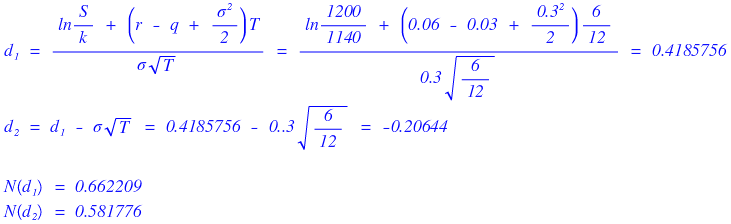
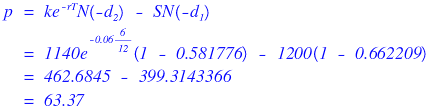
The notes round this to 63.37. Recomputing without the early rounding gives 63.4011 per index unit. How many do we need?

So the unrounded cost is $63.4011 \times 300{,}000 \approx 19.0203$ million dollars. If each listed option covers 100 index units, those 300,000 units mean 3,000 contracts.
b. Describe an alternative strategy with European calls and show that it gives the same result as (a).
They want calls that produce the same insured terminal value. For each index unit, a call plus risk-free cash paying K at expiry gives $\max(S_T,K)$, just like the index plus a put. We can do it!!! With dividends, keep the cash flows straight: $c+Ke^{-rT}=p+S_0e^{-qT}$. The right side uses a prepaid claim on the terminal index, not a current share with its interim dividends thrown away. To match the whole dividend-paying portfolio as well, account separately for those dividends.
(Honestly I don’t get why something this easy is part (b).. did I solve it wrong T_T?)
c. Insurance by keeping part of the portfolio in risk-free assets instead of options: what’s the initial position?
Ah, this is something the earlier posts didn’t cover. Let me go through it lightly here, so we come away with “ohh~ there’s this kind of insurance too~”.
First, be careful with units: raw portfolio delta is the sum of the number of units held times each unit’s delta, $\Delta_{\mathrm{book}}=\sum_i n_i\Delta_i$. A money-weighted average works only after converting to a consistent normalized sensitivity. The picture below is that normalized intuition, not a general formula for raw delta. Here I normalize the original risky portfolio’s own price sensitivity to 1. The sketch writes 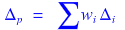 .
.
Now, the portfolio has risky assets and risk-free assets, and I’m gonna split it cleanly into exactly those two buckets: risky and risk-free. The cash or risk-free bond has $\Delta = 0$ with respect to the risky portfolio’s price, holding rates fixed, right?????????????
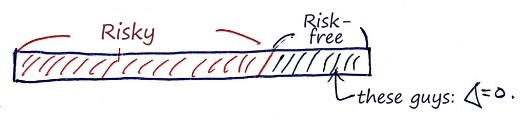
Now, with the portfolio set up like this, suppose we suddenly move 1% of the risky assets over to risk-free:
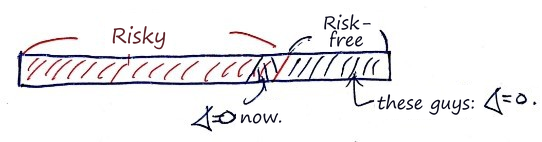
The red part turned a little bit blue!!! The original portfolio’s $\Delta$ was the weighted sum of the deltas of those red risky assets. If you move 1% of the red over to risk-free??? $1/100$ of the original delta walks out……
Whoa!! We can create a negative change in $\Delta$ relative to the fully risky starting portfolio!!!! The remaining stock-and-cash portfolio still has positive delta.
So if you move $k\%$ to risk-free, you generate a delta of $-k/100$, and if you move $33.2761947\%$ to risk-free assets, you can make a delta of $-0.332761947$!!! Whoa~
But why make a delta of $-0.332761947$, you ask???
OK OK OK OK OK OK. In (a), the point was to use index options to make up the loss when the portfolio takes a hit, right? But really, what this manager actually wants is not a stand-in index option. It’s a put option with the portfolio itself as the underlying, right?
So: the portfolio’s current value is $360{,}000{,}000$, and the strike (the value you want insured) is $342{,}000{,}000$ (that’s $-5\%$ from 360 million). A put like that is
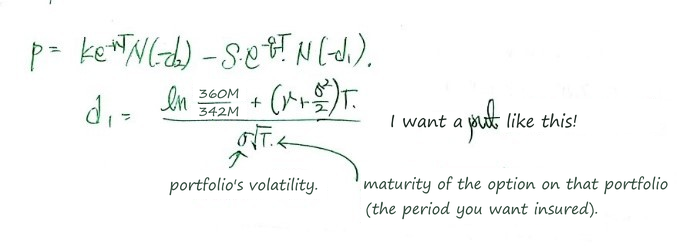
That’s the option the manager would really like to have. But… an option like that doesn’t exist..T_T
(The option I dreamed up here is the same as the option we found in (a)…. That’s because $\beta = 1$. In a bit we’ll do a $\beta \neq 1$ case too, and for the logic to match there, I figured I should put it this way here as well… so that’s how I talked it through T_T)
But!!!! We can get something with a similar effect… We generate, inside the portfolio itself, as much $\Delta$ as the imaginary option we’d like to have… The way to do it is the trick from before.
So how much do we need to generate???
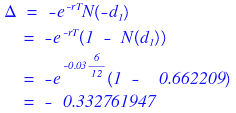
That’s why I said what I said up there…. heh heh With full-precision inputs the initial fraction moved to cash is about 33.2735%. This is a dynamic insurance strategy: the fraction must be rebalanced as prices and time change. One initial allocation doesn’t guarantee the floor through jumps or trading costs.
d. With 9-month index futures, what’s the initial position?
Time to refresh the brain, because the underlying is the index again now. Same line of thinking, though. The 9-month index futures is a derivative too, so it’ll have a $\Delta$, right?

The futures price is tied to spot like this, so

there’s its delta per index unit. The correct carry exponent is $(r-q)T$; it equals $0.03T$ here by coincidence. Selling one index unit of the futures generates $-1.022755$. And how much delta should we generate with them?! As much as the options generated in (a)!!!! That is, $-0.332761947 \times 300{,}000 = -99{,}828.5841$.
The number $X$ of $F_9$ that makes that much:
$$-1.022755 \times X = -99{,}828.5841$$$$X = 97{,}607.52487$$
So instead of 300,000 put options, we use 97,607 nine-month futures???
No no no no no. One futures contract is on the index $\times 250$, so we have to cancel out that weight of 250:
$$97{,}607.52487 / 250 = 390.4300995 \approx \mathbf{390 \text{ contracts}}$$Prob 17.18
The portfolio’s beta is 1.5 and its dividend yield is 4% per year. Solve the problem above again!!!
As told: what’s different from the problem above is $\beta = 1.5$, and the portfolio’s dividend yield is now $4\%/\text{yr}$. So: $T = 1/2$, $q = 0.03$, $\sigma = 0.3$, $r = 0.06$, $S = 1200$, $\beta = 1.5$. Lay that out and we’re good to go.
a.
In (a) we need to find the put’s strike price, you know? With $\beta = 1.5$, expect a very different answer than before. Let’s start.
I’m gonna compute the expected return CAPM (Capital Asset Pricing Model) predicts for the $\beta=1.5$ portfolio when the index changes by $x\%$.
- Take the index change $x$, and add 6 months of the index’s $3\%$ dividend, i.e. $1.5\%$: $\;x + 1.5$
- Subtract 6 months of the risk-free rate: $\;x + 1.5 - 3 = x - 1.5$
- Multiply that by $\beta$: $\;1.5(x - 1.5)$
- Add back 6 months of the risk-free rate and subtract 6 months of the portfolio’s dividend: $\;1.5(x - 1.5) + 3 - 2$, i.e. $1.5(x - 1.5) + 1$
That’s the linear beta-model approximation to the portfolio’s price return. We’re assuming it tracks that relation without residual risk and using simple half-year rate approximations; CAPM alone doesn’t promise a realized return. Within that exercise model, what $x$ gives a portfolio change of $-5\%$?
$$1.5(x - 1.5) + 3 - 2 = -5$$$$x = -2.5$$
There we go!!!!
So in that beta approximation, a $5\%$ portfolio fall corresponds to about a $2.5\%$ index fall!!!!!
$$1200 - 1200 \times 0.025 = 1170$$If we want to insure with index options, we use index puts with $K = 1170$!!! Now let’s price the $K=1170$ option:
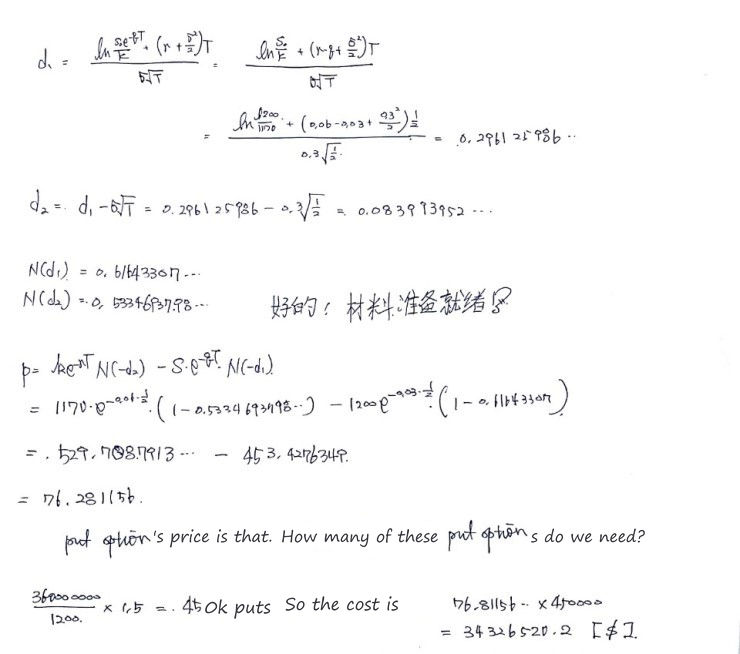
Suddenly a wave of ugh-so-annoying hits…. sooo annoying…. waaah..T_T I’ll type it up later..T_T
c.
The most ideal method was a put option with my portfolio itself as the underlying, and we said that if we tweak my portfolio on purpose so it gets a similar effect, that could be the answer. So let’s find the delta of that option that only exists in our imagination.
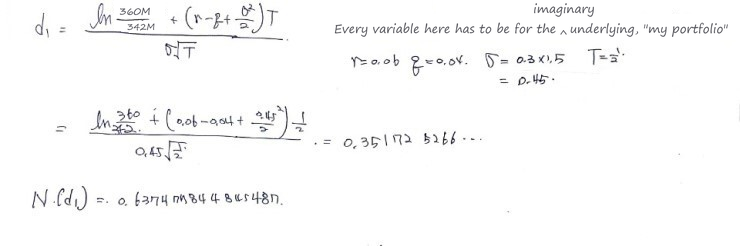
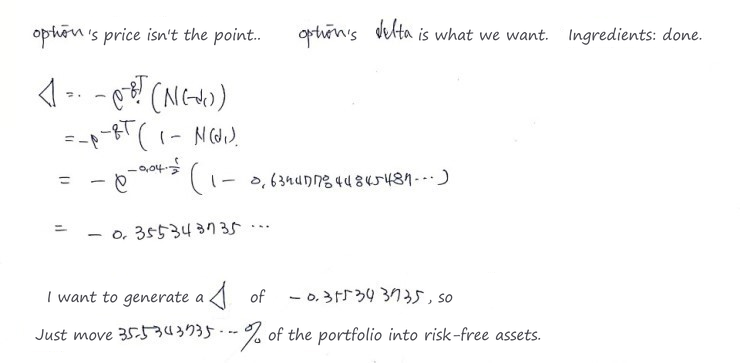
A short comment..? The index put in (a) has delta $-0.377856367$. The separate put on the portfolio has delta $-0.355343735$ with respect to its own underlying. That 45% portfolio volatility assumes perfect index tracking with beta 1.5 and no residual risk; beta alone doesn’t tell us the volatility.
So which magnitude do we match — $0.377856367$ or $0.355343735$?
→ To make the delta of the assets in the portfolio equal to 1, I moved every point of view onto my portfolio. If you anchor at the index, “delta” really means the value for changes in the index, right?
In 17.17, with exact index tracking and the same yield, the two constructions line up after scaling. Here they are different models of the insurance, not just a change of units! Matching the index puts in (a) means moving about 37.79% to cash; the separate portfolio-put model in the sheet gives 35.53%. I wandered into that second model…T_T
d. Initial futures hedge
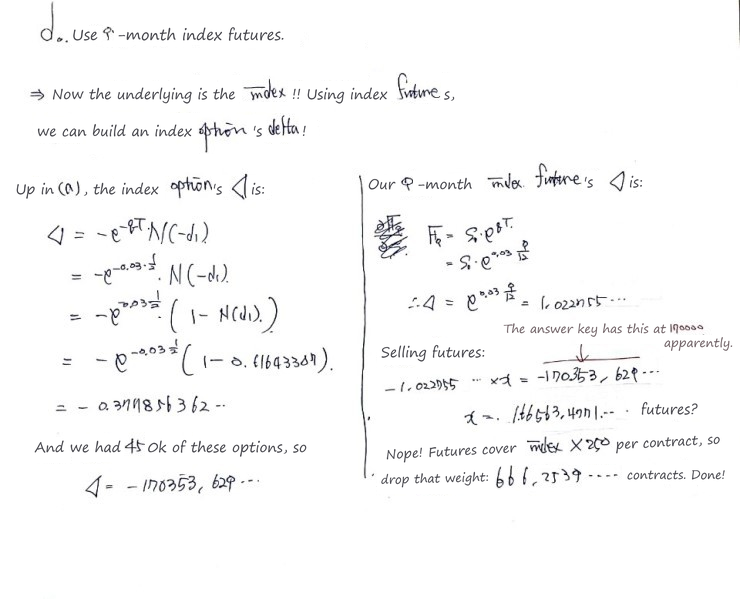
Using the index puts from (a), sell $450{,}000\times0.377856367/(250e^{0.03\times9/12})\approx665.01$, or about 665 nine-month futures contracts. The picture’s 666 comes from a multiplication slip.
Prob 17.22
One last handwritten problem! Initially short 30,000 euros to cancel the option book’s delta. A rise from 0.90 to 0.93 changes the option-book delta by about $-80{,}000\times0.03=-2400$, to 27,600. Against the existing short 30,000, the combined delta is now $-2400$, so buy back 2,400 euros.
The price-move component of the initially delta-neutral book’s P&L is about $\tfrac12(-80{,}000)(0.03)^2=-36$ dollars. Short elapsed time doesn’t make theta zero: that’s a price-only approximation, leaving time decay and financing aside.
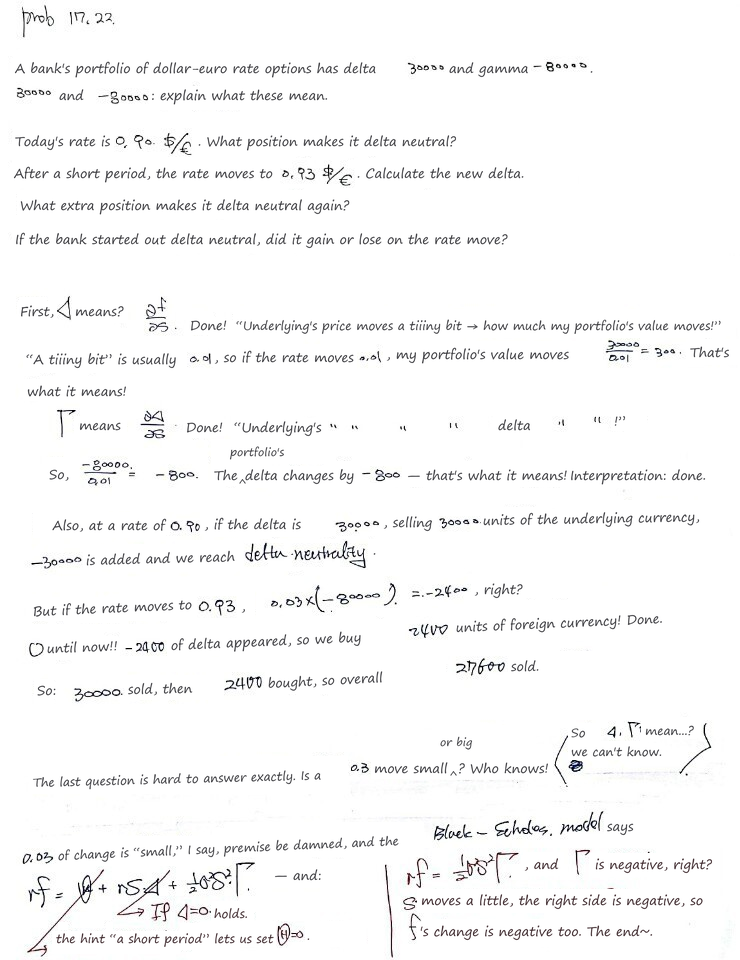
Heads-up. The figures here are the original notes, slips and all. A few things to watch for:
- In Prob 17.13, a delta-neutral position changes by $\Delta\Pi \approx \Theta\,\Delta t + \frac{1}{2}\Gamma(\Delta S)^2$; the relation in the picture, $r(\Delta f) = \Theta + \frac{1}{2}\sigma^2(\Delta S)^2\Gamma$, is not a valid one. Positive gamma gives a positive local price-move contribution in that expansion. The currency-option PDE has (r-r_f)S Delta; the pictures use the non-dividend version. Positive gamma gives a positive local price-move contribution, not a guaranteed overall profit after time decay, financing and costs.
- In Prob 17.17, $d_2 = +0.20644$ (written with a minus sign), and $N(d_1)$ is taken at $d_1$ rounded down to 0.4185; with $d_1 = 0.4185756$, $N(d_1) = 0.662237$, so the put is worth 63.40 (the textbook’s answer), the insurance about 19.02 million dollars, the put delta $-0.33273$, 99,820 index units and 97,599 index units in futures, which is still 390 contracts. The formulas carry the dividend yield: $p = Ke^{-rT}N(-d_2) - Se^{-qT}N(-d_1)$ (the number already includes $e^{-qT}$), $d_1$ has $(r - q + \frac{\sigma^2}{2})T$, the put’s delta is $-e^{-qT}N(-d_1)$, and the futures price is $F = S_0e^{(r - q)T}$ (0.03 is right because $r - q = 0.03$). The raw portfolio delta is the sum of quantity times per-unit delta; the value-weighted formula in the picture needs a consistently normalized sensitivity. The risk-free part has zero delta with respect to the risky price when rates are held fixed.
- In Prob 17.18, two numbers are miscopied (76.281156 per put, as the product 34,326,520.2 shows, and 529.7087913 for the first term), and in (d), $0.377856362 \times 450{,}000 = 170{,}035.363$, not 170,353.629, which gives 665 futures contracts, not 666. In (c), the sheet replicates a put on the portfolio itself (with its volatility of 45%) and gets 35.53%; the textbook’s answer replicates the index puts of (a), which comes to 37.79% of the portfolio. The beta-based strike mapping assumes a linear realized tracking relation without residual risk; CAPM does not guarantee that relation. Likewise sigma_portfolio=beta*sigma_index assumes no residual risk. The two put models in (c) are different insurance constructions, not identical options in changed units.
- In Prob 17.22, the changes are $30{,}000 \times 0.01 = 300$ and $-80{,}000 \times 0.01 = -800$ (written as quotients), the rate moves by 0.03, not 0.3, and the delta-neutral position changes by about $\frac{1}{2}\Gamma(\Delta S)^2 = \frac{1}{2}(-80{,}000)(0.03)^2 = -36$, a loss, as the sheet concludes. A short elapsed period does not make theta zero. The -36 dollars is the approximate price-move component, neglecting time decay and financing, not an unconditional total-profit statement.
Comments
Discussion happens via GitHub Discussions. You'll need a GitHub account to comment.