Electrostatics: Coulomb's Law and the Electric Field
An introduction to electrostatic equilibrium, Coulomb's law, vector superposition, and the electric field of fixed point charges in vacuum.
Editorial note (2026): This English edition preserves the personal stories in these 2014 study notes, while clarifying the physical assumptions and correcting the derivation identified below.
Hello! I’m starting an electromagnetism series too. Writing these posts has at least got me into the habit of studying every day.
I draft everything on A4 paper before posting it, and I’ve already put together about 50–60 pages. When am I going to get all of that onto the blog? Haha. Anyway, let’s begin.
What does “static” mean?
We’ll start electromagnetism with electrostatics. Back in middle school and high school, the phrase “static electricity” mostly made me think of rubbing a plastic writing board against my clothes and holding it near my head to make my hair stand up. Or grabbing a doorknob and going, “Aaargh!”
That left me wondering what static electricity actually meant. Those familiar examples involve charge building up; the doorknob shock is the brief discharge that follows.
For this lesson, picture charges held in fixed positions, or a macroscopic charge distribution that has settled into a state that stays constant in time. That is the electrostatic setting. Taking a photograph of moving charges at an arbitrary instant does not, by itself, make their electromagnetic behavior electrostatic.
Suppose we add some excess charge to a solid conducting sphere—a metal ball. Charges can move through the conductor, and the added charge redistributes. While that redistribution is happening, we have not yet reached electrostatic equilibrium. Once equilibrium is established, the excess net charge is on the surface and the electric field inside the conducting material is zero in the ideal electrostatic model. The material still contains charged particles; their microscopic motion has not magically stopped.
It’s that settled state we want to study here. Or, if you prefer my more ridiculous picture, imagine a tremendously strong Superman holding point charges perfectly still. Treat that as an idealization!
The time-dependent side of electromagnetism comes later. We touched on it near the end of Electromagnetism II, and I found it very hard—even though I suspect we were only scratching the surface.
Coulomb’s law comes from observing nature
Start with a fixed point charge $q$ in vacuum. What force does it exert on a test charge $Q$ at a positive distance $\eta$ from it?
A quick note about that symbol: in my original notes I wanted to use a cursive $r$ for the relative separation. I couldn’t find a convenient way to type it on the blog, so I used the similar-looking Greek letter $\eta$, eta. I’ll keep that notation here, but spell out its meaning carefully.
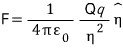
Here, the source image’s $F$ represents a vector force. The distance $\eta$ is a positive scalar, and the hatted eta is the unit vector pointing from the source charge toward the test charge. Both $q$ and $Q$ are signed charges: like signs give repulsion, and opposite signs give attraction.
Why this particular force law? My joking answer was, “I don’t know—call God and ask!” But the point behind the joke matters.
I remember a professor telling us to be clear about what comes first in science. Nature does something; people observe it, ask how it works, and develop an explanation. Coulomb’s law describes an experimentally established behavior. It is not a formula we get to impose on nature just because it looks nice.
The superposition principle deserves the same respect. For fixed source positions, we add the electric-field vectors produced by the individual source charges at the same observation point. The field is linear in those source charges: doubling every source charge doubles the field. This is a physical property, even if addition feels obvious. The inverse-square dependence on distance is fully compatible with that linearity in charge.
The small symbol in the denominator is epsilon-zero:

It denotes the permittivity of vacuum, $\epsilon_0$. Imagine comparing electric forces in vacuum, air, and water. The surrounding material can affect the result through its response to the charges, but $\epsilon_0$ itself remains the vacuum constant. A material’s permittivity describes a different part of the model; polarization and boundaries also matter. We’ll use the vacuum law here.
In high school, we often bundled $1/(4\pi\epsilon_0)$ into a constant called $k$. I’m going to leave it written out this time. Apparently I’ve graduated to carrying the whole fraction around!
Adding the forces from many charges
What happens when there is more than one source charge? Suppose there are $n$ fixed point charges, with signed charges $q_1, q_2, \ldots, q_n$.
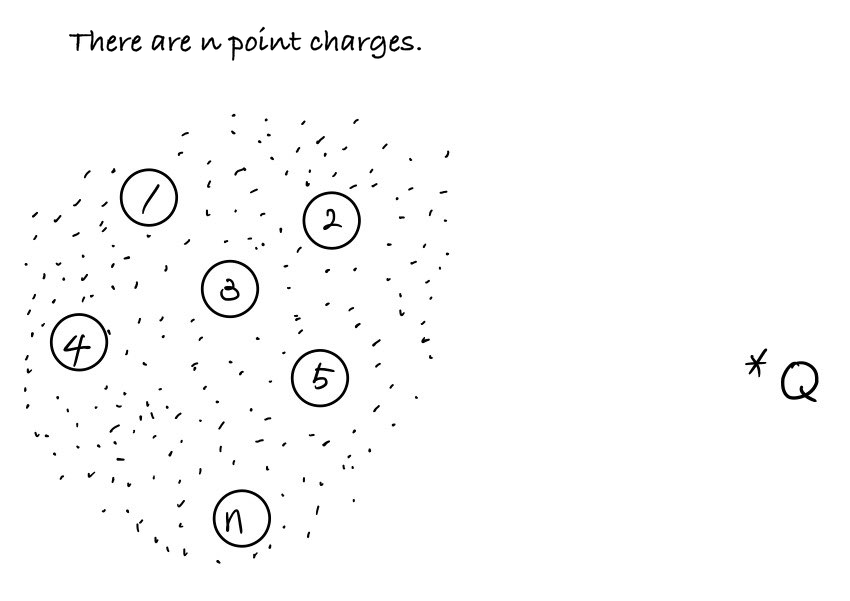
The test charge $Q$ experiences a contribution from every source charge. We add those force vectors to obtain the total force.
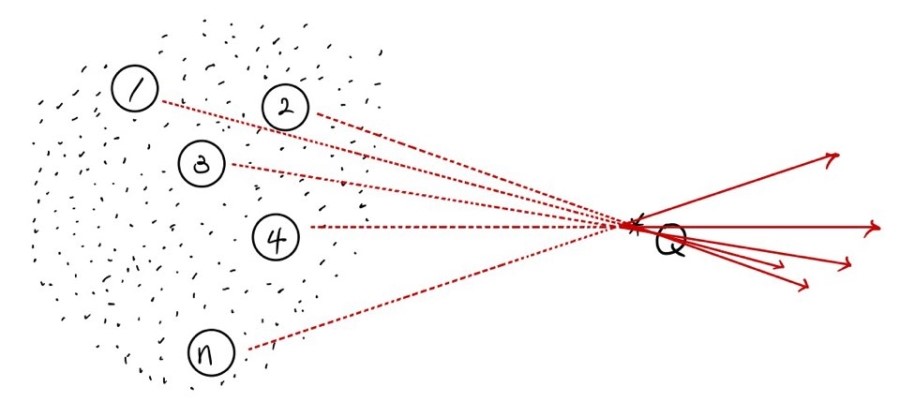
This sketch illustrates repulsion when the source charges have the same sign as $Q$. An opposite-sign source reverses its corresponding force. The dashed connectors indicate geometry; they are not electric field lines, and the drawing does not specify a scale for the force magnitudes or identify a separate resultant arrow.
Editorial correction (2026): The derivation in the original Korean post omitted the squares on the separation distances and retained extra Coulomb constants after factoring. The equations below correct those slips and make the vector notation explicit. The original formula image is preserved with the source material.
Let $\mathbf r_i$ be the position of source charge $q_i$, and let $\mathbf r$ be the observation point where we place $Q$. The observation point must be distinct from every source position. Define the displacement from source $i$ to that point:
$$ \boldsymbol{\eta}_i=\mathbf r-\mathbf r_i $$Its positive length is the separation distance:
$$ \eta_i=\left\lVert\boldsymbol{\eta}_i\right\rVert>0 $$The corresponding unit direction is:
$$ \hat{\boldsymbol{\eta}}_i=\frac{\boldsymbol{\eta}_i}{\eta_i} $$The total electrostatic force is the sum of the individual contributions:
$$ \mathbf F(\mathbf r)=\sum_{i=1}^{n}\mathbf F_i(\mathbf r) $$Each contribution follows Coulomb’s law:
$$ \mathbf F_i(\mathbf r)=\frac{1}{4\pi\epsilon_0}\frac{Qq_i}{\eta_i^2}\hat{\boldsymbol{\eta}}_i $$Factor out $Q/(4\pi\epsilon_0)$. Every source contribution remains in the sum:
$$ \mathbf F(\mathbf r)=\frac{Q}{4\pi\epsilon_0}\sum_{i=1}^{n}\frac{q_i}{\eta_i^2}\hat{\boldsymbol{\eta}}_i $$The electric field inside the brackets
Why did I put that last part in red brackets in the original derivation? Because I wanted to introduce the electric field, $\mathbf E$!
The field produced by the prescribed source charges is:
$$ \mathbf E(\mathbf r)=\textcolor{red}{\left[\frac{1}{4\pi\epsilon_0}\sum_{i=1}^{n}\frac{q_i}{\eta_i^2}\hat{\boldsymbol{\eta}}_i\right]} $$The red expression is the source field, explicitly labeled $\mathbf E(\mathbf r)$. It contains the source charges and their positions, but no test charge $Q$. Multiplying it by the signed test charge gives the force:
$$ \mathbf F(\mathbf r)=Q\,\mathbf E(\mathbf r) $$An electric field assigns a vector to each observation point. It tells us the force per unit positive test charge there. We can calculate this source field without placing a probe at the point. If we do use a physical probe, its charge must be small enough not to redistribute the sources. The field defined above excludes the probe’s own field.
I still find it helpful to say, loosely, “the influence charges create on other charges.” But the precise object is that vector at each point, not just a region of space.
Gravity was the comparison that came to mind when I first wrote this. I’d read a description of gravity in terms of curved spacetime, and pictured a bowling ball sitting on a Simmons mattress. Nearby ping-pong balls or golf balls would roll toward it. The bowling ball was my Sun, and the ping-pong ball was my Earth.
That is only an intuition-building picture. The mattress already relies on gravity to make the smaller balls roll; it does not explain gravity itself, and it is not a mechanism for an electric field. For the field idea, the simpler comparison is useful: a gravitational field tells us the gravitational force per unit mass, while an electric field tells us the electric force per unit positive charge.
I’m not sure my description captures the intuition very well. If you have a clearer way to picture it, please leave a comment!
I’ve wandered quite a bit in this first post, so I’ll stop with Coulomb’s law and this first look at the electric field. Next time I’ll get further into the subject. Better start writing that one right away.
Comments
Discussion happens via GitHub Discussions. You'll need a GitHub account to comment.