Laplace's Equation: Harmonic Potentials and Boundary Values
Learn how Laplace's equation describes charge-free electrostatic potentials, from one-dimensional solutions to mean values, boundary conditions, and uniqueness.
We have reached a useful turning point in electrostatics: finding the potential from the conditions around a region. Laplace’s equation describes what happens inside a region containing no charge, even when charges elsewhere create a field there.
The notation can look intimidating at first. Let’s build it from familiar equations, then start with the one-dimensional case before moving to circles, spheres, and boundary values.

From a charge distribution to the potential
For a continuous charge distribution, Coulomb’s sum becomes an integral. Keep the observation point $\mathbf r$ distinct from the source point $\mathbf r'$. The displacement from source to observer is $\mathbf s$, its length is $s$, and its unit vector is $\hat{\mathbf s}$:
$$ \mathbf s=\mathbf r-\mathbf r',\qquad s=|\mathbf s|. $$$$ \hat{\mathbf s}=\frac{\mathbf s}{s},\qquad k=\frac{1}{4\pi\epsilon_0}. $$Here $\epsilon_0$ is the vacuum permittivity. In free space, a localized charge distribution with convergent integrals gives the vector electric field
$$ \mathbf E(\mathbf r)=k\int_{\mathbb R^3}\rho(\mathbf r')\frac{\mathbf s}{s^3}\,d^3r'. $$With the reference potential chosen to approach zero at infinity, the scalar potential is
$$ V(\mathbf r)=k\int_{\mathbb R^3}\frac{\rho(\mathbf r')}{s}\,d^3r'. $$The field and potential have different kernels. Both integrals run over source coordinates while the observation point stays fixed. MIT’s treatment of charge distributions develops this distinction.
These free-space expressions require the complete charge distribution, including any induced charges. When conductor potentials are given but their surface charges are unknown, a boundary-value formulation can be more useful. Solving its differential equation may still be difficult; boundary conditions remain essential.
Poisson’s equation and the charge-free case
In electrostatics in vacuum, the potential relation and Gauss’s law are
$$ \mathbf E=-\nabla V, $$$$ \nabla\cdot\mathbf E=\frac{\rho}{\epsilon_0}. $$The minus sign makes the field point toward decreasing potential. Electrostatic work between fixed endpoints is path-independent, and potential difference is minus the field’s line integral. The local condition is $\nabla\times\mathbf E=0$; deriving a global scalar potential from that condition alone also requires suitable topology, such as a simply connected region.
Substitute the negative gradient into Gauss’s law:
$$ \nabla\cdot(-\nabla V)=-\nabla^2V=\frac{\rho}{\epsilon_0}. $$Equivalently, Poisson’s equation is
$$ \nabla^2V=-\frac{\rho}{\epsilon_0}. $$These signs agree with the University of Texas derivation. In an open region where the charge density vanishes, the right-hand side is zero. The original equation below correctly retains a minus sign on the left:
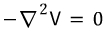
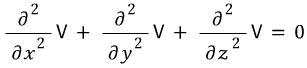
Multiplying by minus one gives the usual form, $\nabla^2V=0$: Laplace’s equation. A twice continuously differentiable function satisfying it is called harmonic. This description applies inside the charge-free region, excluding charge singularities and charged surfaces. It does not require the potential or field to vanish.

In Cartesian coordinates, the three-dimensional equation is
One dimension: a constant slope
Suppose the potential depends only on one Cartesian coordinate $x$ throughout a charge-free interval. The equation reduces to
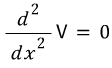
Integrating twice gives
$$ V(x)=Ax+B. $$The slope $A$ is constant: equal changes in position produce equal changes in potential. This is a Cartesian reduction; a potential depending only on spherical radius obeys a different radial equation.
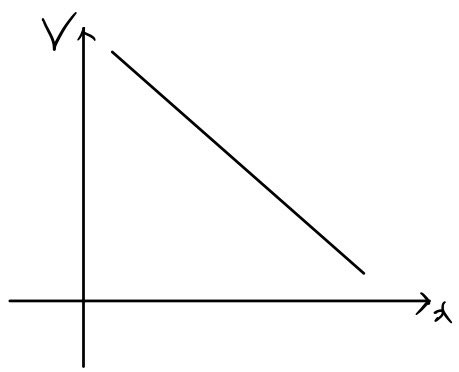
The sketch shows one possible negative slope. Positive and zero slopes are allowed too. The vanishing second derivative says that the first derivative is constant. It is not a statement about jerk, which is a third time derivative; spatial derivatives of potential are not mechanical acceleration.
For example, prescribe $V(0)=V_0$ and $V(L)=V_L$, with $L>0$. These two boundary values determine the solution on the interval:
$$ V(x)=V_0+\frac{V_L-V_0}{L}x. $$If the boundary values are equal, the potential is constant. For any positive offset $h$ such that the whole interval from $x-h$ to $x+h$ stays in the charge-free region, direct substitution also gives
$$ V(x)=\frac{V(x-h)+V(x+h)}{2}. $$Thus the value at the midpoint equals the average of the two endpoint values. Higher dimensions have a related averaging rule.
Two dimensions: a harmonic surface can bend
When the potential depends on two Cartesian coordinates, Laplace’s equation becomes
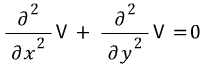
Think of the graph as a surface whose height represents the potential. Its two second derivatives must sum to zero, but each can be nonzero. For a simple mathematical example, take
$$ V(x,y)=x^2-y^2. $$Then
$$ V_{xx}=2,\qquad V_{yy}=-2,\qquad V_{xx}+V_{yy}=0. $$The graph is a curved saddle. Its opposite bending in the two coordinate directions balances in the Laplacian; harmonic does not mean flat.
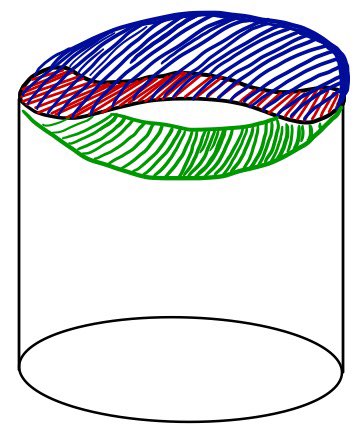
The sketch offers a qualitative way to imagine a fixed boundary and different surfaces spanning it. An ideal membrane with uniform tension, small slopes, and no transverse load satisfies Laplace’s equation in the linear approximation. General minimal-area surfaces instead satisfy a nonlinear equation. The drawing alone cannot establish that its red surface is exactly harmonic or minimizes area. See the UBC membrane model and Cornell’s minimal-surface equation.
For a precise averaging rule, choose a circle of radius $R>0$ centered at $(x_0,y_0)$ whose entire closed disk lies inside the harmonic region. Parameterize its circumference by
$$ \begin{aligned} x'(\theta)&=x_0+R\cos\theta,\\ y'(\theta)&=y_0+R\sin\theta. \end{aligned} $$Writing its potential as $g(\theta)=V(x'(\theta),y'(\theta))$, the mean-value property is
$$ V(x_0,y_0)=\frac{1}{2\pi}\int_0^{2\pi}g(\theta)\,d\theta. $$This is a uniform average around the circle, not an unweighted average of arbitrarily spaced sample points. Stanford’s mean-value theorem supplies the full harmonic-domain condition.
Three dimensions: the average over a sphere
The same idea extends to each sphere whose entire closed ball lies inside the charge-free region. In the diagram, the red dot marks the center; the black dots indicate places where the surface potential is sampled. They do not represent charges on the sphere.
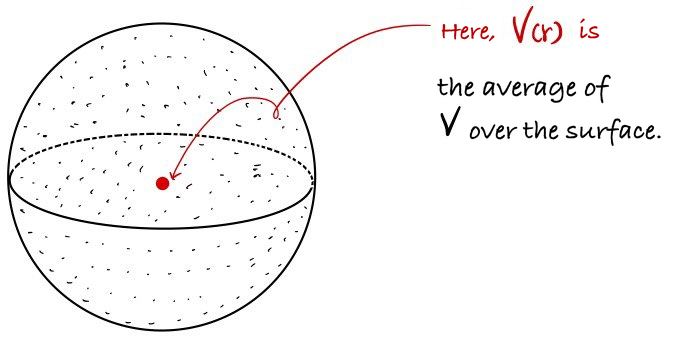
Let $\mathbf r_0$ denote the center, $R>0$ the radius, and $S_R(\mathbf r_0)$ the spherical surface. Then
$$ V(\mathbf r_0)=\frac{1}{4\pi R^2}\int_{S_R(\mathbf r_0)}V(\mathbf r')\,dA'. $$Here $dA'$ is a scalar area element. The denominator is the sphere’s area, so this is an average of potential, not electric flux. The source’s compact equation uses the same correct normalization:
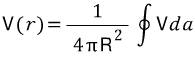
The potential can vary around the sphere; spherical symmetry is unnecessary. Each admissible radius gives the same central value. UCSB’s mean-value discussion gives the three-dimensional result.
Maximum and minimum values
Suppose the domain is bounded and connected, and the potential is harmonic inside and continuous on its closure. Its maximum and minimum values are attained on the boundary. A nonconstant harmonic potential has no interior local maximum or minimum. A constant solution is the exception: it attains both everywhere.
For an unbounded domain, behavior at infinity must be addressed separately, and extrema need not be attained. These qualifications belong to the maximum principle.
The saddle example helps distinguish a stationary point from an extremum: at its center the slope vanishes, but nearby values are higher in one direction and lower in another.
Boundary values and uniqueness
Laplace’s equation has many solutions by itself. Specifying the potential on the complete boundary gives a Dirichlet problem. On a bounded domain, there is at most one harmonic solution continuous to that boundary. Existence is a separate question involving the domain and boundary data. Inner boundary components also need their values; exterior problems require conditions at infinity. The electrostatic uniqueness theorem explains why complete boundary data matter.
Here is the short proof for the bounded case. Suppose two solutions have the same boundary values, and define their difference:
$$ w=V_1-V_2. $$Linearity makes $w$ harmonic, and $w=0$ on the boundary. The maximum and minimum principles therefore give $w\leq0$ and $w\geq0$ throughout the domain. Hence $w=0$, so the two solutions coincide.
Prescribing the outward normal derivative instead gives a Neumann problem. For a bounded connected domain with a sufficiently smooth boundary, compatible data determine a solution up to an additive constant. Integrating Laplace’s equation over the domain and applying the divergence theorem requires
$$ \int_{\partial\Omega}\frac{\partial V}{\partial n}\,dA=0. $$A reference potential fixes the remaining constant. UCSB’s treatment of Neumann data explains both compatibility and this freedom.
Uniqueness is what makes the method of images useful in the next lesson. If an image-charge construction satisfies the same field equation in the physical domain and every required boundary condition, including behavior at infinity, it gives the physical solution there. A clever construction still has to meet those conditions.
Editorial note — 9 September 2026
This English edition revises the original Korean post. Three image references that had pointed to unrelated diagrams were first restored from the source. Separately, the sphere annotation was translated, and three displayed formula images were replaced with typeset equations to clarify source and observation coordinates and distinguish field from potential.
Those replacements also restore the missing minus sign in the source’s field–potential relation and the missing divergence dot in its Poisson derivation. The source’s final red Poisson equation was already correct, as was its negative-Laplacian-equals-zero equation, retained above. All historical image files are preserved.
The prose corrects the derivative/jerk comparison and the claim that harmonic surfaces cannot curve. It also states the membrane approximation, the regions required for mean values, the constant-solution exception, and the conditions for boundary-value uniqueness. These are scientific corrections as well as language edits.
Comments
Discussion happens via GitHub Discussions. You'll need a GitHub account to comment.