The Method of Images: A Charge Above a Grounded Plane
Derive the potential, electric field, induced surface charge, force, and interaction energy for a point charge above an infinite grounded conducting plane.
The method of images turns a conductor problem into a charge problem that we can solve directly. We choose imaginary charges to reproduce the required boundary potential, then use uniqueness to justify the construction. Once we know the potential, differentiation gives the electric field:
$$ \mathbf E=-\nabla V. $$The minus sign matters. Each field component is the negative partial derivative of the potential along that coordinate.
The boundary problem
Place a fixed point charge $q$ at $(0,0,d)$, with $d>0$, in vacuum above an infinite ideal conducting plane at $z=0$. The plane is grounded: its potential stays at zero, and charge can flow between the conductor and a reservoir.
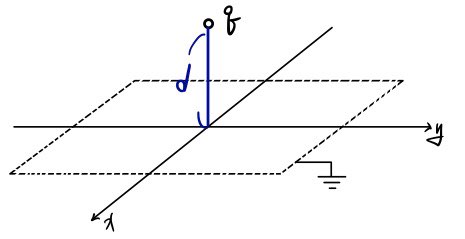
We want the potential in the upper region, $z>0$, excluding the point occupied by the charge. Its boundary value on the plane is
$$ V(x,y,0)=0. $$We also require $V$ to approach zero at spatial infinity in every direction within the upper region. Letting only $z$ grow would not state the full condition. The source is specified too: the potential must have the Coulomb singularity of charge $q$ at $(0,0,d)$ and no other singularity above the plane.
The induced surface charge is initially unknown, so the isolated-charge potential is not enough. The image construction gives us a way to include its effect without first finding that charge distribution. Whether a useful construction exists depends on the boundary geometry; a simple finite set of images is not available for an arbitrary conductor.
Choose an image and check the potential
For the auxiliary charge problem, remove the conductor and put an image charge $-q$ at $(0,0,-d)$. The real charge and its image are equally far from the plane.
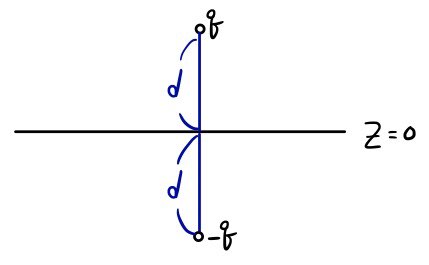
Define the Coulomb constant and the distances from an observation point to the two charges:
$$ k=\frac{1}{4\pi\epsilon_0}, $$$$ R_+=\sqrt{x^2+y^2+(z-d)^2}, $$$$ R_-=\sqrt{x^2+y^2+(z+d)^2}. $$Adding the two Coulomb potentials gives the expression in the original equation image:

In the shorter notation, this is
$$ V=kq\left(\frac{1}{R_+}-\frac{1}{R_-}\right). $$On the plane, the two distances are equal, so the terms cancel. At spatial infinity both terms tend to zero. In the upper region, the image contribution is nonsingular, and the real-charge term has exactly the required source singularity.
These checks make the construction a solution of the boundary problem. To see why it is the unique decaying solution, subtract it from any other solution with the same charge singularity and boundary values. The singularities cancel; the difference extends to a harmonic function with zero boundary values and decay at infinity. The uniqueness theorem then makes that difference zero.
The image charge lies outside the physical region we are solving. Continuing this formula below the plane does not give the field inside the conductor or in the shielded lower region. The actual conductor is equipotential, and its electrostatic interior field is zero.
Differentiate to find the electric field
Keep all three components when taking the negative gradient. Away from the real charge, in the upper region,
$$ E_x=kqx\left(\frac{1}{R_+^3}-\frac{1}{R_-^3}\right), $$$$ E_y=kqy\left(\frac{1}{R_+^3}-\frac{1}{R_-^3}\right), $$$$ E_z=kq\left(\frac{z-d}{R_+^3}-\frac{z+d}{R_-^3}\right). $$The vector field is assembled from these components:
$$ \mathbf E=E_x\hat{\mathbf x}+E_y\hat{\mathbf y}+E_z\hat{\mathbf z}. $$The transverse components generally remain nonzero above the plane. On $z=0$, however, equal distances make both $E_x$ and $E_y$ vanish. The field immediately outside the conductor is therefore normal to its surface, as an electrostatic conductor requires.
Find the induced surface charge
Use $\sigma$ for charge per unit area; $\rho$ would denote charge per unit volume. To relate $\sigma$ to the field, imagine a thin Gaussian pillbox straddling the surface. Its lower face lies inside the conductor, its upper face lies just outside, and the outward normal from the conductor is $\hat{\mathbf n}=\hat{\mathbf z}$.
In the thin limit, the side flux vanishes. The upper and lower faces have opposite outward normals, so Gauss’s law gives
$$ (\mathbf E_{\rm out}-\mathbf E_{\rm in})\cdot\hat{\mathbf n} =\frac{\sigma}{\epsilon_0}. $$Here $\mathbf E_{\rm in}=0$. Only the upper face contributes, giving
$$ \sigma=\epsilon_0 E_z(0^+). $$There is no factor of two from the two faces. A free sheet with equal fields on both sides is a different boundary problem; it does not describe this conductor pillbox.
Evaluate the field from above at $z=0$:
$$ E_z(x,y,0^+)= -\frac{qd}{2\pi\epsilon_0(x^2+y^2+d^2)^{3/2}}. $$Thus the induced density is
$$ \sigma(x,y)= -\frac{qd}{2\pi(x^2+y^2+d^2)^{3/2}}. $$For a positive $q$, the field just outside points toward the conductor and the induced surface charge is negative. Its magnitude is greatest directly beneath the charge and decreases with distance along the plane. The exponent is $3/2$, giving the required dimensions of charge per area.
Integrate over the plane
Write the distance from the axis as $s=\sqrt{x^2+y^2}$. A circular ring has area $2\pi s\,ds$, so the charge within radius $R$ is
$$ Q(R)=\int_0^R\sigma(s)\,2\pi s\,ds, $$$$ Q(R)=-qd\int_0^R\frac{s\,ds}{(s^2+d^2)^{3/2}}. $$Using the antiderivative $-1/\sqrt{s^2+d^2}$ yields
$$ Q(R)=\frac{qd}{\sqrt{R^2+d^2}}-q. $$Taking the radius to infinity gives
$$ Q_{\rm induced}=-q. $$The equality follows from this infinite grounded-plane geometry. It is not a general rule that every conductor near a charge acquires the opposite total charge. Grounding allows the exchange with a reservoir needed to maintain the prescribed potential.
Force on the real charge
The force on $q$ comes from the induced charges. Exclude the singular self-field of the real point charge. In the image construction, the induced field at the real charge is simply the field of $-q$, a distance $2d$ away.
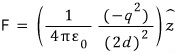
The equivalent expression is
$$ \mathbf F=-\frac{q^2}{16\pi\epsilon_0d^2}\hat{\mathbf z}. $$The force points toward the plane for either sign of $q$. Changing the charge’s sign also reverses the induced charge, leaving the attraction unchanged.
Why the energy needs a separate calculation
Two independently real charges $q$ and $-q$, separated by $2d$ in vacuum, would have the following interaction energy:
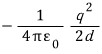
This excludes the divergent self-energies of the individual point charges. It describes a physical two-charge system, whereas our actual system contains one point charge and a grounded conductor. Matching the field in the upper region does not make these two systems’ assembly energies equal.
Bring the charge in from infinity
Move $q$ slowly along the axis toward the grounded plane. At a temporary height $a$, the electric force component is
$$ F_z(a)=-\frac{q^2}{16\pi\epsilon_0a^2}. $$An external agent balances this force during quasistatic motion, with no change in kinetic energy. Set the distance-dependent interaction energy to zero at infinity. The external work is then
$$ U(d)=-\int_{\infty}^{d}F_z(a)\,da, $$$$ U(d)=\frac{q^2}{16\pi\epsilon_0}\int_{\infty}^{d}\frac{da}{a^2}, $$$$ U(d)=-\frac{q^2}{16\pi\epsilon_0d}. $$This agrees with the original grounded-plane energy image:
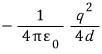
The negative work means the external agent removes energy while lowering the charge under control. Another way to express the same result uses the induced potential at the real charge:
$$ V_{\rm induced}(0,0,d)=-\frac{q}{8\pi\epsilon_0d}, $$$$ U(d)=\frac{1}{2}qV_{\rm induced}(0,0,d). $$As the charge moves, the induced charges readjust and the image position changes with it. The image is not an independently fixed physical charge. Differentiating $U_{\rm pair}(d)$ would count a different motion of a different system and give the wrong force for the grounded-plane problem. The numerical half-factor between these two displayed energies belongs to this plane construction; it should not be assumed for every image geometry.
Throughout this calculation, $U$ is the finite interaction or assembly energy with the point charge’s infinite self-energy excluded. It is not the unregularized integral of the nonnegative total field energy density over all space. Calculating the external work keeps that distinction explicit while respecting the grounded boundary.
The image construction has now given us the potential, field, surface charge, and force. For energy, the essential extra step was to follow the actual grounded system as the charge moved.

Editorial correction
Editorial correction — 2026-09-09. This English edition of the original study note restores the potential equation that had been replaced by a misplaced pillbox image. It replaces the historical field-expression image, two-sided pillbox diagram, and surface-density image with corrected typeset mathematics and explanation. Those historical source files are preserved.
The corrections include the negative gradient and all three field components, the conductor pillbox with zero interior field, and the surface-density exponent $3/2$. The text also makes the spatial boundary and charge-singularity conditions explicit, and derives the grounded-plane energy from quasistatic work with point-charge self-energy excluded. The retained force and energy images agree with the expressions explained here.
For further derivations, see the University of Texas at Austin notes on the method of images and ideal conductors.
Comments
Discussion happens via GitHub Discussions. You'll need a GitHub account to comment.