Separation of Variables: Strips and Pipes
Solve Laplace's equation in a grounded strip and rectangular pipe using separated modes, Fourier sine coefficients, and carefully stated boundary conditions.
The method of images solves some electrostatic boundary problems by replacing conductors with suitable imaginary charges. Separation of variables takes another route: it builds simple solutions that fit the geometry, then combines them to match the remaining boundary data.
This study note works through a grounded strip and a rectangular pipe. The useful habit is to ask which coordinate describes decay and which coordinates describe variation between grounded walls.

From a product to ordinary differential equations
In a charge-free region with constant permittivity, the electrostatic potential satisfies Laplace’s equation. For a problem independent of the third coordinate, it reads
$$ \frac{\partial^2 V}{\partial x^2} +\frac{\partial^2 V}{\partial y^2}=0. $$We first look for a nonzero separated mode of the form
$$ V(x,y)=X(x)Y(y). $$Substitution gives
$$ X''(x)Y(y)+X(x)Y''(y)=0. $$Primes denote ordinary derivatives of each factor with respect to its own coordinate. On a patch where both factors are nonzero, division by their product gives
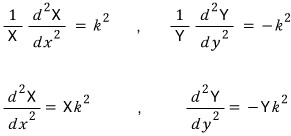
$$ \frac{X''}{X}+\frac{Y''}{Y}=0. $$The first ratio depends only on $x$ and the second only on $y$. Because these coordinates can vary independently, each ratio must be constant. For the grounded strip below, the useful choice is
$$ \frac{X''}{X}=k^2,\qquad \frac{Y''}{Y}=-k^2, $$with $k>0$. Equivalently,
$$ X''=k^2X,\qquad Y''=-k^2Y. $$Unlike the divided ratios, these ordinary differential equations remain meaningful where a factor vanishes. The retained source image records the same equations.
Their general one-coordinate solutions are
$$ \begin{aligned} X(x)&=Ae^{kx}+Be^{-kx},\\ Y(y)&=C\sin(ky)+D\cos(ky). \end{aligned} $$The product $V=XY$ is one separated solution. It is not the general solution of the original partial differential equation.
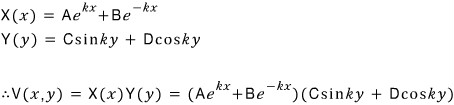
A boundary potential usually needs a sum of modes. Separation succeeds here because the geometry supplies a suitable sine basis; it does not require the complete potential to be one product, or depend on a lucky guess.
A semi-infinite grounded strip
Take $a>0$. The strip extends along positive $x$, with $y$ strictly between $0$ and $a$. Its geometry and boundary data are independent of $z$, so we seek a $z$-independent potential.
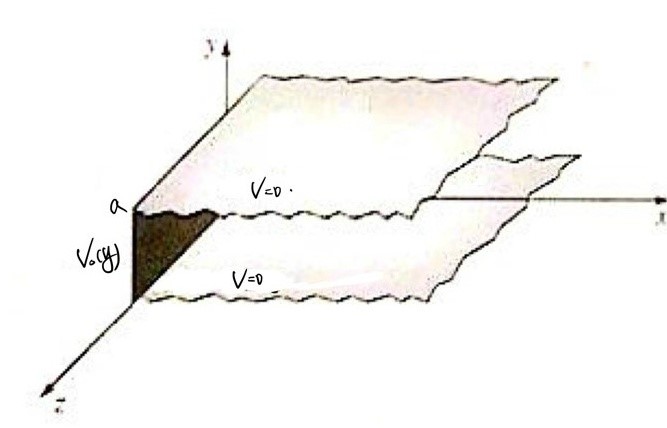
The two side walls are grounded:
$$ V(x,0)=V(x,a)=0. $$At the open entrance we prescribe
$$ V(0,y)=g(y),\qquad g(y)=V_0(y). $$Here $g$ specifies boundary values across the entrance. A varying $g$ does not describe a single connected conductor in electrostatic equilibrium, which would be an equipotential.
We seek a bounded harmonic potential that tends to zero uniformly across the strip as $x$ tends to infinity. First consider smooth entrance data that vanish at both endpoints, so the entrance and grounded walls agree at the corners.
Let the boundaries choose the modes
For a nontrivial product mode, the wall at $y=0$ gives $D=0$. The wall at $y=a$ then requires
$$ \sin(ka)=0,\qquad k=\frac{n\pi}{a}, $$where $n$ is a positive integer. There is no nontrivial zero mode: a linear $Y$ vanishing at both endpoints is identically zero. A negative eigenvalue for $-Y''$ would give hyperbolic factors, and the same two zero boundary conditions again force the trivial solution. Negative integers only duplicate the sine modes up to a sign.
Decay along positive $x$ removes the growing exponential, so $A=0$. Absorb the product of the remaining amplitudes $BC$ into $C_n$. It is convenient to name the transverse and longitudinal factors:
$$ \begin{aligned} s_n(y)&=\sin\!\left(\frac{n\pi y}{a}\right),\\ r_n(x)&=e^{-n\pi x/a}. \end{aligned} $$Then a mode and its superposition are
$$ \begin{aligned} V_n(x,y)&=C_n r_n(x)s_n(y),\\ V(x,y)&=\sum_{n=1}^{\infty}V_n(x,y). \end{aligned} $$The $x$ in the exponential is essential: it makes the exponent dimensionless and produces the required decay. Each mode satisfies Laplace’s equation because its positive second derivative in $x$ cancels its negative second derivative in $y$.
Linearity guarantees that a finite sum is a solution. For an infinite sum, convergence and differentiation must also be justified. With the smooth data considered here, the exponential factors give uniform convergence of the series and its differentiated series whenever $x$ stays a positive distance from the entrance.
Find the Fourier coefficients
At $x=0$, every $r_n$ equals one. The remaining condition is the sine expansion
$$ g(y)=\sum_{n=1}^{\infty}C_n s_n(y). $$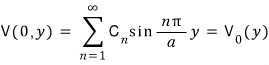
The sine functions are orthogonal on the transverse interval. For positive integers $n$ and $p$,
$$ \int_0^a s_n(y)s_p(y)\,dy =\frac{a}{2}\delta_{np}. $$The Kronecker delta is one when the indices agree and zero otherwise. Multiply the entrance expansion by $s_p(y)$ and integrate over $y$. All other coefficients disappear, leaving
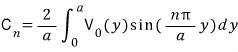
$$ \frac{a}{2}C_p=\int_0^a g(y)s_p(y)\,dy. $$Rename the surviving index $n$ to obtain
$$ C_n=\frac{2}{a}\int_0^a g(y)s_n(y)\,dy. $$This is the coefficient formula in the retained image, using $g=V_0$ and the definition of $s_n$ above.
The mode shapes already satisfy the differential equation, grounded walls and decay. Only the entrance data are needed to determine their amplitudes.
Boundary limits and uniqueness
The meaning of the entrance condition matters. For a piecewise smooth $g$, the sine series approaches $g$ at an interior continuity point and the average of its one-sided limits at an interior jump. Each sine term is zero at the endpoints. Thus nonzero endpoint data cannot also give a potential continuous at the corners where the entrance meets a grounded wall.
For smooth compatible data, the series gives a bounded harmonic solution with the stated continuous boundary values. It is unique among solutions with those values and uniform transverse decay. To see why, subtract two solutions and truncate the strip at $x=L$. Their difference is zero on the entrance and side walls. The maximum principle bounds its magnitude by its maximum on the far cross-section. Uniform decay makes that bound tend to zero as $L$ grows.
Discontinuous corner data require boundary limits on the open faces instead of continuity on the entire boundary. The elementary uniqueness argument just given assumes compatible continuous data; it should not silently be applied across a corner discontinuity.
A semi-infinite rectangular pipe
Now let $a,b>0$. The pipe extends along positive $x$, with $y$ between $0$ and $a$ and $z$ between $0$ and $b$. The four side walls are grounded. At $x=0$, the potential is prescribed on the open rectangular entrance.
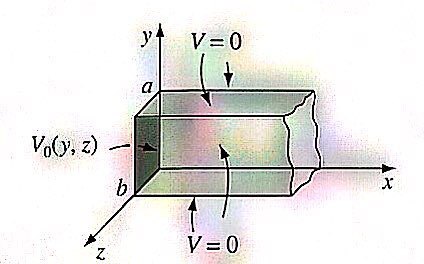
The boundary conditions can be written as
$$ \begin{aligned} V(x,0,z)&=V(x,a,z)=0,\\ V(x,y,0)&=V(x,y,b)=0,\\ V(0,y,z)&=h(y,z). \end{aligned} $$Here $h(y,z)=V_0(y,z)$. Again we require a bounded solution and decay to zero uniformly across the transverse rectangle as $x$ tends to infinity. Smooth entrance data compatible with the grounded edges provide a sufficient setting for the continuous boundary problem.
Separate the three coordinates
Start from $V(x,y,z)=X(x)Y(y)Z(z)$. The three-dimensional Laplace equation gives, on patches where the factors are nonzero,
$$ \frac{X''}{X}+\frac{Y''}{Y}+\frac{Z''}{Z}=0. $$Each ratio is constant, and the constants sum to zero. The grounded transverse walls lead to the choice
$$ \begin{aligned} Y''&=-k^2Y,\\ Z''&=-l^2Z,\\ X''&=(k^2+l^2)X. \end{aligned} $$Thus $y$ and $z$ carry the sine modes, while $x$ carries the exponential decay. With
$$ \kappa=\sqrt{k^2+l^2}>0, $$the separate factors are
$$ \begin{aligned} X(x)&=Ae^{\kappa x}+Be^{-\kappa x},\\ Y(y)&=C\sin(ky)+D\cos(ky),\\ Z(z)&=E\sin(lz)+F\cos(lz). \end{aligned} $$Their product $V=XYZ$ is the expression in the retained source image.

The walls at $y=0$ and $z=0$ set $D=F=0$. The opposite walls quantize the transverse wave numbers:
$$ k=\frac{n\pi}{a},\qquad l=\frac{m\pi}{b}. $$The integers $n$ and $m$ are independently positive. Decay sets $A=0$, and the amplitude $BCE$ becomes one coefficient $C_{nm}$.
Retain $s_n(y)$ from the strip and define
$$ \begin{aligned} t_m(z)&=\sin\!\left(\frac{m\pi z}{b}\right),\\ \kappa_{nm}&=\pi\sqrt{\frac{n^2}{a^2}+\frac{m^2}{b^2}},\\ S_{nm}(y,z)&=s_n(y)t_m(z). \end{aligned} $$At a point $(x,y,z)$, write the decaying mode value as $U_{nm}$. The modes and their sum are
$$ \begin{aligned} U_{nm}&=C_{nm}e^{-\kappa_{nm}x}S_{nm}(y,z),\\ V(x,y,z)&=\sum_{n=1}^{\infty}\sum_{m=1}^{\infty}U_{nm}. \end{aligned} $$The transverse second derivatives contribute negative squared wave numbers. Their sum cancels the positive longitudinal contribution $\kappa_{nm}^2$, so each mode is harmonic. The sine factors vanish on all four sides, and the exponential decays along the pipe.
Apply orthogonality in both directions
At the entrance the double series becomes
$$ h(y,z)=\sum_{n=1}^{\infty}\sum_{m=1}^{\infty}C_{nm}S_{nm}(y,z). $$
The $y$ integral supplies the factor $a/2$ as before. In the other direction,
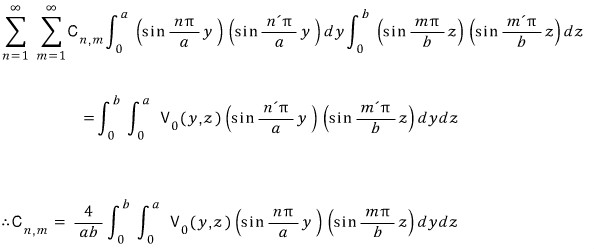
$$ \int_0^b t_m(z)t_q(z)\,dz =\frac{b}{2}\delta_{mq}. $$Multiply the entrance expansion by $S_{pq}(y,z)$ and integrate over the rectangle. Orthogonality in both coordinates selects $C_{pq}$. To keep the integral readable, define its integrand and value separately:
$$ \begin{aligned} F_{pq}(y,z)&=h(y,z)S_{pq}(y,z),\\ I_{pq}&=\int_0^b\!\int_0^a F_{pq}(y,z)\,dy\,dz. \end{aligned} $$The inner integral is over $y$ from zero to $a$; the outer one is over $z$ from zero to $b$. The selected coefficient therefore obeys
$$ \frac{ab}{4}C_{pq}=I_{pq}. $$Renaming the two surviving indices gives the result
$$ C_{nm}=\frac{4}{ab}I_{nm}. $$Together with the definitions of $F_{nm}$ and $S_{nm}$, this says to integrate $h(y,z)$ against both sine factors and multiply by $4/(ab)$. The retained source image shows the expanded calculation with primed indices.
For smooth compatible data, this expansion gives the prescribed boundary limits and a harmonic interior solution. Exponential decay again controls differentiated sums away from the entrance. We do not need a claim that an arbitrary double Fourier series converges pointwise everywhere. The same truncated-domain maximum-principle argument establishes uniqueness for the continuous compatible problem with uniform decay.
Check the result with a constant entrance potential
Suppose the strip entrance has the constant value $g(y)=V_c$. Direct integration gives
$$ C_n=\frac{2V_c}{n\pi}\bigl[1-(-1)^n\bigr]. $$Thus even coefficients vanish, while an odd index gives $C_n=4V_c/(n\pi)$.
For the pipe with $h(y,z)=V_c$, the two integrals separate. Let
$$ P_j=1-(-1)^j. $$Then
$$ C_{nm}=\frac{4V_c}{nm\pi^2}P_nP_m. $$If either index is even, the coefficient is zero. When both are odd,
$$ C_{nm}=\frac{16V_c}{nm\pi^2}. $$A nonzero constant entrance value conflicts with the grounded walls at the entrance corners or edges. These formulas describe the bounded harmonic interior solution and its limits on the open entrance and open side walls; they do not assign a common continuous value where those faces meet.
This is a useful check on the factors of two, the two independent indices and the direction of decay. More generally, inspect a proposed mode by differentiating it, evaluating it on each grounded wall and checking its behavior far down the strip or pipe. The final entrance expansion then determines how much of each mode is needed.

Editorial correction and sources
Editorial correction — 2026-09-12. This is a corrected English edition of the original study note, not an unchanged literal translation. Three misassigned local images were first restored from the original live source. The obsolete external-link preview was then removed from display. Seven historical image occurrences were retired from display; all original and restored files remain preserved.
The readable mathematics corrects the divided Laplace expression, restores missing $x$ factors in exponential decays, supplies a missing integration differential and corrects the three-dimensional derivative notation and axis assignments. Korean explanatory image text is replaced by English prose and native mathematics. The original pipe-series exponent and sine factors were already correct. Eleven source images remain displayed unchanged, with English descriptions and readable mathematical equivalents for every retained equation image.
The derivation was cross-checked against Richard Fitzpatrick’s Separation of variables and the University of Texas at Austin course notes Separation of Variables Method. The first reference uses a strip width of $\pi$; this note uses $a$. In the course notes’ pipe example, the decay coordinate is $z$; here it is $x$, with transverse coordinates $y,z$. The first reference’s equations 777 and 797 contain derivative and sine-coordinate typos; the formulas here follow direct differentiation and the stated boundaries.
Comments
Discussion happens via GitHub Discussions. You'll need a GitHub account to comment.