Electric Displacement
Deriving the electric displacement field D, its free-charge Gauss law, and its use in cylindrical and spherical dielectric examples.
In the previous post on bound charge, we found that a polarization field \(\mathbf P\) produces
\[ \sigma_b=\mathbf P\cdot\hat{\mathbf n}, \qquad \rho_b=-\nabla\cdot\mathbf P. \]Here \(\sigma_b\) is the bound surface charge on a dielectric-vacuum boundary, with \(\hat{\mathbf n}\) pointing outward from the dielectric, and \(\rho_b\) is the bound volume charge in a smooth polarized region. These are charges associated with the material’s polarization. They are distinct from free charge: charge placed on a conductor, supplied by an external circuit, or otherwise not represented by \(\mathbf P\).
The distinction suggests a useful auxiliary field. Instead of placing free and bound charge together on the right-hand side of Gauss’s law, we can absorb the bound-charge contribution into a new field, \(\mathbf D\).
Deriving the electric displacement field
The total charge density is
\[ \rho_{\mathrm{tot}}=\rho_f+\rho_b, \]where \(\rho_f\) is free charge density. The differential form of Gauss’s law is therefore
\[ \nabla\cdot\mathbf E =\frac{\rho_f+\rho_b}{\varepsilon_0}. \]Substitute \(\rho_b=-\nabla\cdot\mathbf P\):
\[ \begin{aligned} \varepsilon_0\nabla\cdot\mathbf E &=\rho_f-\nabla\cdot\mathbf P,\\ \nabla\cdot\left(\varepsilon_0\mathbf E+\mathbf P\right) &=\rho_f. \end{aligned} \]This motivates the definition
\[ \boxed{\mathbf D\equiv\varepsilon_0\mathbf E+\mathbf P}. \]Its Maxwell equation is
\[ \boxed{\nabla\cdot\mathbf D=\rho_f}. \]Integrating over a volume \(V\) and applying the divergence theorem gives the integral form:
\[ \boxed{ \oint_{\partial V}\mathbf D\cdot d\mathbf a =Q_{f,\mathrm{enc}} }. \]Only the enclosed free charge appears on the right. For comparison,
\[ \oint_{\partial V}\mathbf E\cdot d\mathbf a =\frac{Q_{f,\mathrm{enc}}+Q_{b,\mathrm{enc}}}{\varepsilon_0}. \]Across an interface, a pillbox version of the \(\mathbf D\) law gives
\[ \hat{\mathbf n}\cdot(\mathbf D_2-\mathbf D_1)=\sigma_f, \]where \(\sigma_f\) is free surface charge and \(\hat{\mathbf n}\) points from region 1 to region 2.
What \(\mathbf D\) does—and does not—mean
It is tempting to call \(\mathbf D\) “the electric field with polarization removed.” That is not generally correct. The quantities even have different SI units:
\[ [\mathbf E]=\mathrm{V/m}, \qquad [\mathbf D]=[\mathbf P]=\mathrm{C/m^2}. \]The definition \(\mathbf D=\varepsilon_0\mathbf E+\mathbf P\) is a reorganization of Gauss’s law. It lets us track free charge separately from the bound charge already encoded by \(\mathbf P\). It does not mean that \(\mathbf D\) is the sum of “all electric fields except the polarization field,” and \(\nabla\cdot\mathbf D=\rho_f\) does not by itself determine \(\mathbf D\). We still need symmetry, boundary conditions, or other Maxwell equations.
The definition and the free-charge Maxwell equation are material-independent. A constitutive relation is additional information about a particular material. For a homogeneous, isotropic, linear dielectric,
\[ \mathbf P=\varepsilon_0\chi_e\mathbf E, \qquad \mathbf D=\varepsilon\mathbf E, \qquad \varepsilon=\varepsilon_0(1+\chi_e). \]The shortcut \(\mathbf D=\varepsilon\mathbf E\) is not universal. In an anisotropic medium, \(\varepsilon\) may be a tensor; in a nonlinear or history-dependent material, \(\mathbf D\) need not be proportional to \(\mathbf E\) at all. In vacuum, \(\mathbf P=0\), so \(\mathbf D=\varepsilon_0\mathbf E\)—not \(\mathbf D=\mathbf E\).
Example 1: a line charge inside a dielectric cylinder
Consider an infinitely long free line charge of density \(\lambda\) on the axis of a cylindrical dielectric of radius \(a\). Assume cylindrical symmetry, a homogeneous linear dielectric of permittivity \(\varepsilon\) for \(0\lt s\lt a\), vacuum for \(s\gt a\), and no free charge on the interface \(s=a\). The ideal line \(s=0\) is singular, so the following fields apply for \(s\gt 0\).
First imagine the dielectric absent. A coaxial Gaussian cylinder of radius \(s\) and length \(L\) gives
\[ E(2\pi sL)=\frac{\lambda L}{\varepsilon_0}, \qquad \mathbf E_{\mathrm{vac}}(s) =\frac{\lambda}{2\pi\varepsilon_0s}\,\hat{\mathbf s}. \]Now restore the dielectric. Applying the \(\mathbf D\) flux law to the same Gaussian cylinder gives
\[ D(2\pi sL)=\lambda L, \qquad \boxed{ \mathbf D(s)=\frac{\lambda}{2\pi s}\,\hat{\mathbf s} } \quad(s\gt 0). \]This result holds on both sides of \(s=a\) because every such Gaussian cylinder encloses the same free line charge and the assumed symmetry fixes the direction and magnitude. The normal component of \(\mathbf D\) is continuous at \(s=a\) because there is no free surface charge there.
The electric field follows only after we use the constitutive relation in each region:
\[ \mathbf E(s)= \begin{cases} \displaystyle \frac{\lambda}{2\pi\varepsilon s}\,\hat{\mathbf s}, & 0\lt s\lt a,\\[8pt] \displaystyle \frac{\lambda}{2\pi\varepsilon_0 s}\,\hat{\mathbf s}, & s\gt a. \end{cases} \]Thus the dielectric reduces \(|\mathbf E|\) relative to its vacuum value by the factor \(\varepsilon_0/\varepsilon\) inside the material. The displacement field is not restricted to the dielectric: outside, it remains \(\mathbf D=\varepsilon_0\mathbf E\).
Example 2: a radially polarized spherical shell
Now consider a dielectric occupying the spherical shell \(a\lt r\lt b\), with prescribed polarization
\[ \mathbf P(r)=\frac{k}{r}\,\hat{\mathbf r} \qquad(a\lt r\lt b), \]and \(\mathbf P=0\) elsewhere. Assume electrostatics, spherical symmetry, and no free charge anywhere.
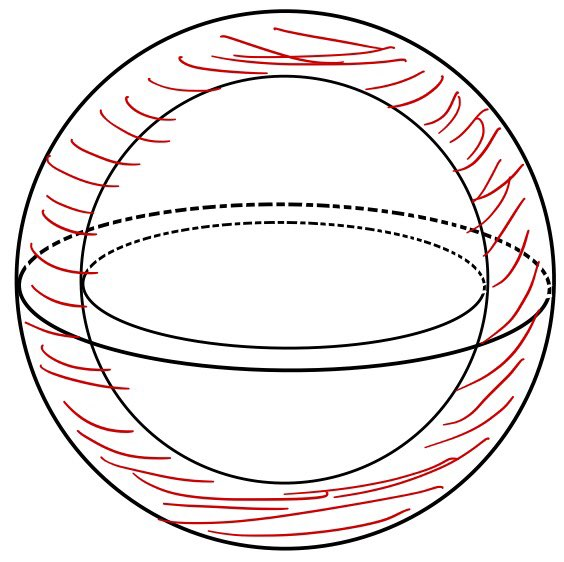
Solution from the bound charges
In the shell,
\[ \rho_b =-\nabla\cdot\mathbf P =-\frac{1}{r^2}\frac{d}{dr}\!\left(r^2\frac{k}{r}\right) =-\frac{k}{r^2}. \]At the inner boundary, the outward normal of the dielectric is \(-\hat{\mathbf r}\); at the outer boundary, it is \(+\hat{\mathbf r}\). Therefore
\[ \sigma_b(a)=-\frac{k}{a}, \qquad \sigma_b(b)=\frac{k}{b}. \]For \(r\lt a\), a centered Gaussian sphere encloses no charge, so spherical symmetry gives \(\mathbf E=0\). For \(a\lt r\lt b\), the enclosed bound charge is
\[ \begin{aligned} Q_{b,\mathrm{enc}}(r) &=4\pi a^2\sigma_b(a) +\int_a^r\rho_b(r')\,4\pi r'^2\,dr'\\ &=-4\pi ka-4\pi k(r-a)\\ &=-4\pi kr. \end{aligned} \]Gauss’s law then gives
\[ \mathbf E(r) =\frac{Q_{b,\mathrm{enc}}(r)}{4\pi\varepsilon_0r^2}\,\hat{\mathbf r} =-\frac{k}{\varepsilon_0r}\,\hat{\mathbf r}, \qquad a\lt r\lt b. \]For \(r\gt b\), the inner surface charge, volume charge, and outer surface charge sum to zero:
\[ -4\pi ka-4\pi k(b-a)+4\pi kb=0, \]so \(\mathbf E=0\) there as well. Altogether,
\[ \mathbf E(r)= \begin{cases} \mathbf 0, & r\lt a,\\[3pt] \displaystyle -\frac{k}{\varepsilon_0r}\,\hat{\mathbf r}, & a\lt r\lt b,\\[8pt] \mathbf 0, & r\gt b. \end{cases} \]Solution from \(\mathbf D\)
Because there is no free charge,
\[ \oint\mathbf D\cdot d\mathbf a=0. \]For a centered spherical Gaussian surface, symmetry requires \(\mathbf D=D(r)\hat{\mathbf r}\), so
\[ 4\pi r^2D(r)=0 \quad\Longrightarrow\quad \mathbf D=0 \]in each region. The conclusion uses spherical symmetry and the regular boundary behavior; zero divergence alone would not be enough. Inside the polarized shell,
\[ \mathbf 0=\varepsilon_0\mathbf E+\mathbf P \quad\Longrightarrow\quad \mathbf E(r)=-\frac{\mathbf P(r)}{\varepsilon_0} =-\frac{k}{\varepsilon_0r}\,\hat{\mathbf r}. \]Outside the shell, \(\mathbf P=0\), so \(\mathbf D=\varepsilon_0\mathbf E=0\). This agrees with the explicit bound-charge calculation.
The advantage of \(\mathbf D\) is now precise: its flux law isolates free charge. When symmetry makes that law solvable, it can spare us from summing the bound charges one by one. The material response is still present—it enters through \(\mathbf P\) or through an appropriate constitutive relation when we recover \(\mathbf E\).
Comments
Discussion happens via GitHub Discussions. You'll need a GitHub account to comment.