Magnetic Fields in Matter
Chapter 6 is basically Chapter 4's magnetic twin — once you survived polarization and electric dipoles, magnetic dipole moments and multipole expansions are a total breeze!
Now we’re going to do something very similar to the ‘polarization (polarization)’ we did in Chapter 4….
Back then, it was about stuff happening due to another electric field, wasn’t it~~
This time in Chapter 6. Magnetic Fields in Matter, it’s about the material doing stuff~ due to an external magnetic field~
But! As much as we suffered in Chapter 4, it’s not that hard here!
Because I did the polarization part in Chapter 4 soooooo hard in my own way, I could breeze through this easily!
The professor said so too, and at first I was like (pfft, liar,…) lolol but it really was true hehehe
In Chapter 4, the ’electric dipole moment p’
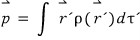
how did we pull this out???? Right, we defined it and brought it in while doing a ‘multipole expansion’???
The multipole expansion was
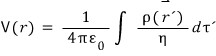
we did a power series expansion of this expression, right?
It’s the same here.
We do a multipole expansion on the A-vector we did earlier. Vector A is

and do a multipole expansion of it~
We decompose into monopole, dipole term, quadrupole, etc., and from there
we define the ‘magnetic dipole moment m’ and come in, but the method is so identical to the one in Chapter 4…..
I’ll skip the stuff that gets derived the same way.
It’s really the same.
Just doodling by hand, if you use the mathematical tools we had before exactly~~ as-is, you can prove it.
So then

Vector area????? Let’s just move along easy-peasy
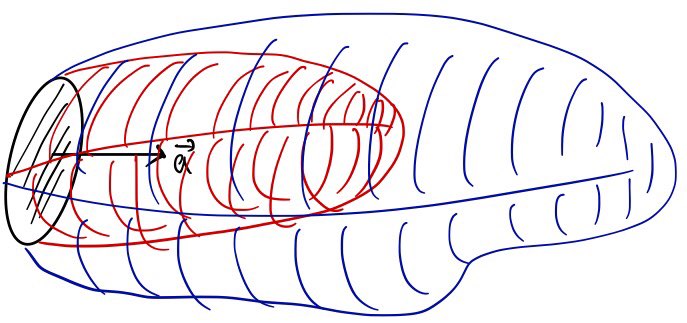
Vector area — whether it’s that black surface, the red bent surface, or the blue bent surface,
vector area is defined as the area of the closed surface that wraps around that curved surface, like a.
This part isn’t hard either, right?
I was wondering whether to cut it, but to maintain the logical flow of the writing,
even though you all already know this, I just attached a picture. hehe
So then, finally, in Chapter 4 as well we computed the potential due to the electric dipole, right?
This can also be derived via multipole expansion, but I’ll just attach one equation.
First, the potential due to the electric dipole is
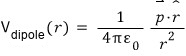
The vector potential due to the magnetic dipole is similar.
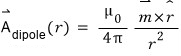
((Somehow, just the dot product got changed to a cross product??
As you’ll see going forward, the differences between the magnetic field and the electric field are almost all just these dot-product-vs-cross-product differences..
Of course, some people might feel it’s obvious, but for me it still hasn’t hit home T_T T_T T_T sob))
Now all the base layers are laid, let’s go in@@@@@@@@@
Matter is made of atoms, and atoms have electrons orbiting around.
Can we say that an electron circling is the same as a current i flowing in the opposite direction???
What I want to say is, an atom plopped~ right there I want to see as a magnet plopped~ right there.
«Actually, when electromagnetism was developing, atoms were described with the orbit model, right? Of course, in modern times it’s the orbital model, electron cloud??
Anyway… from a quantum-mechanical perspective, that orbit model is all wrong, so;;; if you ask “hey, why are we doing this!!!!!?!?!?!”.. I wouldn’t have anything to say, but….
I feel it’s on the same level as the question “why do we do Newtonian mechanics?!!?!??!” T_T T_T
Dammit, I need to take quantum mechanics quickly so I can form my own argument, but I haven’t learned it yet so just….(I’m taking it next semester! hehehe heehee heehee) for now I’ll keep going hehehe»
Usually, the directions of these atoms with electrons circling are all over the place, so when you do the vector sum of the dipole moments, you get 0 and they cancel out.
(The atomic level is too small, so at a macroscopic level it can be viewed as a dipole moment.)
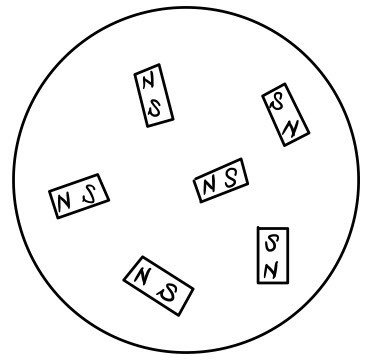
So these guys who were like this (I expressed the atomic-level guys as magnets like this)
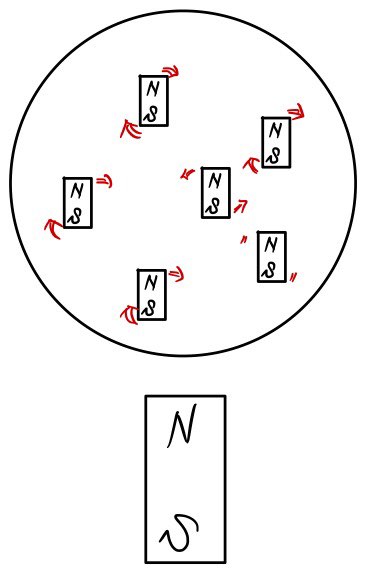
when you bring a magnet close, usually the N-pole is approaching, so the atoms inside fall into line with their S-poles pointing down.
This kind of material is called a ‘paramagnet (paramagnet)’
and the opposite case — when the N-pole approaches, they point their N-poles downward
and as a result, due to the repulsive force with the magnet, they go whoosh~ away — there are such materials too (well, I’ve never seen one lololololol this is news to me)
This is called a ‘diamagnet (diamagnet)’
Ahhhhh and when you take the magnet away from a paramagnet, most of them lose their magnetism again, right?!?!?!?
But there are cases where they don’t, right??? (like when you hold a magnet up to iron for a long time and the iron becomes a magnet)
And when that persists for quite a long time, the material is called a ‘ferromagnet (ferromagnet)’
Okay, now out of the many atoms, let’s look at just one!!! That~ one atom!!!
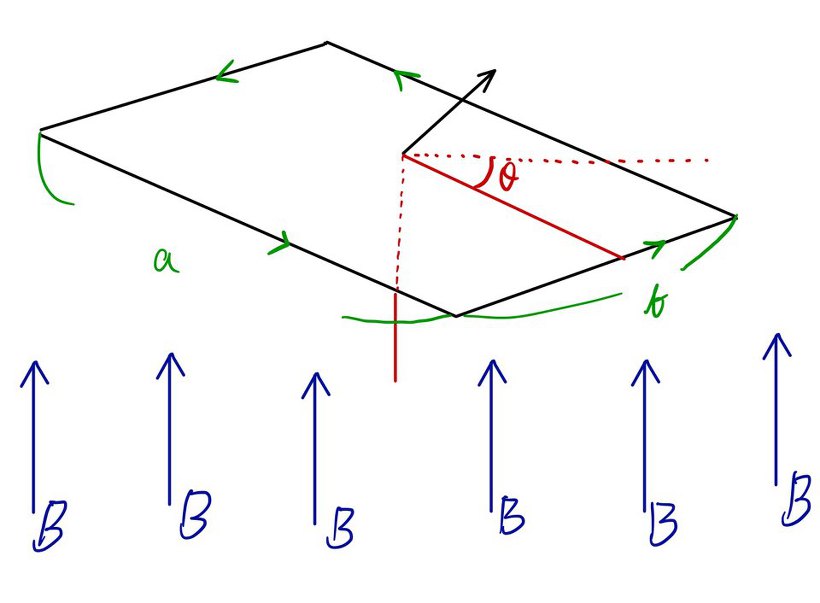
Out of a ton of atoms, in one of them the electron is circling like that (if we have to be picky, the electron would be going clockwise)
Then the magnetic dipole moment would be m = abin, right? (n is the unit vector)
At that time, the external magnetic field B comes in like that.
And we already know it! That it falls into line so that theta becomes 0 degrees!
Now I’m going to work out how it falls into line.
Sides 1 and 3 will each receive force forward and backward,
and sides 2 and 4 will each receive force to the right and left (∵F_magnetic = q(v x B))
Now let’s look at that figure from the front.
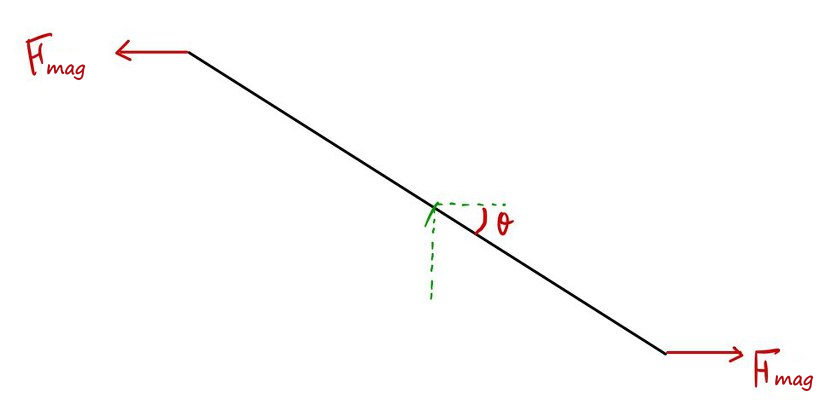
Due to F_magnetic, it will experience a torque.
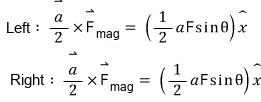
Therefore the total torque is, (aFsinθ)x
and since F = ibB,
torque = (abiBsiθ)x
= (mBsinθ)x = mxB
We’ve looked at the mechanism for falling into line.
Okay okay okay okay, at first the atomic arrangement of the material is all over the place, so when you add up all those magnetic dipole vectors you get 0 and no magnetic field forms, but
when B is applied from outside, the magnetic dipole moments get arranged
and like polarization in Chapter 4, magnetization forms.
(Just as the alignment of electric dipole moments was expressed as the vector P, polarization density,
the alignment of magnetic dipole moments is expressed as a vector, and the magnetization M (magnetigation) is formed.
It means the magnetic dipole moment per unit volume.)
So ultimately, because of this, a magnetic field due to the object is formed again.
Let’s look at this newly formed magnetic dipole moment and check out the ‘bound current’ that has newly formed in that object.
In Chapter 4, we looked at ‘bound charge density’, right? Very~~~ similar to Chapter 4, right? Not just similar, it’s just the same, the same.
The derivation process, as before, starts from the ‘potential’.
I was debating whether to skip, but for this part I’ll lay out the equations in a row. (it’s really the same as the bound charge density)
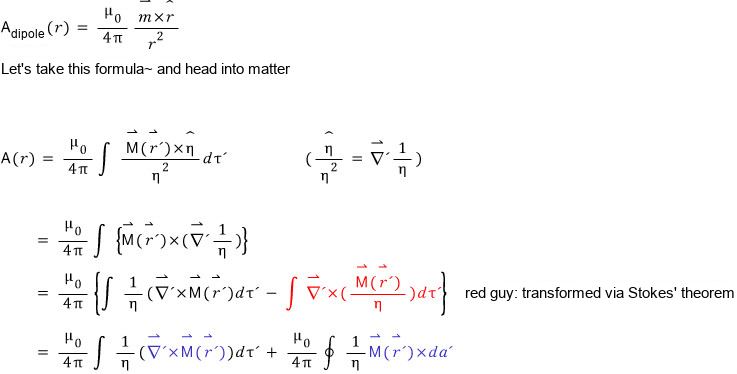
In the following, the first term is the vector potential term due to the volume current density—
and the second term is the vector potential term due to the surface current density—
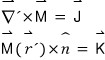

Can
it
really
be
this
similar
As previewed at the very front, it seems the only difference is the dot product becoming a cross product.
mmmhahahahahahaha
Verily we draw near the end of magnetostatics ~
Once we doth study the auxiliary field (auxiliary field), ’tis done
‘Tis the same principle as the D-vector we learned as the displacement electric field in Chapter 4, mmmhahahahahaha
‘Tis late and the man doth seem to be losing his mind, mmmhahahahahahaha
That’s all for today and I shall retire unto slumber, mmmhahahahahahahahahahahaha
Tomorrow, after I finish up the auxiliary field!!! I do plan to set mine efforts upon the general-mechanics posting
Mmmhahahaha, farewell to thee all, mmmhahahahaha
Comments
Discussion happens via GitHub Discussions. You'll need a GitHub account to comment.