The Auxiliary Field H
Just like D tidies up the electric side, H does the same for magnetics—letting us work with free currents only and ignore the messy bound current stuff.
Back in Chapter 4 we learned about the displacement field $D$, and this concept is similar to that.
Looking at it microscopically is way way too complicated (nearly impossible). What I mean by looking at it microscopically is that the external electric field causes polarization, that polarization creates a new electric field, that new electric field changes the polarization again, another new electric field arises, which changes the polarization again..(infinite loop). That’s what it means.
So the gist was ’let’s look at it macroscopically'.
The magnetic field mechanism is similar, so by the same logic as ’let’s look at the $D$ vector’, in magnetic fields too, ’let’s look at the $H$ vector’. ($D$ was the electric field that only cares about free charge, right??? $H$ means the magnetic field that only cares about free current.)
The auxiliary field
Let’s get started. The things that can be considered currents inside a material are bound currents due to magnetization, and free currents from all other factors excluding that.
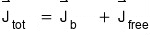
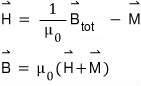
If we mess around with this identity together with the relations we learned before,
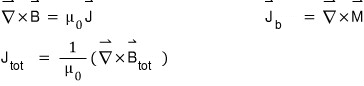
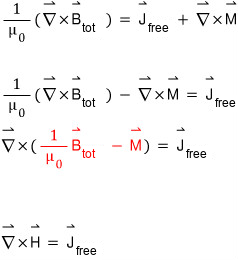
The red part, we’ve decided to call the auxiliary field $H$.
Hmm, for a paramagnet, this would mean subtracting the effect of $M$ from $B$, and for a diamagnet, it would be the opposite~
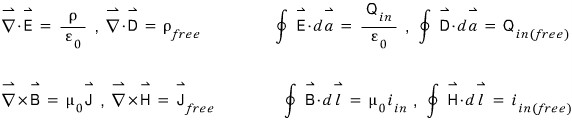
As always, if we compare with electrostatics,
Applying it to a problem would help understanding faster, right????
A copper rod
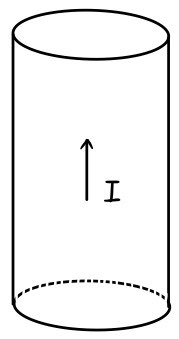
A copper rod of radius $R$ has a free current $i$ uniformly spread through it. Find $H$ inside and outside (copper is a diamagnet).
“Aghh, why does the first example have to be a diamagnet……-_-”
For a diamagnet, the direction of $M$ produced by $B$ is the opposite of common sense.
(If you bring an N pole close, the N pole, having come closer, ends up moving away — a very strange kind of material)
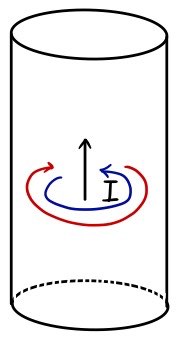
It’d look like this, right???? The magnetic field due to the free current is like the blue line, and the magnetic field due to $M$ (from the tiny magnets formed by magnetization) forms like the red one, right??
Okay so, let’s not do the $B$ part and the $M$ part separately!!! All at once, PWAK!!! Now that we’ve learned $H$, let’s just look at $H$.
Since $H$ only cares about free currents, the idea is: let’s not look at the effect of bound currents.
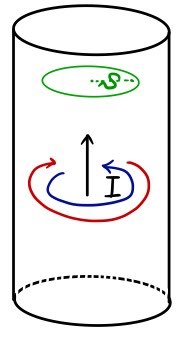
If we set up the Amperian loop like that, the $i_{\text{in(free)}}$ — the free current — passing through the Amperian loop is????
Since $i$ is uniformly spread through the whole thing,  this much passes through the Amperian loop~
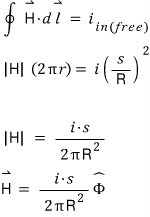
Now $B$ is easy to find too!!! (just like how finding $D$ and then $E$ was easy in Chapter 4)
In the region where $M$ is defined, you just plug in $M$ and use the $H$ we found. Outside, where $M$ is 0? Just plug 0 in for $M$^^^easy
Linear media
Now earlier, we found $P$ and drew out the relation linking $D$ and $E$ for a linear dielectric, right?
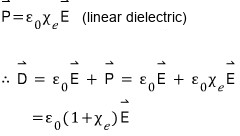
Like this~ hehe. Here, it’s not a dielectric, but… we just call it a linear material (or linear medium). In a linear material, $M$ and $H$ have this kind of relation:

It’s somehow the opposite of above, isn’t it???? Just as $P$ was expressed with $E$, it seems like $M$ should be expressed with $B$….
This is apparently just by convention. If we were to express $M$ with $B$,
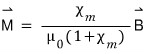
since it comes out looking like this mess, I guess they just wanted to express it simply and cleanly….(that’s my guess..)
Anyway!!! $\chi_m$ is called the magnetic susceptibility. When $\chi_m$ is positive and large, due to an external magnetic field, the magnetization density has a large value in the same direction, and when $\chi_m$ is negative and small, due to an external magnetic field, the magnetization density has a small value in the opposite direction??? something like that feel? hehe
In a word, property property property of the material!
So, in a linear medium (only in a linear medium!!! don’t forget forget forget isisis that it’s only in a special case)
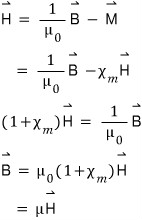
We just call $\mu_0(1+\chi_m)$ simply $\mu$, and it’s called the permeability^^^
Now I should post magnetostatics problem-solving, but I’m thinking of just skipping it.
Because, lolololol… my exams ended long ago lolololol
T_T If I get bored while studying, I’ll post the practice problems I’ve solved now and then, if I can hehe
(I have the original, but actually turning it into a post isn’t an easy thing T_T)
Heads-up. The figures here are the original notes, slips and all. A few things to watch for:
- In the picture for $H$ inside the wire, the left side should be $|H|(2\pi s)$, not $|H|(2\pi r)$: the Amperian loop has radius $s$. The result $|H| = \frac{is}{2\pi R^2}$ is right.
Comments
Discussion happens via GitHub Discussions. You'll need a GitHub account to comment.