Electrodynamics
Diving into electrodynamics together — breaking down current density, conductivity, and the Lorentz force as we work our way toward Maxwell's equations!
I was originally planning to post starting from the electrodynamics part that I took in Electromagnetism 1 hehehe
Because, if I do just this and then move on to Maxwell’s equations, establish Maxwell’s equations,
and then the process of proving ’electromagnetic waves’ with those Maxwell’s equations seems like it’ll flow a bit more smoothly hehe
Electromagnetism 1 felt like baby-level. Taking Electromagnetism 2 last semester, I really… have nothing but memories of how hard it was…
Posting this while sort of reviewing too,,,, and,,, it’ll be hard….
Let’s struggle together…hehehehe okay I’ll get started.
Mechanics:
- The study of the laws of motion of objects. A branch of physics.
There’s statics dealing with the equilibrium of forces, dynamics dealing with the relationship between force and motion, and kinematics dealing only with motion.
- A phenomenon where component elements have mutually dependent relationships and constrain each other.
What are we studying in Chapter 7, Electrodynamics?
In my thinking, just simply, like, we plug in an electrical cord and how does energy electrically turn into what and how do charges receive force how ~~~~~
like, tearing apart and ripping open these relationships one by one and looking at them? something like that is my guess,,, but anyway let’s just follow along with the book one by one,,,,
How does the unit current density J come about? Since current is the flow of charge…. hm so charges? go forward? do they??
Just?? Norinono, they don’t just go, they just now receive a force and then go forward right???
It could be the force from the electric field we learned before,… or it could be the force from the magnetic field!!!~~ or is there something else
So J is proportional to the force f.
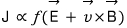
When you want to change a proportion into an equation?!?!?~~ you need a proportionality constant right
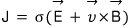
So let’s change that proportion into an equation.

Like so~~~ sigma is the same symbol used for ‘surface charge density’, so I think Griffiths apologizes for it
Here sigma is not surface charge density~~~~ it’s the “conductivity” of the medium!!!!!
Conductivity is supposedly an index indicating “how well the medium lets charges move”
<With copper wire, silver wire, and gold wire, how well they conduct is all different, but since gold and silver are expensive, we usually use copper wire — we learned this in high school right~~~??? That conductivity is correct!!!!>
So, that’s why the reciprocal of sigma (1 over sigma) means “resistivity ρ”!!! If you think about it just a little

you can go “hmm~~ meiksense~”, so I’ll move on
Now then~~~? In reality, the speed of moving electrons is damn slow…
But you’ve heard that the speed of electricity is the speed of light right…(I heard that.. maybe wrong info though….hehe somebody pwease tewl meee;;)
Hm anyway actually the electrons don’t actually move at the speed of light. So

Clack!! When one hits, pyung pyung pyung pyung, almost immediately the pendulum at the far end reacts
if you think of each of the pendulums as an electron…
That is, the guys carrying the charge are indeed super slow,
but the “flow of energy” (just like energy transferring through pendulums) is extremely fast!!!
(I’m not saying the charge carriers collide like the pendulums in the figure above)
Anyway so the electrons’ speed isn’t fast!!!!!!!!!!!!! If we take this as the main point
in this, the velocity v is almost 0. It’s fine to see it that way, they say.

We can organize the relation like this
and this is the famous ‘Ohm’s Law’!!!!!
A lot of you must be surprised, right? Ohm’s law is definitely the one we learn in middle school

this!!?
If you think about it juuuust a little, it’s the same thing hehehe
Now we have to think about this
“Why can it be the same at any part of the circuit???????????”
Let me think about this question.
Why is the current i constant…..
Even in a simple closed circuit, if you put an ammeter here and there, it’s the same everywhere right???
My book explains the reason like this
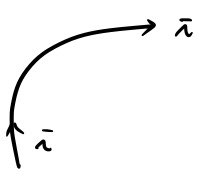
There’s a wire like this with current flowing, and (for now) let’s think that charges gather at that bent part.
Then the charges gathered there will radiate an electric field E. Out to both sides
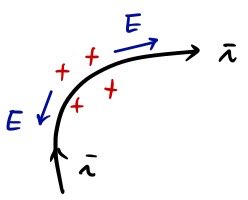
Then the incoming charges receive a force and come in a bit slowly, and the outgoing charges receive a large acceleration at first … and then
since the gathered charges decrease, they’ll receive a smaller acceleration.
Like this, they reach an “equilibrium state” where charges no longer gather.
Mr. Griffiths calls this “a marvelous system that self-adjusts to make the current uniform.”!!!
(The natural world is really amazing…)
Also, since this adjusts very quickly, we can think that at any time, at any place in the circuit, the current is the same hehehe
So then the factors driving the charges in the circuit can be said to be two.

and

. (

is just the force from the battery?)
Each charge is receiving

this much force.
If we just add the whole damn lot together!!!!! Voltage!!!!!!!!!!!
Why voltage~~~

you remember this right. E can be called the force that a unit charge receives.. right??? (because

)
And

is the force a unit charge receives, so we’re good.
The integral of that is called electromotive force (electro motive force, ε)!

<cf. Since the charges are all moving at the same velocity,,, would it be a problem to understand it as: there’s no force they receive from the E they themselves emit? T_T>
Comments
Discussion happens via GitHub Discussions. You'll need a GitHub account to comment.