Motional EMF
A casual walkthrough of how yanking a circuit through a magnetic field pushes charges around and why the rate of flux change is the key to EMF!
Earlier we learned that the sum of all the forces acting on unit charges is called the electromotive force (EMF). EMF… simply put, just how many volts the battery has. How that battery pushes charges around in wires!!
This time let’s see how unit charges get pushed around by magnetic fields!
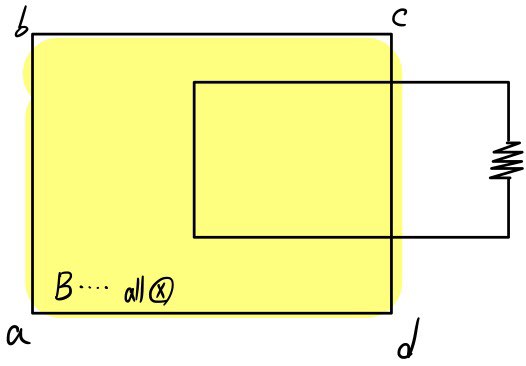
The abcd rectangle is a region of magnetic field. A closed circuit is hanging there all janky like lol
In this state, if you yank~ that circuit along, the charges that had been evenly distributed on the wire all whoosh!! move together, and the ones on the top and bottom parts of the wire start feeling a force from the magnetic field.
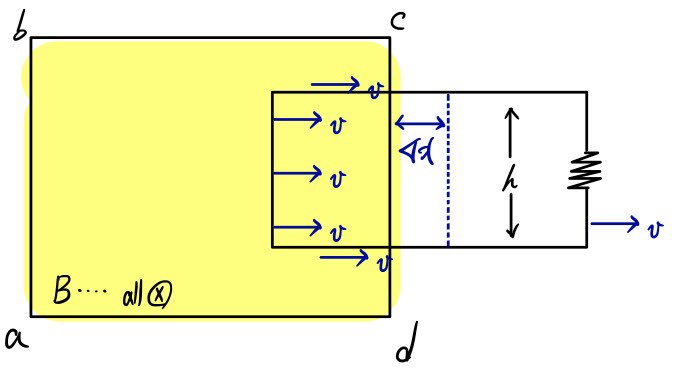
The charges that were on the left side will get a force in the ↑ direction and move:

If we integrate this over the whole circuit, it’ll become an EMF again~
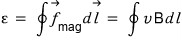
The only part that survives in this integral is the guys on the far left, so 
Actually, that formula is something someone must have figured out through some experiment — that when the magnetic field through a circuit with no power source changes, current flows… So they must have been wondering:
“Huh?!?! The magnetic field is changing, but why is current being generated??”
“The EMF and the rate of change of magnetic flux surely must have some relation~~~!”
They must have thought like that, right…?
Now back to our picture — when a person pulls the closed circuit at velocity $v$, if we write out the change in the flux passing through as a formula: in  seconds, the area of the closed circuit that’s inside the magnetic field changes by
  this much, so…
Um, then the flux passing through is  , so its amount of change
  is
is  this much! It’ll be!!
Since what we’re looking at right now is the rate of change of flux, let’s divide each of those equations above by $\Delta t$!!
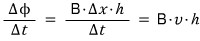
So is that how we finish the formula???
Not yet.
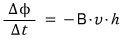
That’s what it should say!!!
Above, when we were looking at the magnitude of the change, we weren’t looking at the direction of the change. So it’s a bit confusing, but at the end I adjusted it to include the direction too lol
Let me also solve problem 7.7 lol
Prob 7.7
As shown in the figure, a metal bar of mass $m$ slides frictionlessly across a wire track of spacing $l$ (ell). There’s a resistor $R$ at the end of the two wires, and a magnetic field $B$ pointing into the page is spread uniformly everywhere.
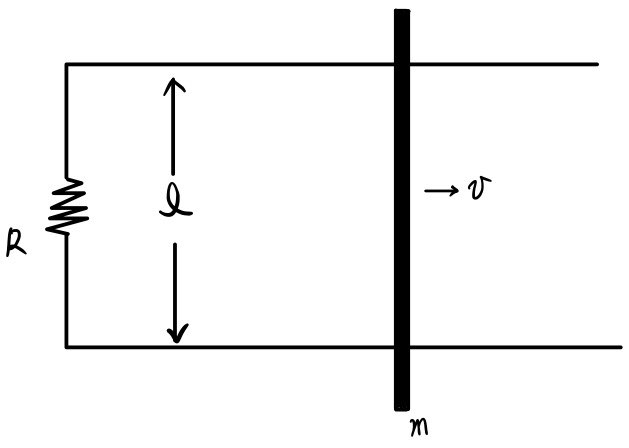
- a) When the bar moves to the right with speed $v$, find the magnitude and direction of the current passing through the resistor.
- b) Find the magnitude of the magnetic force on the bar.
- c) If at time $t=0$ the bar is launched with speed $v_0$ and then left alone, find the speed of the bar at time $t$.
Take that!!! OK, let me start with a)
a) When the bar moves to the right with speed $v$, find the magnitude and direction of the current passing through the resistor.
Before, the whole wire was moving, now only part of the wire moves ??? you might think. OK, as the bar moves, the charges on the bar move to the right at speed $v$. The unit charges will feel a force of $v \times B$ !!! If we take a line integral over the closed circuit
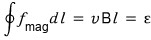

The current will flow downward!!
b) Find the magnitude of the magnetic force on the bar.
We did this before — a wire carrying current $I$, in a magnetic field $B$, feels

Putting in the $I$ we found
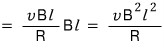
c) If at time $t=0$ the bar is launched with speed $v_0$ and then left alone, find the speed of the bar at time $t$
What this is saying is — when you kick it like BAM!!!!, it gets a strong!!! push and moves with speed $v$. Then because of that $v$, current $I$ flows, and the current-carrying wire feels  , right~~ (same as above)
So let’s solve the first-order differential equation the way we learned in mathematical physics class.
(the method of making an integrating factor and multiplying)
 — this is the entirety of the force the wire feels right now. So if we flesh out and set up the equation of motion
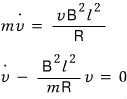
make it like this! lol then!!!!
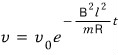
Then at first the kinetic energy was  — the speed was
  — and then it drops to 0, so the energy just vanishes away~~~…
Huh?!?~? Where did it go?
Let’s look at the resistor $R$. The power dissipated is $VI = I^2R$. But $I$ depends on time $t$! Then the dissipated power $P$ also depends on time $t$:
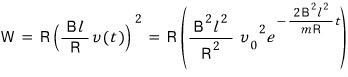
Therefore
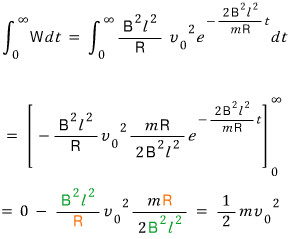
Conclusion!!! All the energy consumption went to $R$ and was dissipated there~
Example 7.5
A long cylindrical magnet of length $L$ and radius $a$ has magnetization density $M$ uniformly spread parallel to its axis. It passes at constant speed $v$ through a circular wire loop whose radius is slightly larger. Draw the EMF induced in the loop as a function of time.
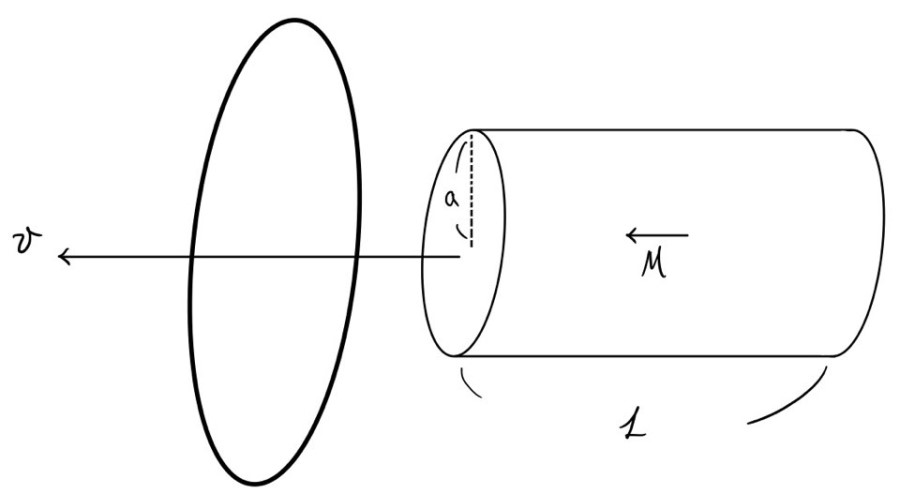
“A long cylindrical magnet of length $L$ and radius $a$ has magnetization density $M$ uniformly spread parallel to its axis. It passes at constant speed $v$ through a circular wire loop whose radius is slightly larger. Draw the EMF induced in the loop as a function of time.”
Whoa lol, they make problems like this? lol First, since magnetization density $M$ shows up, I

tried writing this out.
(Ah, I’ll skip the vector notation from now on… too annoying… I’ll draw the vector arrows when I need to emphasize that something is a vector…. lol the obvious vectors… let’s just say they’re vectors….lol)
If magnetization density $M$ points in that whatever direction, then inside there’s no bound current flowing, and on the outer surface, in the tangential direction  , like this,
  is flowing, so..
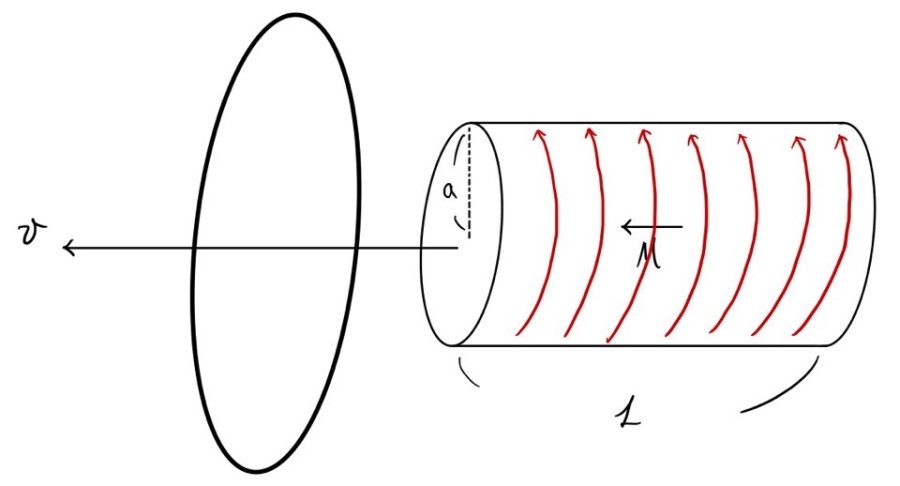
this kind of picture!!!
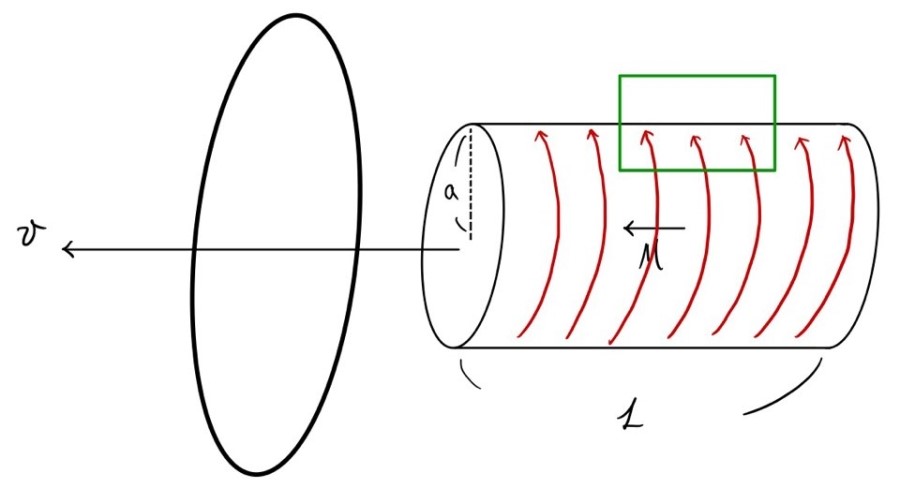
Now if we set up an Amperian loop like this, the formula 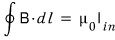 gives us
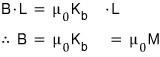
The magnitude of the magnetic field becomes that, and if we include the direction too, it’s this way ← lol
Now I want to draw $\Phi$ as a graph against time lol!!! Easy, right?
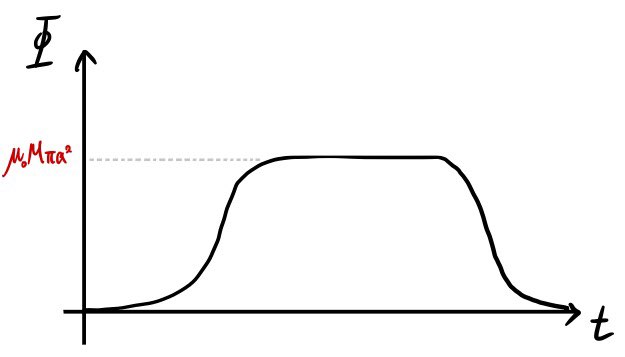
The reason the maximum of the flux $\Phi$ is $\mu_0 M \pi a^2$ is just,…. easy…. skipping. (Because $B = \mu_0 M$ anywhere inside the magnet, which acts like a coil?!)
Now let’s draw the EMF graph with respect to time!!! Not hard, right??!!
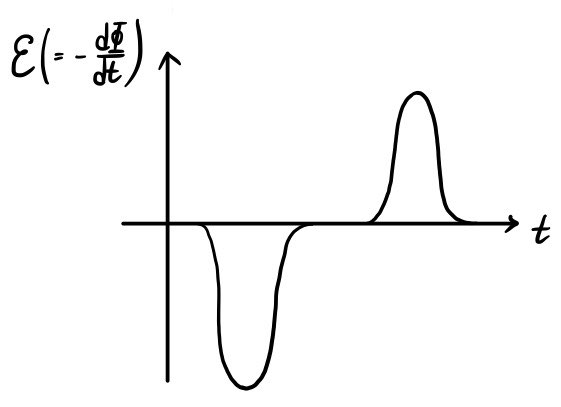
As for which way this EMF goes, it’s generated to bring things back to the original state… (you’ve heard of this, right?!) When the magnetic field ← is generated in the loop, the wire loop says “hey no, piss off”. And in order to cancel it out, it generates magnetic field → in this direction….lol lol
“Nature hates change.”
(fun fun. In chemistry this property of nature seems to be represented by Le Chatelier’s principle?~~?~~~~~)
Heads-up. The figures here are the original notes, slips and all. A few things to watch for:
- In the equation of motion for the sliding bar, the magnetic force opposes the motion, so it should read $m\dot v = -\frac{B^2l^2}{R}v$ and $\dot v + \frac{B^2l^2}{mR}v = 0$; the picture has the opposite signs. The decaying solution in the next picture is right.
- In the energy check, the last line drops a minus sign: the bracket at $0$ is $-\frac{B^2l^2}{R}v_0^2\frac{mR}{2B^2l^2}$, so the result is $0 - \left(-\frac{1}{2}mv_0^2\right) = \frac{1}{2}mv_0^2$, as shown.
Comments
Discussion happens via GitHub Discussions. You'll need a GitHub account to comment.