Faraday's Law — Induced Electric Field
Using Stokes' theorem to connect changing magnetic flux and the electric field, we derive ∇×E = −∂B/∂t and apply it to a worked example!
Previously

from this perspective, we saw that when the magnetic field $B$ changes, an EMF is generated!!! hehe So now we can connect the magnetic flux $\Phi$ and the electric field $E$! (This is so we can see the relationship between $E$ and $B$)
We’ll use  and
and  , and
, and  too!!!
Then
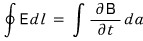
the left and right sides have different integrals.. The left side slaps an integral over a closed curve, and the right side slaps one over the area inside that curve, so oho!!! Stokes’ theorem comes to mind. Let’s use it to match up the integration regions!!
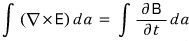
Since the integration areas are the same, by the logic that the integrands must be equal
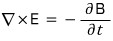
Whoa!!! What is this!!! The curl of the electric field was zero!?!?
That was in electrostatics… now it’s No electro-static… hehe So compared to before, it’s been ‘generalized’ one step further!!!
Anyway, the important point is: regardless of the cause, when the magnetic field $B$ changes, an electric field is generated!!!
(The direction is the curling direction, um~~~ a rotating direction?~?~? If this doesn’t make sense, I’ll try to prepare a post about curl!!)
So now, with this logic, let’s solve a problem… I think that’s all for the concepts…… we’ll look at how to apply it to problems~~ stuff like that
Example 7.7
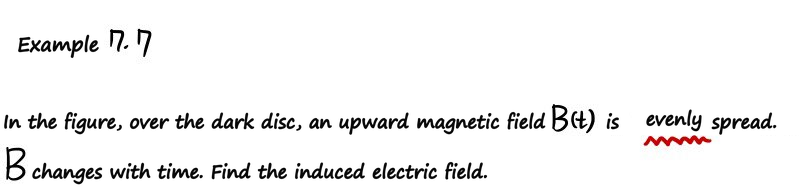
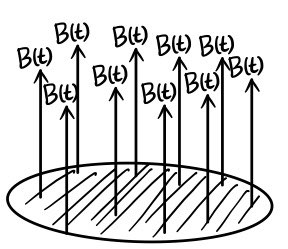
Looking at this, I’ll work backwards. $B(t)$ exists at every point in that black region, and $B(t)$ changes with time. That means
interpreting it this way, “Since $B(t)$ changes at each point, $\nabla \times E$ does exist.”
But since $B(t)$ is the same~~ at every point, the value of $\nabla \times E$ at each point must be the same!!!
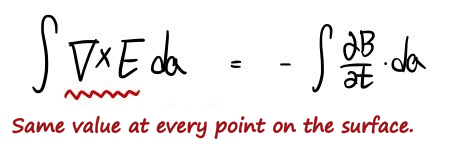
↓
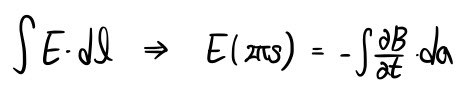
So, continuing the above equation and writing out the cut-off part,

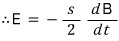
The magnitude of the electric field is this, and the direction would be the tangential direction~~~~~ hehe
Example 7.9
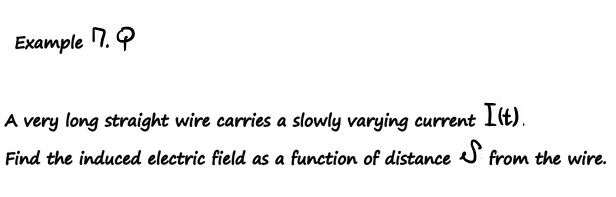
Current flows, and $B$ is generated around it, right. Now, if that $I$ changes, the $B$ generated around it also changes~~~ And if $B$ changes at some point, an induced electric field will be generated around it.
This problem seems to be asking to calculate that induced electric field. heh First, as a review, let’s find $B$ using an Amperian loop!!! hehe
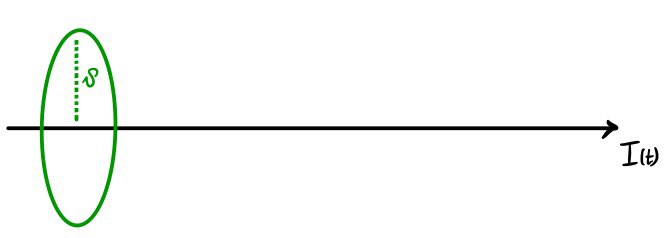

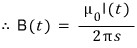
$B(t)$ was easy to find as expected. Now we need to swap out the closed curve. Because if current $I$ passes through inside the closed curve, it gets in the way of finding the induced electric field we want. On top of that, $B(t)$ is a function of $s$, and it’s not defined when $s = 0$, so I moved it!!!
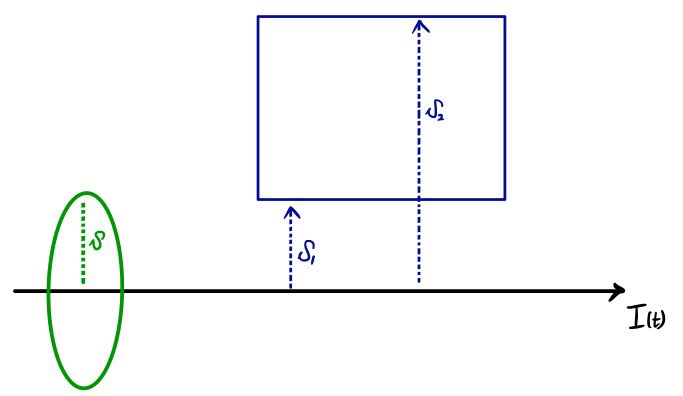
As for why it has to be that kind of rectangle: $B(t)$ represents the magnetic field at each single point. So to make it something like a set of points with the same $s$, I placed that rectangle.
Alright then, let’s calculate the induced electric field.
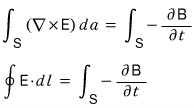
So the left side is

The right side — for starters, the direction of $B$ and the direction of $da$ are the same
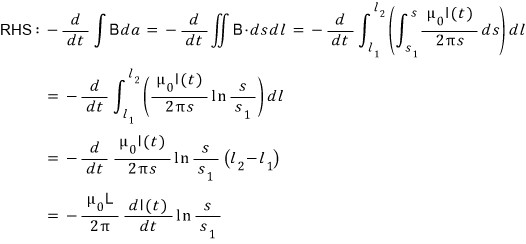
So then
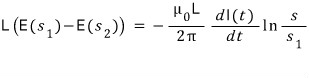

Doone!
Prob 7.17
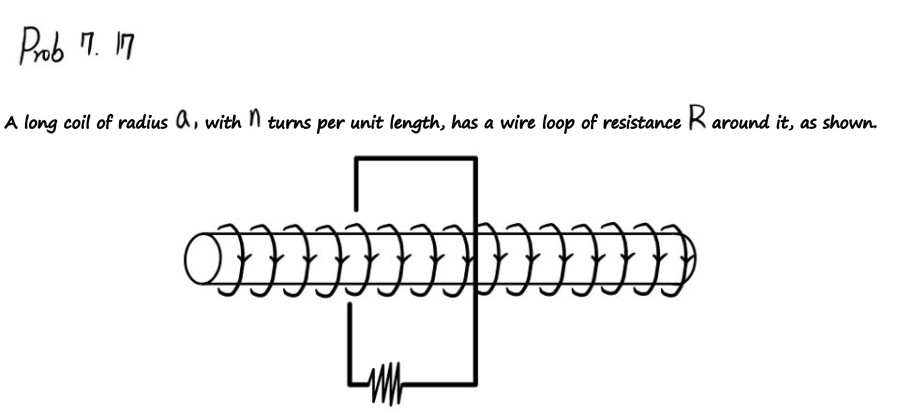
If we steadily increase the current in this coil at a constant rate of change with time, how much current flows in the loop, and in which direction through the resistor?
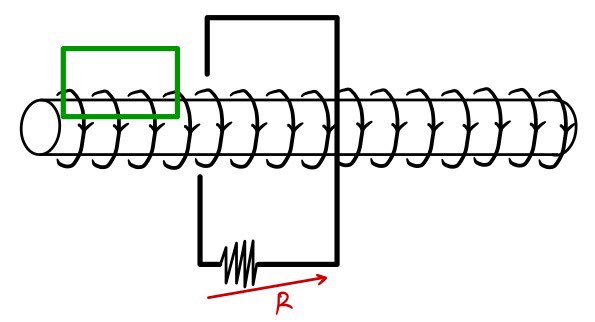
As another review, let’s find the magnetic field inside the solenoid. Setting up the Amperian loop like that and calculating $B$,
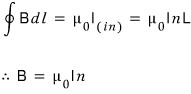
easy as always hehe
Now what we’re curious about is the “current” that arises in that loop. (Not the induced electric field inside the solenoid.) So we need to use  :
:

The magnitude of the EMF is calculated like that! Let’s find $I$!!
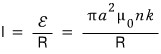
Yesss!!
The direction is whichever direction cancels out the suddenly-appeared magnetic field, so from $R$’s point of view, from back to front!! (the red arrow!)
Yo~~~
Heads-up. The figures here are the original notes, slips and all. A few things to watch for:
- In the two small formulas of Faraday’s law in integral form, the right-hand side needs a minus sign: $\oint \vec E\cdot d\vec l = -\int \frac{\partial \vec B}{\partial t}\cdot d\vec a$, and likewise $\int(\nabla\times\vec E)\cdot d\vec a = -\int\frac{\partial \vec B}{\partial t}\cdot d\vec a$.
- In the right-hand-side calculation for the long wire, lines 2 and 3 still carry $2\pi s$ in the denominator; after the $s$ integral the factor is $\frac{\mu_0 I(t)}{2\pi}\ln\frac{s}{s_1}$. The last line, $-\frac{\mu_0 L}{2\pi}\frac{dI}{dt}\ln\frac{s}{s_1}$, is right.
- The final result should read $E(s) = \frac{\mu_0}{2\pi}\frac{dI}{dt}\ln\frac{s}{s_0} + E(s_0)$, which follows from $L\left(E(s_0) - E(s)\right) = -\frac{\mu_0 L}{2\pi}\frac{dI}{dt}\ln\frac{s}{s_0}$; the picture has the opposite sign and leaves $\ln s_0$ outside the factor.
Comments
Discussion happens via GitHub Discussions. You'll need a GitHub account to comment.