The Poynting Vector
We're uncovering the Poynting vector — a quick dive into electromagnetic field energy and conservation laws before jumping into electromagnetic waves!
This time’s goal is none other than uncovering the Poynting vector!!!
A vector, derived by the British physicist J.H. Poynting, that represents the energy flow of the electromagnetic field.
Derived by the British physicist J.H. Poynting (1852–1914). In vacuum, between the magnetic flux density $B$ and the electric field $E$, if we denote the vacuum permittivity and permeability as $\varepsilon_0$ and $\mu_0$ respectively, and time as $t$, the following Maxwell’s equations hold.
It’s something like this~ Um,, after this come momentum, angular momentum, and the Maxwell stress tensor!!!! I’ll skip those and move on heh. If you follow along in the book, that part won’t be hard. The Maxwell stress tensor is hard to understand from the book alone, but if you look at the part I wrote up as an appendix, it’ll be easier to understand mathematically.
So, let’s uncover the Poynting vector here!!!! And from the next post on, it’ll be the long-awaited ’electromagnetic waves’!
Yes, so this post goes right into the Poynting vector. Just simply, a story about energy~~~ It’s not hard! Since the Poynting vector is used a lot with electromagnetic waves, I think we need to know its definition precisely before moving on.
Why is the title of Chapter 8 “Conservation Laws”?
First, to live up to the title, let’s account for all the energy in space!! Accounting for the energy that exists in the form of electric and magnetic fields,
- The energy it takes to drag charges into some space one~by~one~ = the total electric energy in the space
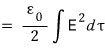
- The energy it takes to make a current flow in some space = the total magnetic energy in the space
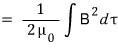
(For why these are the way they are, please go look at the earlier posts of this series >< Electric Potential (Part 2) (Electromagnetism I Studied #4))
Therefore the total energy stored as electromagnetic field energy in the space is
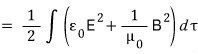
Lo~~ng ago, I think that one was introduced so we could put it to use right about now; let me pull it out in a different way. With the work-energy theorem!
The work-energy theorem
Originally ‘work’ is adding up $F$ along the $\ell$ direction all the wa~~~~y!?!?!? Right?!?! hehe

(I only just now discovered that the equation editor has a cursive ell ($\ell$)……hehehe)
Then the $F$ here will be the force due to the electric and magnetic fields,

and if we write $d\ell$ as the distance the charges travel during the time $dt$,

Therefore
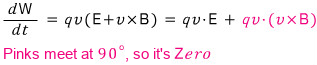

What if the charge distribution is continuous???? Let’s extend it that way: we can just use the relation  . Then,
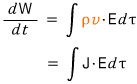
Argh, $J$ suddenly shows up -.- Using Maxwell’s Eq. let’s express $J$ in terms of $E$ and $B$
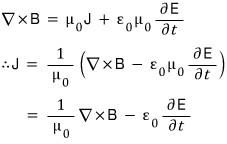
Then here’s what the equation above becomes
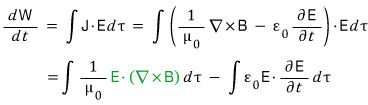
It becomes like this, and I’m going to pull a little prank and express that green part a bit differently lol
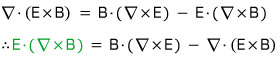
Substitute, go go go!

Into the purple, let’s plug in one of Maxwell’s equations, and plugging it in

A symmetric term just went and popped up like this. The two are too far apart, so they’re both about to cry.. okok, I’ll let the two of them hug each other

Now if you think about pinky and reddie just a li~~ttle bit,
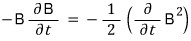
if you change it and express it like this!!!
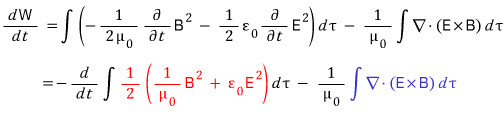
Oh my~~~ how do you do, Mr. Red~~~ aren’t you the total electromagnetic field energy stored in the space!?!?
Let’s call the energy stored in the electromagnetic field per unit volume $u$, and Mr. Blue over there, let’s express him with a surface integral using the divergence theorem.
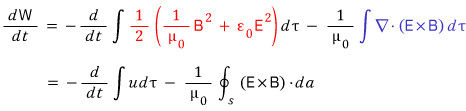
The Poynting vector
So what does this mean?
At the very beginning, we said that when $q$ is pushed by the electromagnetic force, integrating that over $d\ell$ is ‘work’, right? When the charges get that work!!!!!  , at that moment the energy that had been stored as the electromagnetic field in that space disappears,

But~ apparently through that surface “some vector  ” is leaking out.
So, just like we alway~~~~s did,
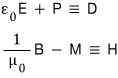
just like we did with these, we’ll newly define this some-vector too!
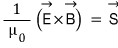
This vector is called the Poynting vector, and what $S$ means is “Energy flux density”
Um, this guy is “the energy carried by the fields that passes through a unit area per unit time” — that’s exactly what the ‘Poynting vector’ means.
If you look at it in a space with n~~~othing in it (no charges either), I think you’ll probably get it.
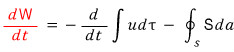
Since there are no charges to do work on either, the red one is Zero
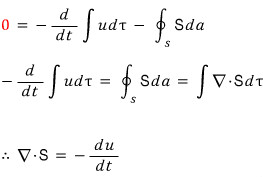
Expressing it like thiiis might make the meaning easier to take in.
The rate of change of the disappearing energy = the divergence of $S$ (the derivative of $S$ with respect to space)
It’s harder to say in words…. In the book there’s also an additional explanation like this


Ex. 8.1: Joule heating
When current flows along a wire, the electromagnetic force does work on the charges and the wire heats up — Joule heating occurs. There’s an easier way to compute the energy delivered to the wire per unit time, but you can also do it using the Poynting vector. If the wire’s material is uniform, the electric field parallel to the wire is
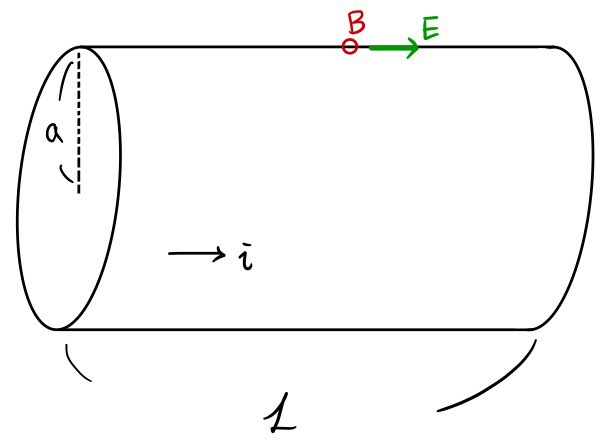
Since $V = EL$, $E = V/L$. How do we find $B$? I’ll use an Amperian loop.
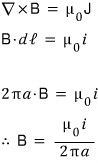
So $E$ points to the right, and $B$ pops out of the monitor, and the direction of $E \times B$ would be toward the center of the wire. Let’s look at the magnitude of $S$.

Describing the direction of $S$ as well,
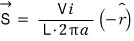
Now the next post, as I said, will move on to electromagnetic waves!
Ah and also, while studying electromagnetic waves now, I heard something about the Poynting vector. Since this post is about the Poynting vector anyway, I’ll write it down here once, and I’ll also write it in later posts.
Professor: “Light goes from here to there…. What is that?”
Student: “??????”
Professor: “Heh heh heh heh, now, couldn’t you think of light traveling as the Poynting vector????”
Me: “Heh heh heh heh, is that so? hehehe I’ll switch majors bye bye bye”
Heads-up. The figures here are the original notes, slips and all. A few things to watch for:
- In the straight-wire picture, the second line is Ampère’s law in integral form, so it needs the loop integral: $\oint B\cdot d\ell = \mu_0 i$, which gives $2\pi a B = \mu_0 i$ on the next line.
- The work and flux lines leave out dot products: $dW = F\cdot d\ell$, $\frac{dW}{dt} = qv\cdot(E + v\times B)$ and $\oint S\cdot da$. And since $u$ depends on position as well, the last line is $\nabla\cdot S = -\frac{\partial u}{\partial t}$.
Comments
Discussion happens via GitHub Discussions. You'll need a GitHub account to comment.