Electromagnetic Waves — Wave Basics
Before diving into EM waves, let's nail down what a wave actually is — and derive the 1D wave equation from a taut rope using Newtonian mechanics!
Before thinking about electromagnetic waves…. which you’ve probably heard a lot about…. I think we first need to get to know this thing called a ‘wave’.
Hmm~~ apparently, from the very start, there’s no satisfying answer anywhere in this world to the question “what is a wave???” All they say is that the essence of a wave is “a wiggle of the medium spreading out at a constant speed while keeping a constant shape”….
(Hmm… I don’t think there’s anything to refute in that statement, nothing to nitpick…? But doesn’t light have no medium?)
For now let’s not think too deeply and just keep following the book.. Well anyway, this is going to be the time to model that axiom-like statement with equations.
Deriving the 1D wave equation
Let’s have a go at deriving the 1D wave equation!!! First, the essence of a wave is, as said above, ““the ‘medium’ goes wiggle-wiggle~ in a steady way!”” That’s what we’ll run with.
Let me flick!!!! a taut! taut! rope with my hand. Then the rope will do wave motion without fail, and working out that wave motion with Newtonian mechanics will be our first task.
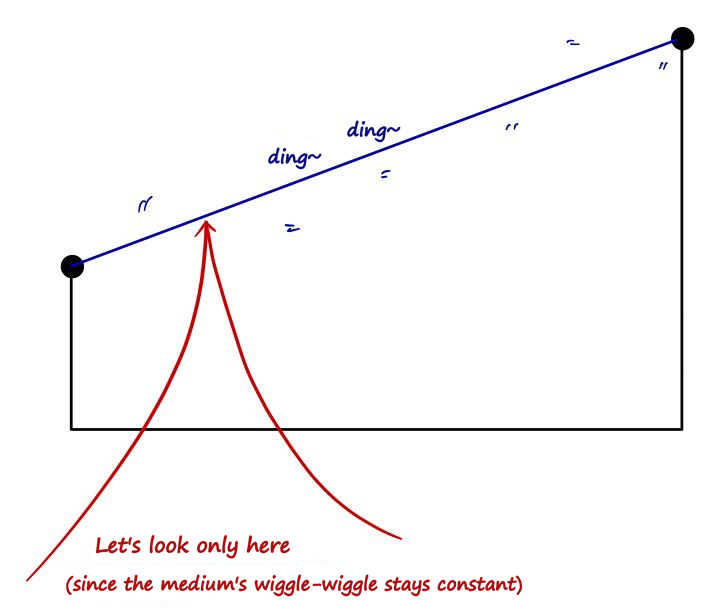
Let’s zoom in like crazy and look at!!! that spot, and at that moment snap!!!! a photo. (Taking a photo is a metaphor for fixing the time variable $t$.)
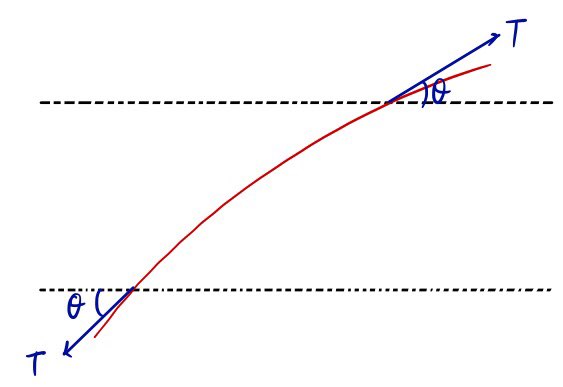
The force that a freakin’ tiny piece of rope receives is clearly all tension, so the net force in the vertical direction ($y$-axis direction) will be the source of the acceleration of the medium (the rope) wiggling up and down. That net force is

$\theta'$ and $\theta$ are strictly different, and apparently, given enough time, you could show that this net force gives a wave equation. But our goal right now isn’t that: it’s to derive the string wave with Newtonian mechanics using a somewhat easy model, and since for that easy model we said a taut! taut! rope, we’ll assume  .
.
When $\theta$ is freakin’ small, it can be approximated as  .
.
(Anyone who doubts it can plot the Taylor expansion in Matlab or whateverr haha)
Then
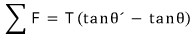
The reason I bothered to switch to tangent and write it like this is, what you can do by switching to this form is: $\tan\theta$ is the ‘slope’, and since it’s a freakin’ tiny point, viewing $\tan\theta$ as the “(instantaneous) slope”
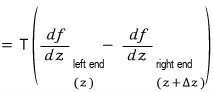
I went and introduced a variable out of nowhere… T_T Like in the book, let me set the horizontal below as the $z$-axis and the height of the medium as $f$.
Alright now I’m going to multiply that equation by 1. But not just any 1, a kind of grandiose 1 hehe (not really grandiose)
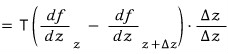
Alright and now the shenanigans begin!!!!
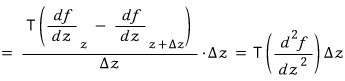
If anyone doesn’t get that the middle term is the second derivative with respect to $z$, they should go back and look at high school calculus hehe
Alright alright alright, but we were looking at the net force (Net Force), right??? And Uncle Newton said ‘force’ is $ma$, right. Then we could also look at the exa~~~ct same net force like this.
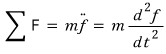
Oh my god!!!!! Viewed this way, we can also see it with respect to time~~
Alright, but up there there’s something to fix, lol — $m$ is a letter that’s often used for total mass,,, so I’ll fix it! Why?!?!? Because we’re looking at only a super freakin’ tiny part. If we call the mass per unit length $\mu$ (so the tiny piece $\Delta z$ has mass $\mu\Delta z$), we can now write the equation like this
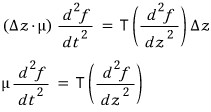
Now it’s time to hear something a little chest-tightening. The book says this T_T: “As you’ll soon find out,  .”
.”
Let’s be patient just a bit!! For now!!!!! Apparently that’s how it is…. Argh,,,, it feels really stuffy in my chest,,,, T_T let’s be patient ….
So the equation we organized above can be written like this.
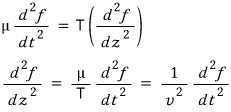
Aha, but now rather than expressing it with total derivatives, I should express it with partial derivatives hehe
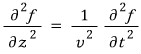
<(classical) wave equation>
Oh ho, this gives a slightly similar feel to the Schrödinger equation for probability waves that I know, but it’s also different. So apparently, the wave equation derived from the classical-mechanics $F = ma$ like this is called the ‘classical’ wave equation.
Alright anyway, ‘our goal right now’ that I kept mentioning earlier seems to have been accomplished. To sum it up again:
When there’s a wave, if you look at just one piece of the medium~ you can see that the height of the medium ($f$) differentiated twice with respect to position ($z$), and differentiated twice with respect to time $t$, are related! And in between them, the reciprocal of the (wave) speed squared is tied in!
A wave is that kind of thing~~~~ — the purpose was to catch on to that. Alright, so we’ve learned that a wave is a solution of that kind of 2nd-order differential equation. The reason we bothered using Newtonian mechanics is, as said before, to see once that a wave has such-and-such relations.
Sine waves
So now let’s look at the sine wave, which we know well (and have seen a lot empirically in real life).
(Also, the reason sine waves are important… if I write it out again, according to Fourier’s theorem, no matter how crappy a wave is in the world, it can be represented as a linear combination of sine waves~~~~~ (‘Fourier series’, or its big brother, the Fourier integral)…. because of that)
Of course here too we’re thinking about looking at the position of the medium. First, a wave depends on time $t$ and also on position $z$. If we express it with independent variables, we can write $f(z,t)$, and for now let’s think in 1D for simplicity.
There’s a wave traveling with speed $v$, and our eye is fixed!~ at some point called $z$, and at that time~~! if the time was $t$, ========> $f(z,t)$. But this would have been “the position of the medium at position $z-vt$, $t$ seconds ago” ========> $f(z-vt,0)$.
Supplementary explanation with a picture:
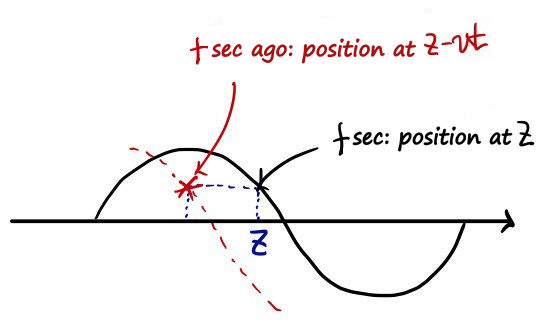

As the book also mentions, what did this trick actually do?
It combined the two variables $z$, $t$ into a single variable, “$z-vt$”.
(The cool thing is if you look at the units of $z-vt$ it’s [m]… yep, distance)
Alright so we’re now thinking about the sine wave that we consider most fundamental, and the variable of the wave function is ‘$z-vt$’ apparently. Oh ho, a sine function with variable $z-vt$!?!? This is a piece of cake!!!!

(While throwing a whole fit saying it’s a sine wave~~ why am I writing cosine~~ the reason will be revealed in a bit)
Oh ho but!!!!! by including some constants that can be determined by initial conditions, let’s try to represent every sine wave in the world!

By some initial conditions $A$, $k$, $\delta$ are determined, and what kind of initial condition determines each of the constants? The constant $A$ is the amplitude!!!!! This is just common sense — how hard you shook it~~ determines $A$. Then $v$ is the wave’s speed, and $\delta$ is the phase difference!!!! (If I express it in words, I think the best way to say it is “at what time did you start looking” at the wave that’s flowing slowly~~)
Then $k$!!!! What is this!!!!
If we get rid of the phase difference and think about it

The meaning of $k$ is: how many $\lambda$ (wavelengths) are contained in $2\pi$ [meters].

Then the equation above is
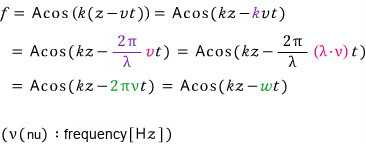
The conclusion for a wave traveling to the right with speed $v$ has come out! heh heh heh Then as a Bonus, we can also know a wave traveling to the left with $v$: $v$ just changes to $-v$. Nice.
We’ve figured out the equation that represents the waves we see in everyday life, or when we use simple models.

Switching to the exponential
But… trigonometric functions,,,, nice, sure.
But no matter how convenient trigonometric functions are, could they be more convenient than exponential functions?????
That’s a no-no~ The reason I’m saying this is that trigonometric functions and exponential functions are basically the same guy,,,, so wouldn’t it be better to switch to an exponential function that’s easier to handle and play with the equation? The above
this
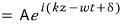
can we write it like this??? Pro~bably~ not~? If we expand 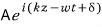 ,
,

an imaginary term gets attached like this. So

we’d have to write it like this~~~~~~
Just one more thing,,,, who wouldn’t know that delta is the phase difference… Probably in electrical engineering? Electronic engineering? In those fields they write  , and
, and

they’d probably express it like this??? (not really sure though,,, hehe??)
I’m in the physics department~~ we’ll write it like this!!!!! We’ll write  , so the equation above is
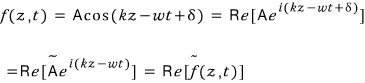
Like this!!
<<Tilde and No-tilde are confusing,,, just think of it as “the phase difference will be considered later~”. Because the wave’s identity is all inside the exponential>>
Incident, reflected and transmitted waves
So then our equation

let’s use this to look at incidence, reflection, polarization — things you learn in Physics I!!! (I’ll do it with electromagnetic waves later, but before doing that it’s just… practice!)
Alright now if we look at the incident wave and the transmitted wave, at the boundary of the media the tension $T$ is the same, but the mass per unit length $\mu$ of the two media is different, so the speed $v$ changes!!!! (However, the frequency of the wave is the same regardless of whether the medium changes or not.)
Why is the frequency of the wave constant??!?!
The content is kind of obvious, but to explain it with a picture:

↓

↓

↓
A wave given with a frequency of ding-ding-ding! like that will keep goi~ng as ding-ding-ding! But if you say that at the point where the medium changes, suddenly ding-ding-ding turns into diri-diri-di-ro-ro-ro-rong,,,, well,,,,,T_T
So due to the change in medium, the speed of the wave changes. If the speed of the wave changes, the wavelength $\lambda$ will change! (since the frequency $\nu$ is fixed) Since frequency being invariant means $\omega$ doesn’t change,,,, now I’ll write this as an equation.
Let me apply an incident wave (traveling to the right)

— don’t write it like that, let’s extend our thinking into the imaginary domain (for convenience of calculation).

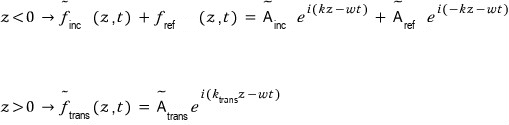
At the boundary of some medium, the transmitted wave with the same frequency $\omega$ goes to the right,,, and the reflected wave will head to the left with $\omega$ unchanged. And since $\tilde{A}$ is related to energy, the $\tilde{A}$ of the reflected wave and of the transmitted wave will be different from the $\tilde{A}$ of the incident wave.
And the speed of the incident wave and the speed of the transmitted wave are different, and if the speeds are different the wavelengths are different, and wavelengths being different means $k$ is different.
Reflected wave heading left:

Transmitted wave heading right:

Let’s say $z=0$ is the boundary where the medium changes. On the incident side ($z \lt 0$), the superposition of the incident and reflected waves will keep happening, and on the transmitting side ($z \gt 0$), the transmitted waves will be proceeeeeeding along
Alright, a question here….
“Guys, if you shoot a gun into water, what path does the bullet take….”
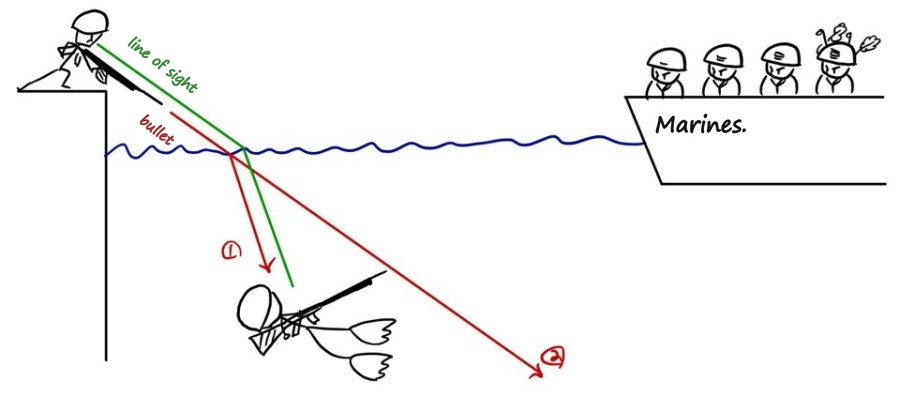
If it were to go along path ①, that means at the very moment!!!!! the bullet hits the water, the bullet would have to bend,,,, To bend like that
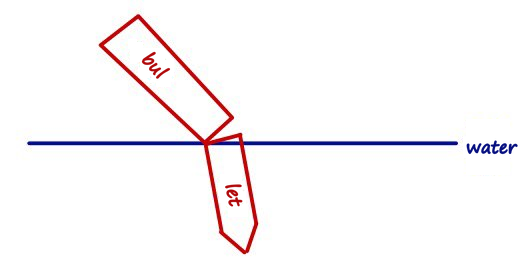
??????
QED, bullets go in a straight line, so hitting a diver is a tough job.
The reason I suddenly did a Marine Corps bit is actually because I wanted to say we should look at the boundary like the bullet proof!!!! At that very moment the medium changes, at that point

if this doesn’t hold, the logic becomes like the rope breaks, just as the bullet is cut,,, so we must satisfy this!! Since we just plug in $z=0$,
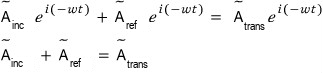
This is really the end, but using the assumption “the derivative is also continuous”, let’s go a tiny bit further. (If the knot joining the two ropes is practically massless, the derivative is continuous too — otherwise the knot would feel a net force)
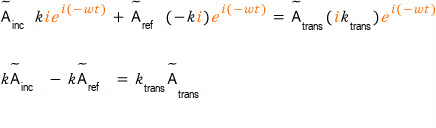
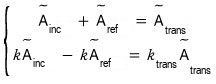
Now what I’m going to do is: I’m going to substitute the first equation into the second equation (in 2 different ways).
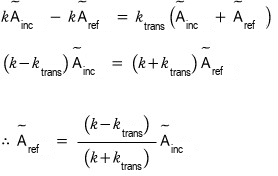
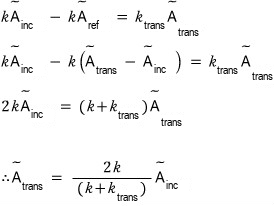
Transmitted in terms of incident, and reflected in terms of incident: we’ve obtained these two relations. And not only with $k$, we can also express them with the speed $v$!
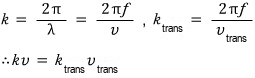
Using this relation, if we express the above two differently
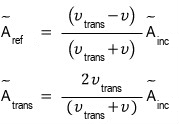
Alright so from the equation above, let’s go to the real-real version with the tildes blown off.
And what we’re going to do while we’re at it is… just… I’ll write it…. First
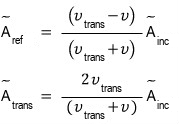
this
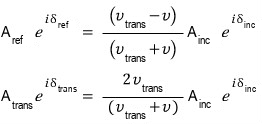
write it like this, and draw a line zap!!! through the middle, and treat the north side as the numerator and the south side as the denominator.
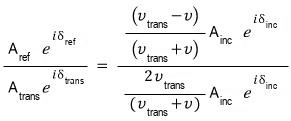
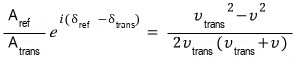
Having organized it like this and looking~~ at it~~~ the right side is unmistakably a real number!!! but looking~~ at the left side~~ real + imaginary!!! it’s a complex number!!
Ahem~~~~ for the equation to hold,,, the left side has to be a real number!!! and there’s only one way to be real.

The red dude has to be 0, there’s no other way!! That case is
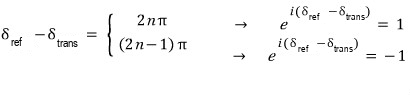
That is!!!
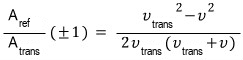
① In the case  , it’s positive: it’ll be
  , and this is “when the medium it passes into is lighter (smaller $\mu$)”
② In the case  , it’s negative: it’ll be
  , and this is “when the medium it passes into is heavier (larger $\mu$)”
Aha! So case ① is  , and~ case ② is this way

so it’s like this~ — which is what we learned in high school:
Fixed-end reflection flips the wave!!!! That’s exactly it.
Alright so in the next post it’ll be time to truly truly learn electromagnetic waves properly, right?? T_T omg already trembling…….
Electromagnetic waves were really hard T_T Even though I’m reviewing this, I think it’ll be hard…..Ha…..
Heads-up. The figures here are the original notes, slips and all. A few things to watch for:
- In the string-segment picture and the two after it, the net vertical force is $T\left(\frac{\partial f}{\partial z}\Big|_{z+\Delta z} - \frac{\partial f}{\partial z}\Big|_{z}\right)$: the right end’s slope minus the left end’s, the other way round from the picture.
- For a heavier second string ($v_{trans} \lt v$), the transmitted wave stays in phase and the reflected one flips: $\delta_{inc} = \delta_{trans} = \delta_{ref} + \pi$ (the last picture puts the $\pi$ on the transmitted wave).
Comments
Discussion happens via GitHub Discussions. You'll need a GitHub account to comment.