Reflection and Transmission of Normally Incident Electromagnetic Waves
We dig into what happens when an EM wave hits the boundary between two linear media, using Maxwell's boundary conditions to work out reflection and transmission!
Picking up right where the last post left off.
Alright!!! What we’ve now seen is BOTH the case with a linear medium and the case without one!!! So now I’ll throw out a question.
“What happens when the medium changes from vacuum into a linear medium~~~~~~~” or “What happens when it changes from one linear medium to another linear medium~~~~~~~~”
Now I’ll set off to find the answer to this question. The key would be in the “boundary conditions,” right????? (Just like in the bullet discussion — the wave can’t be cut off~), that’s how we’d think about it.
At the boundary!!!!! Do you remember how we derived those boundary conditions? When we learned Maxwell’s equations!! Back then in Chapter 7, by placing a Gaussian surface at the boundary surface and setting up an Ampèrian loop!!!
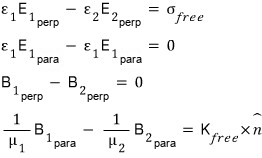
This is what we learned. Based on these equations, let’s go find out about reflection, transmission, and refraction! First, let’s look at the reflection & transmission of the electromagnetic wave, and then refraction after that, in that order.
Incident, reflected and transmitted waves
Let’s say the change in medium happens on the $xy$ plane ($z=0$) (i.e., the two linear media are in contact at that location), and the electric field $E$ simply wiggle-wiggles along the $x$-axis (the polarization vector is $\hat{x}$). Then the wiggle-wiggle direction of $B$ will automatically be along the $y$-axis!
Alright then, let’s shoot a wave from left to right. Shooting!!! Pew~
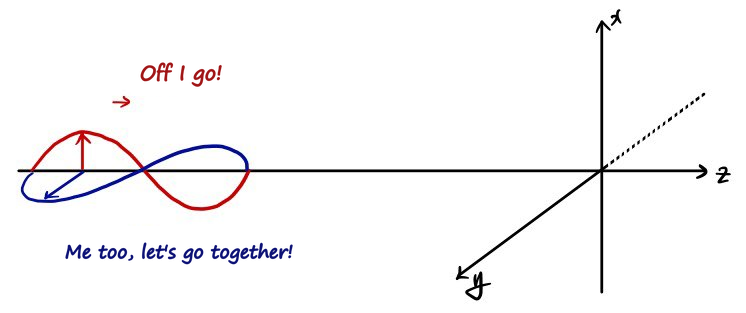
Alright! Off we go!


So~ then on the $xy$ plane ($z=0$), the reflected wave and the transmitted wave are ~~~~~~ Before saying that — for the reflected wave, the wave number ($k$) doesn’t change, only the sign changes!!!
<Once again ‘why?’ : the frequency of a wave that’s been launched once doesn’t change…. But the speed changes depending on the medium….. so the wavelength $\lambda$ changes, which means!! the wave number $k$ will change!!!!>
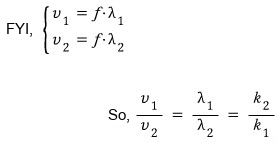
Anyway, so the reflected wave will turn out like this!!!!


<The reason there’s a (-) on the magnetic field: the (-) has to be there so that the Poynting vector for the reflection points in the same direction as the reflected wave!!!!! If the two directions are different, that would mean some kind of weird… physical phenomenon, so apparently it becomes a nonsensical equation!!!! The (-) was attached to prevent the weird conclusion that the wave goes left while the energy flow goes right!>
Nice nice, while we’re on a roll, let’s look at the transmitted wave too!!!!


What this is saying right now is that at $z=0$,
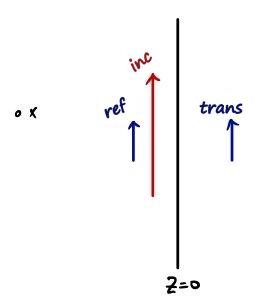
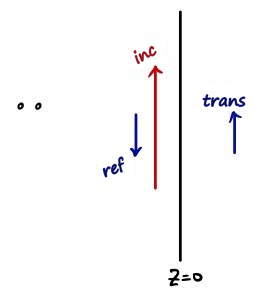
I can’t say for sure, but it’ll be one of these two situations. Whether it’s a free-end reflection or a fixed-end reflection, it’ll be one of the two, right?
The boundary conditions at z = 0
Anyway, as we confirmed earlier, $E$ has no $z$-direction component, so we don’t need to bother with the perpendicular-direction boundary condition. So, focusing on the parallel component,

since this is the case,
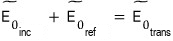
we can organize the equation like this.
Likewise, the magnetic field $B$ also has no $z$-direction component, so for it too we only need to look at the parallel-component boundary condition.
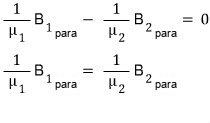
since this holds,

writing it like this
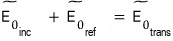

with these two equations, now we’ll mess around to derive 1. the relation between incident and reflected and 2. the relation between incident and transmitted. To do that, I’ll gently fiddle with the second equation first.
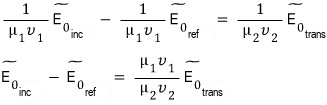
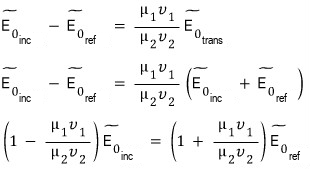
After setting it up like this, now by substituting the first relation into here, let’s work out the relation between incident and reflected & the relation between incident and transmitted.
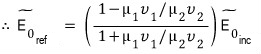
- The relation between incident and reflected
- Likewise, the relation between incident and transmitted is
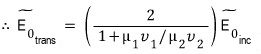
It comes out like this.
The physical meaning
Yeah. So. What. is. the. physical meaning of that, then!?!??!?!?! (Assumption incoming. ※caution: assumption※)
In reality, the permeabilities of most media are almoooost the same, so, almoooost, 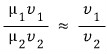 — it can be expressed this way. And also, by Snell’s law that we did back in high school (Snell’s law comes up later, so don’t be too taken aback),
  — it can also be expressed this way.
So those equations above for incident-and-reflected / incident-and-transmitted can now also be expressed in terms of the wave speed $v$ in the medium or the index of refraction $n$.
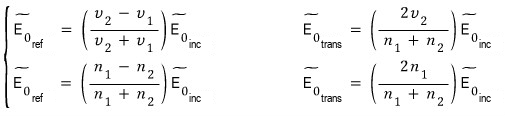
It’s the same as when we worked out the string wave at the ve~~~~ry beginning!!!!!!!! Oho oho, completely the same~~!!

Dividing the two equations against each other: when $v_2 \gt v_1$, the reflected wave doesn’t flip, and when $v_2 \lt v_1$ it flips! Yes!! (The transmitted wave never flips.)
Intensity: reflectance and transmittance
Alright then, on to the next question:
“So how much gets transmitted and how much gets reflected, huuuuhhh??~??”
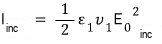
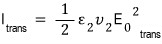
Okay! Then let’s look at the intensity:  ,
,  ,
,  . What this means is, let’s take a look at these guys.
////////
////////
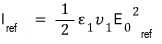
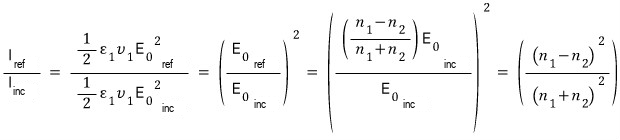
- First, let’s take a look at the intensity ratio between incident and reflected, which looks like a hella lot is going to cancel out.
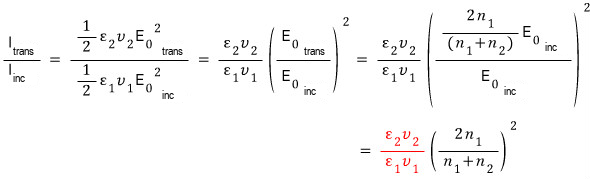
- Let’s look at the intensity ratio between incident and transmitted, which looks a bit annoying!!
@caution: assumption@ (In reality, the permeabilities of most media are almoooost the same, so almoooost) I’ll do a little magic show with this assumption.
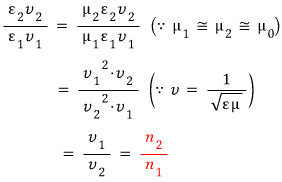
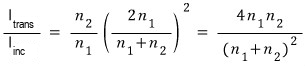
The intensity ratio of reflected to incident is called $R$, the reflectance, and the intensity ratio of transmitted to incident is called $T$, the transmittance.
Since these are ratios of energy, you can see they satisfy $R + T = 1$, bam!!!!
But you might also say something like this: “You punk -_- didn’t you bring in some weird assumption and play around with the equations? Without making assumptions, prove that R plus T equals 1!!!!” You might say that. This was actually in the practice problems.
I am planning to put up a practice-problem post at the very~~ end, but,,,, it’s not particularly hard. You can do it without the assumption. Just that the equations get a bit nastier…wahhh…..T_T
The next post will bring refraction.
Heads-up. The figures here are the original notes, slips and all. A few things to watch for:
- In the boundary conditions, the parallel component of $E$ is continuous with no $\varepsilon$: $E_1^{\parallel} - E_2^{\parallel} = 0$. The first picture’s second line ($\varepsilon_1 E_1^{\parallel} - \varepsilon_1 E_1^{\parallel} = 0$) and the later $\varepsilon_1 E_1^{\parallel} - \varepsilon_2 E_2^{\parallel} = 0$ should both read that way.
- The transmitted wave moves in $+z$, so its magnetic field has a plus sign: $\tilde B_{trans}(z,t) = \frac{1}{v_2}\tilde E_{0_{trans}} e^{i(k_2 z - \omega t)}\,\hat y$. Only the reflected wave, moving in $-z$, gets the minus sign.
- In the summary of both results, the first transmitted coefficient is $\frac{2v_2}{v_2 + v_1}$, not $\frac{2v_2}{n_1 + n_2}$; in terms of indices it is $\frac{2n_1}{n_1 + n_2}$, as the line below says.
Comments
Discussion happens via GitHub Discussions. You'll need a GitHub account to comment.