Refraction of Obliquely Incident Electromagnetic Waves
Tackling oblique-incidence EM wave refraction by ripping E and B fields into normal and parallel boundary components, then matching all four boundary conditions.
Haa………… Let me take one loo~~~ng sigh and get into it: electromagnetic waves refracting at oblique incidence.
We’ll use two homogeneous, isotropic, lossless media, with no free surface charge or current. The electric field is in the plane of incidence: this is p polarization.
I described the situation like this.
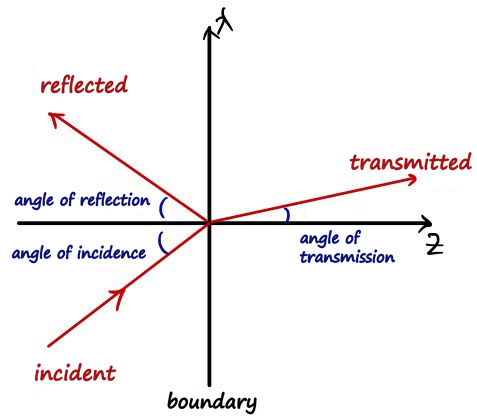
This time I’m ditching the way we described it before, a wave traveling in the $z$ direction, and describing it as an electromagnetic wave traveling through 3D space (really 2D), then going through the boundary conditions.
(Unlike normal incidence, I’ll have to use all 4 boundary conditions, right?)
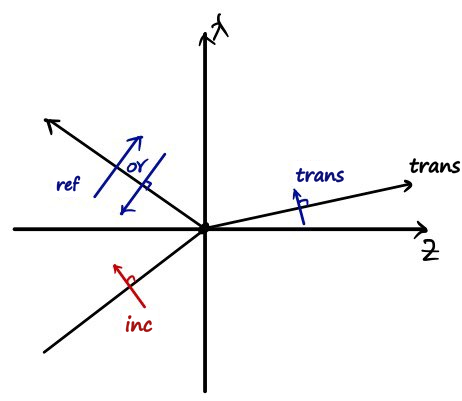
Now here too, even if we don’t know for sure, we can guess that it’ll be one of these two, like this: fixed-end reflection or free-end reflection.
And what I’m also going to do is rip the vector (at the boundary) apart into the direction normal to the boundary ($z$) and the direction parallel to the boundary ($x$), and then try to match the boundary conditions. (Not sure if it’ll work.) So first, let’s rip each of the electric and magnetic fields apart and describe them, go go go!
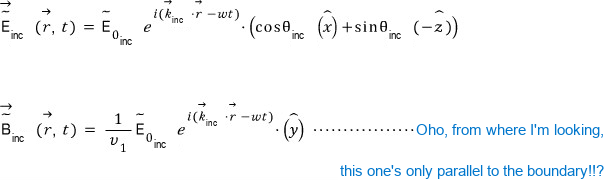
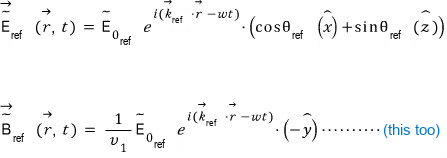
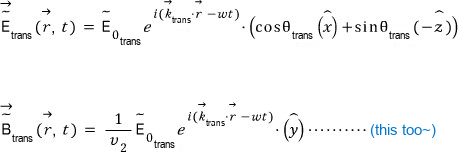
Applying the boundary conditions
Boundary conditions~~
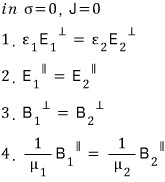
Haa…….. the second sigh, go go go. Now I’m going to apply those one by one…… T_T ugh. T_T
1 !
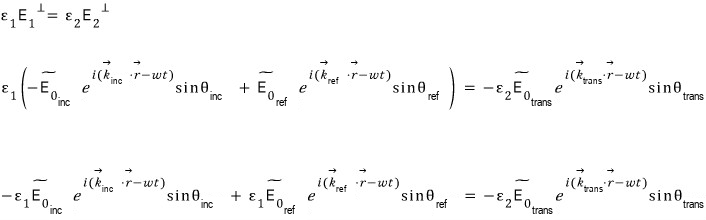
2 !
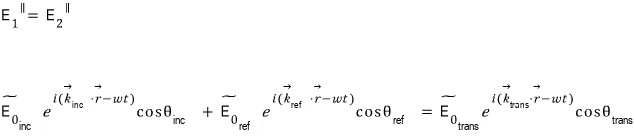
3 !

Phew~ no $B$ perpendicular to the boundary! Yessss!!
4 !
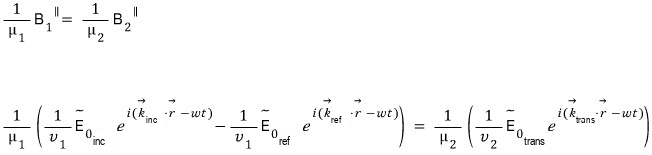
Blasting the exponentials away
Excluding number 3, we got three equations, and here’s what I’m going to do now: I’m going to blast all of these  away.
away.
The logic by which we can blast them is this: those 3 equations have to hold anywhere on the boundary $z=0$, and when $x$, $y$ change just a teeeeeeny bit, those terms each turn out different!
In that case, the only way they can survive as equalities is that those terms containing the variables all have to be the same!

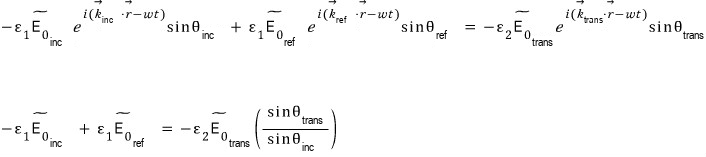
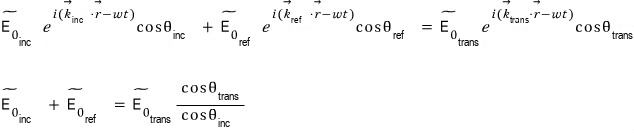
With this, those equations can alllll hold anywhere on $z=0$! And  : using this, let me clean up those 3 equations a bit more.
1
2
3
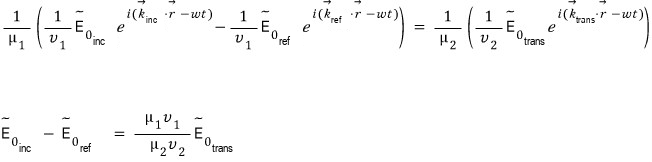
If you mess around with and manipulate the first equation, it comes out the same as the third equation. So we’ll use the second equation and the third equation to work out the relationship between incident and reflected, and between incident and transmitted.
Before that,
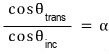
///////

let’s make these little agreements and write the equations a bit more comfortably:
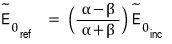
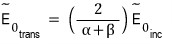
That’s the result for our p-polarized wave.
Brewster’s angle
But!!! But there’s a cool case!! (When is that!?)
There’s a special case where  holds and no reflection happens at all!!!!! (oh my, for real!?) Let me work it out.
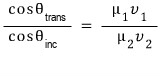
Here’s the trick I’m going to pull: the Pythagorean theorem

and Snell’s law

I’m going to play with these. That is,
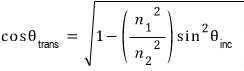
and if I plug this into that very first equation up there
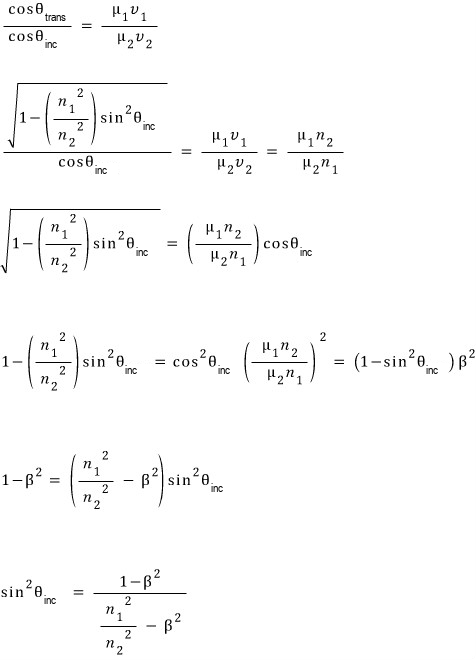
So there’s an angle of incidence at which alpha and beta are equal!!!! Apparently that angle is called Brewster’s angle!
Reflectance and transmittance
Well, anyway, getting back on track,,,, now:
“How much is reflected, and how much is refracted and transmitted??~!?~!?”
Okay then, we just need the magnitudes of the energy fluxes normal to the boundary, right?! The reflected wave travels toward negative $z$, so we use the positive magnitude of its $z$ component here~~~~~
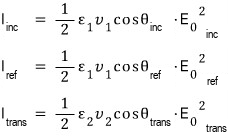
Oh, and you haven’t forgotten this, right?
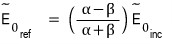
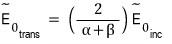
Reflectance ($R$)

Transmittance ($T$)

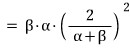
Here too (of course) $R + T = 1$ is still satisfied!!
Heads-up. The figures here are the original notes, slips and all. A few things to watch for:
- Snell’s law has a sine on both sides: $n_1 \sin\theta_{inc} = n_2 \sin\theta_{trans}$ (one picture writes $n_1 \cos\theta_{inc}$); the pictures after it use the right form.
Comments
Discussion happens via GitHub Discussions. You'll need a GitHub account to comment.