Electromagnetic Waves in Conductors — Absorption and Dispersion (Part 2)
We tackle boundary conditions at a conductor surface, cheer over the vanishing free surface current, and find that a perfect conductor reflects a normally incident wave completely, with its phase flipped!
I’ll continue writing right away. Now we’ll look at the boundary between a conductor and a dielectric.
Whether it’s incidence from a dielectric into a conductor or from vacuum into a conductor, whatever — it’s incidence into a conductor!! (A dielectric and vacuum are just a difference in $\varepsilon$, after all.) So if we write down the boundary conditions for a very general situation at the surface of a conductor,
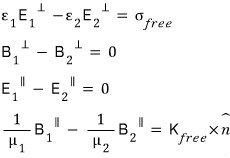
($\hat{n}$ is the normal vector, perpendicular to the surface,,)
(Ah, and also, that free surface charge density $\sigma_{free}$,,,,,,,, if you’re going to mix it up with the conductivity $\sigma$, you might, but we won’t mix them up, we’ll just press on ><) (↑what the hell am I even saying lol)
Don’t be too discouraged looking at these boundary conditions. Good news has arrived!!!
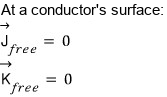
Nice, right?!?! Ahh, it’s zero~ it’s zerooooo~
Be~cau~se~ it’s a ‘conductor’, and a conductor means the conductivity $\sigma$ is huge. What that means is
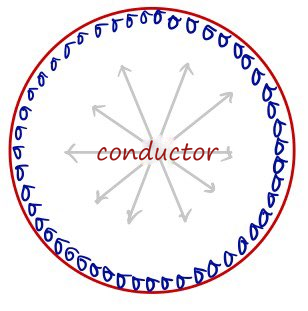
the charges balance out the forces (Coulomb force) among themselves, snap!! Thus, unless you apply an external electric field separately, there’s no way $J$ or $K$ could exist, right???
(Careful, though: our wave is an applied field, so inside the conductor $J_{free} = \sigma E$ does flow. What really vanishes is the surface current $K_{free}$: with a finite $\sigma$, squeezing a current into a sheet of zero thickness would take an infinite field. And $K_{free}$ is the only current that shows up in the boundary conditions, so the good news we need still holds.)
Incident, reflected and transmitted waves
Alright, now let’s go like we did when we were dealing with dielectrics. First of all, like before, the wave comes in normally: the polarization vector of the electric field is $\hat{x}$ (the magnetic field’s is of course $\hat{y}$), the direction of propagation is $\hat{z}$, and let’s say the surface of the conductor is the $xy$-plane ($z=0$).
Now let’s mobilize the knowledge from before. By now these equations don’t feel foreign to us at all >0<
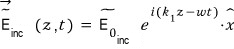
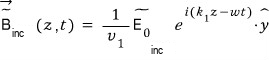
Feeling it!!!!! So what is the reflected wave!?
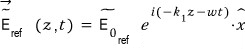
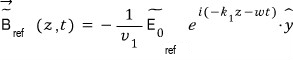
Up to there it was the same as before, so it was easy!!!!! Now the transmitted wave!!! For this one we have to mobilize the knowledge we literally just got. Okay, let’s move out!
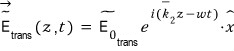
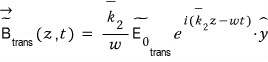
The deeper it goes whoosh~~ into the conductor, the smaller the amplitude gets, hehehe.
Checking the boundary conditions
Alright alright, ok ok, with all that done, now begins the “checking the boundary conditions” you’re probably sick to death of by now!!! Ugh!!
Ok, first of all, equation i):

And!!! There’s no ‘free’ charge density on the surface here!!!! (I never said there’s just no charge density. There’s no ‘free’ charge density.) So the right-hand side is 0, and since we have normal incidence right now, there’s no perpendicular component of $E$ either. Therefore $0 - 0 = 0$, and just like that we’ve checked equation i).
Now let’s check equation ii)!! Ye~~~s, confirmed.
From equation iii) on, I’ve got a sneaking feeling things are really going to get started~
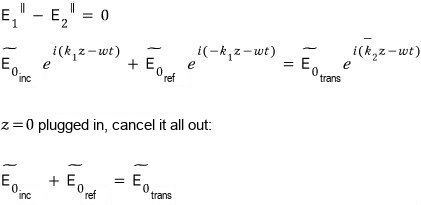
So one relation pops out~~~ (for the amplitudes). Here goes equation iv)!!
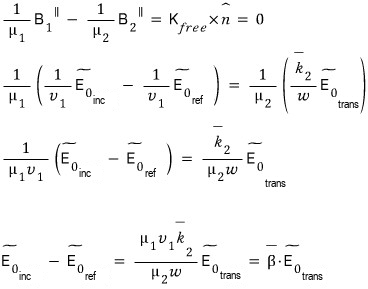
$\bar{\beta}$ is a complex number, and let’s not forget it was originally that thing up there~ And like we did before, we neatly rearrange the first relation swoosh swoosh, plug it into the second equation, and check out the incident-reflected relation // the incident-transmitted relation!!!! I’ll just write the result~ (that’s okay, right~?)
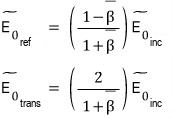
Except for the fact that the coefficients are complex numbers, it’s exactly the same as the dielectric case!?!
Ripping beta-bar apart
So now we need to rip $\bar{\beta}$ apart piece by piece.
What on earth does that complex number $\bar{\beta}$ mean!
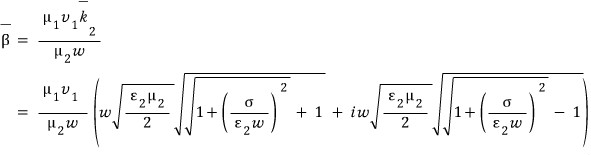
Yahoo!!! A conductor is one whose conductivity $\sigma$ is freaking huge! Plus, a perfect conductor means $\sigma$ is infinite!! And $\sigma$ being infinite means  goes to infinity, and that in turn means
  goes to infinity!!!!!!!

Aha!!! An electromagnetic wave hitting a tooootally perfect conductor doesn’t transmit at all, it’s all reflected, and the phase of the reflected wave flips the other way!!! (like fixed-end reflection)!!
I’m gonna go sleep for today ><
Comments
Discussion happens via GitHub Discussions. You'll need a GitHub account to comment.