Jefimenko's Equations
We build on the Lorenz gauge, bring in the retarded time, and finally nail the causality the Coulomb gauge was missing — hello, retarded potentials, and then Jefimenko's equations!
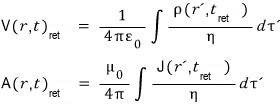
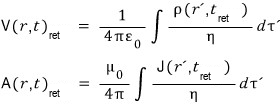
Using the Lorenz gauge from the previous post, we’ll make $V$ and $A$ more general by taking ’time’ into account too. Both potentials then show the time delay explicitly, hehehe. The Coulomb gauge gives the same causal $E$ and $B$; its instantaneous-looking scalar potential is balanced by the vector potential.
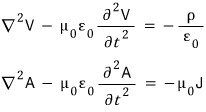
is what we’ve got~~ For now, let’s say $\rho$ and $J$ are constant~~~ in time (easy does it, step by step):
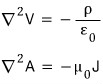
We already solved this back in Electromagnetism 1, right?
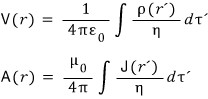
Taking time into account
But hey, we said we were going to take time into account, right? The $\rho$ and $J$ at time $t$ won’t determine $A$ and $V$ simultaneously and instantaneously. $E$ and $B$ come at the speed of light, so $V$ and $A$ come at the speed of light too, and they’re set by whatever has had time to arrive.
So $V$ and $A$ at time $t$ were made by the $\rho$ and $J$ of some teeeny bit earlier time  , yup.
Okay, now let me modify the equations.
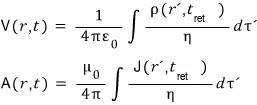
The potential $V$ at position $r$ at time $t$ /// comes from the $\rho$ at position $r'$ at the retarded time $t_{\text{ret}}$.
Alriiight~ let me express that retarded time  in terms of $t$. $V$ (and $A$) at some time $t$ comes from the $\rho$ (and $J$) at a time $t'$ before $t$, and that time $t'$ is the time it takes to travel the distance $\eta$ at the speed of light $c$ (since electromagnetic fields come at the speed of light).

So
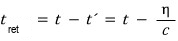
is what we can say. So that equation from before integrates $\rho$ and $J$ at the retarded time, and that’s why they make a point of calling it the retarded potential, apparently~
An example: a very long straight wire
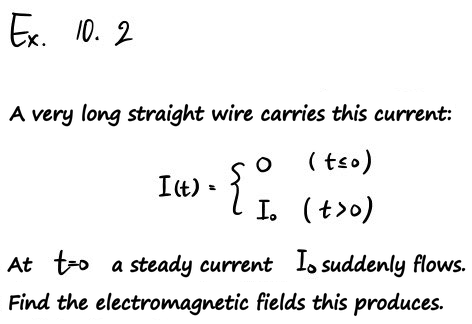
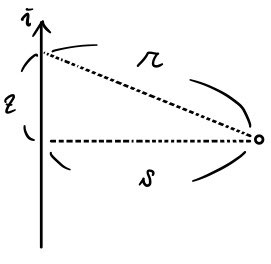
Let’s solve a problem before moving on. It’s a teeny~~ bit of an unfamiliar concept for me, so… the concpt… er, I mean the concept is kinda bewildering.
“Find the electric and magnetic fields at point P, y’all~” it says, but don’t you need some charge before you can find anything -_-!!!!
Yup, the wire is neutral, so $V = 0$. Let’s focus on the vector potential. First let me write down the formula we derived for the retarded vector potential~

Rewriting it nicely for the problem~~ (integrating the current density $J$ over the wire’s cross-section leaves the line current $I(t)$)
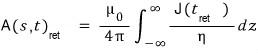
(We said it’s an infinitely long wire, so the integration range is just like that!~)
First, sta~~~rt!!! For the first $s/c$ there’ll be no change in the potential, and once more than $s/c$ seconds have passed, $A$ will gradu-gradu-gradually start to grow. This is how we can think about it~
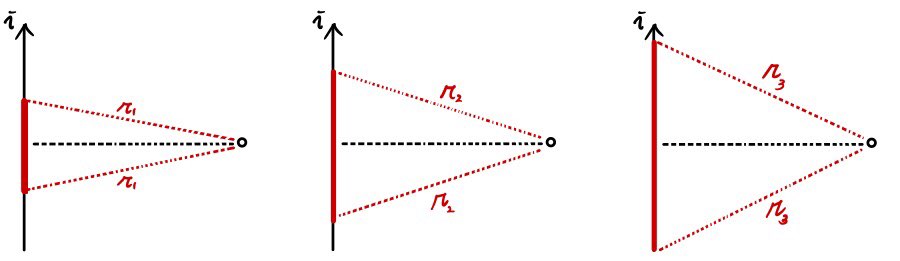
As time flows on~~…. the range that has an effect… hehe

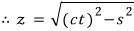
Then we can do the integral like this
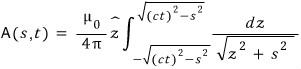
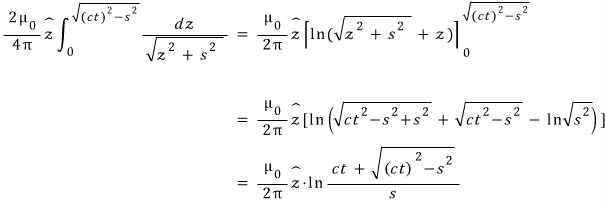
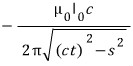
This is the retarded vector potential, and using the relation 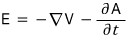 to find $E$ gives
Using the relation  to find $B$ gives
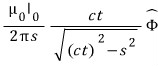
That was just one example. Right~ up until then we were looking at potentials that take causality into account.
The electric field
Alright then, let’s look at the electric field!!!! As we saw in the example abov-e, : we’ll go with this relation. First let me work out grad $V$.
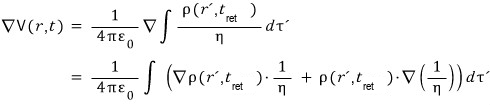
Now the problem is  , this guy.
Why does this turn out like this….?
I’ll use the chain rule: simple, but hard to think up.
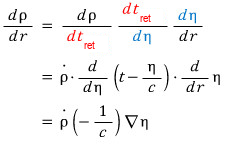
Haa… how do people even think of stuff like this? lolol Amazing, really lol Alright, let’s move on. Oh, and let me also jot down something from Chapter 1 here.

I’ll apply this too.

Waitt a sec!!! If you take del once more here, it comes back to the result with the d’Alembertian, but I’ll skip that!
And now it’s  , this guy’s turn:
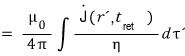
At last we can write down $E(r,t)$.
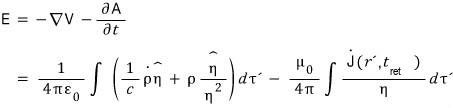
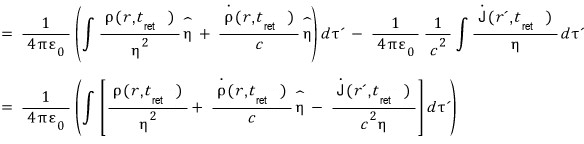
This is the Reallll ultra-rigorous expression for $E$, taking time into account and the change of $\rho$ too, and riding the momentum, let’s compute $B$ too.
The magnetic field

To compute this, if we flip to page 23 for a sec,
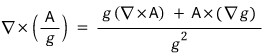
there’s this. Slamming this formula in,
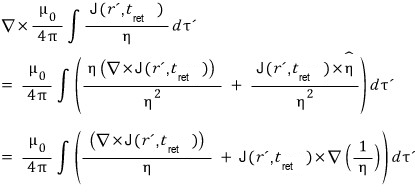
What we’ve got to examine this time is the curl of $J$: we’ll look at just the $x$-component and then generalize. Like this.
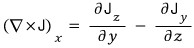
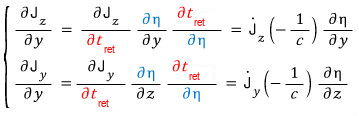
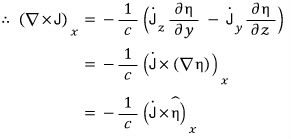
The equation right above — if you do it yourself, it amazingly turns out like that. Try verifying it at least once!! hehe
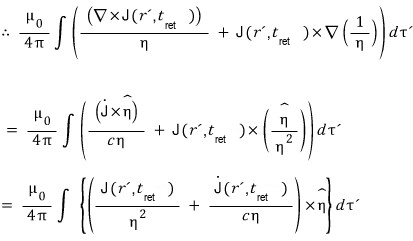
Aaaah~~ dang, that’s complicated, y’know.
This, they say, is what Jefimenko published in 1966 (oh, that’s not so long ago): Jefimenko’s equations~~
I seriously want to switch majors T_T T_T T_T
lolololololol
Heads-up. The figures here are the original notes, slips and all. A few things to watch for:
- In the long-wire example, the current $I_0$ belongs in front of every integral, and inside the roots $ct^2$ means $(ct)^2$: $\vec{A}(s,t) = \frac{\mu_0 I_0}{2\pi}\ln\frac{ct + \sqrt{(ct)^2 - s^2}}{s}\,\hat{z}$, so $\vec{E} = -\frac{\mu_0 I_0 c}{2\pi\sqrt{(ct)^2 - s^2}}\,\hat{z}$, a vector along $-\hat{z}$.
- The gradient is $\nabla(1/\eta) = -\hat{\eta}/\eta^2$ (with the hat), and the $\dot{\rho}$ term needs one more $1/\eta$ in $\nabla V$ and in $\vec{E}$. With the sources at $\vec{r}'$ and $\hat{\eta}$ on the first term, Jefimenko’s equation for E is $\vec{E} = \frac{1}{4\pi\varepsilon_0}\int\left[\frac{\rho(\vec{r}',t_{ret})}{\eta^2}\hat{\eta} + \frac{\dot{\rho}(\vec{r}',t_{ret})}{c\eta}\hat{\eta} - \frac{\dot{\vec{J}}(\vec{r}',t_{ret})}{c^2\eta}\right]d\tau'$.
- In the curl of $\vec{A}$, the second term is $-\vec{J}\times\nabla(1/\eta) = +\vec{J}\times\hat{\eta}/\eta^2$; the second chain-rule row is $\partial J_y/\partial z$; and $\nabla\times\vec{J} = +\frac{1}{c}\dot{\vec{J}}\times\hat{\eta}$ (plus sign). With these, the final $\vec{B}$, Jefimenko’s equation for B, is right.
Comments
Discussion happens via GitHub Discussions. You'll need a GitHub account to comment.