Liénard–Wiechert Potentials — Electromagnetic Fields of a Moving Point Charge
We tackle the EM field of a moving point charge using Liénard–Wiechert potentials — supposedly easier than Jefimenko, but still a complete freaking disaster lol.
In the previous post, we looked at the scalar potential and the vector potential, worked out ultra-rigorously. Why’s that??? To work out the electromagnetic field, right?
Yep. With Jefimenko’s equations from before, we were after the ultra-rigorous electromagnetic field of a ‘moving!!!!!!!!!!’ point charge, I guess. Because only once we’ve covered the moving case do we have a fully general result, right?
But unfortunately, with Jefimenko’s equations, working out the electromagnetic field of a moving point charge is supposedly insanely difficult. (That’s what Griffiths says.)
Then isn’t there some other, easier way?
There is: the Liénard–Wiechert potentials.
(Then why not compute the Liénard–Wiechert potentials from the start, why do Jefimenko first and then this again?????)
(They say that if you use the Liénard–Wiechert potentials to solve for the electromagnetic field of a point charge in hyperbolic motion, it seems to break Gauss’s law…. This paradox was apparently resolved in 1955. I don’t really know, lol. It’s just something in a footnote, so for reference… hehe)
A moving point charge
Alright then, now the charge…… moves………… (we’re totally doomed.) ……… haa…
First!!! Before saying that a charged object moves, we’ll look at a point charge moving, and not just moving any old way: let’s say it moves along ‘some trajectory’.

The formula for $V(r,t)$ from before was
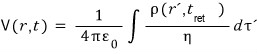
this, and here eta, the relative r, can come out of the integral.
What kind of out-of-the-blue nonsense is this~~~ Well, from here on we’re going to treat the $r'$ vector as a function of time, so it no longer has anything to do with $d\tau'$.

The total charge was $q$, so  . Ahhh~~~~~~~ done!!!
Strange, right? hehehe Somehow it feels like this isn’t right, lol. When life feels smooth, there’s a high chance something is wrong somewhere…. (my short life experience…. hehe) If it’s like this, it’s way too easy….. hmm……….. let me look again.
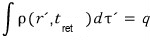
Apparently you can’t say this. Stating the conclusion first:
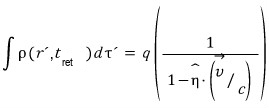
a term like this has to be tacked on. I’ll study it by taking that conclusion and hunting for clues from there… hehe
First,
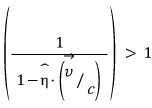
it’ll be — at least when the charge is heading toward us ($\hat{\eta}\cdot\vec{v} \gt 0$). And since the speed of light is nature’s speed limit, the bottom never hits zero, right?
Meaning!! When the charge heads toward us, this retarded-density integral comes out bigger than $q$. The charge itself hasn’t changed: we’re adding contributions emitted at different times, not measuring the total charge on one simultaneous slice.
Why would it come out bigger…?
(Depending on the direction, it can also come out smaller.)
Here’s how I thought about it.
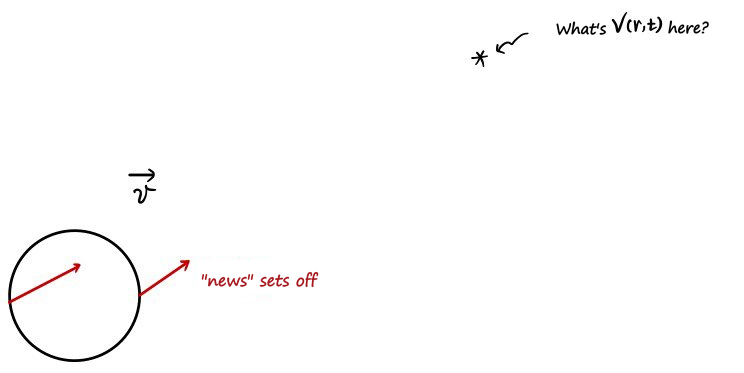
Okay okay okay okay, the news has set off.
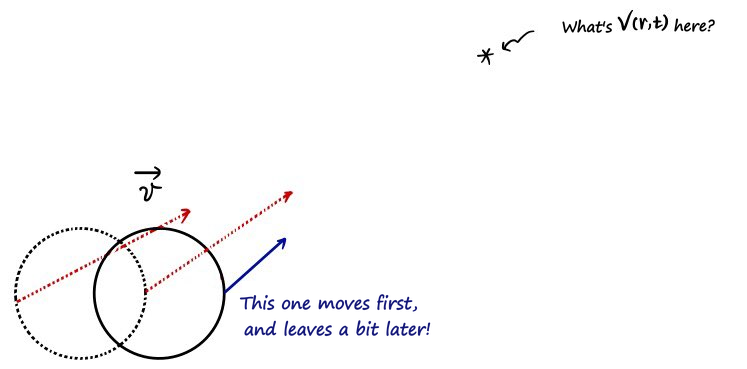
Uh-uh-uh-uh…. here comes a late starter…….
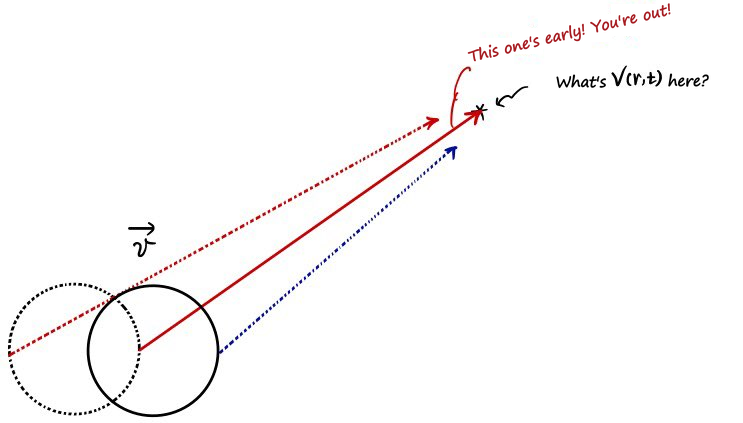
The middle guy doesn’t arrive at time $t$; it arrives a little earlier.
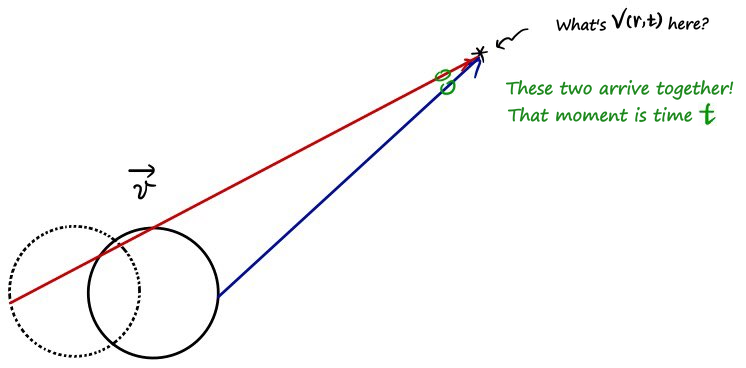
Uh…….. the one that arrives together with it…. is something else that set off at a later time, hehe. Whoa. That’s as far as I’ll take it.
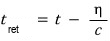
It clicked when I read this: “you have to integrate the  at a different time for each spot in the charge distribution.”
So
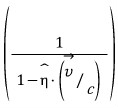
something like this has to be multiplied in!!! That is, because of the volume
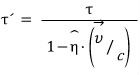
relation, the charge also “looks” different!!!!
Alright, so where were we:

from here,
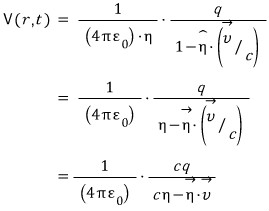
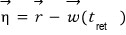
$v$ is the charge’s velocity at time $t$ =  !! And the relative r vector is the vector from the position at the retarded time to the observation point $r$.
The vector potential
 works the same way, except the integral isn’t
  but
but 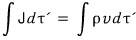 . So:
. So:
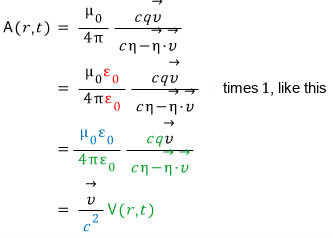
we even get the relationship between $A(r,t)$ and $V(r,t)$~~
These are called the Liénard–Wiechert potentials!!! hehehe
Huh?!?! Done?!?!? Nope nope nope, now it really begins./….. We’ve got $V$ and $A$, so we can get the electric and magnetic fields too…
(That’s what we started this for, you punk -_-)
…folks …….. are you ready to sweat blood? lol Let’s sweat some blood, gogo
The fields, starting with grad V
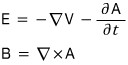
I’ll go with this. Alright then, let’s start with grad $V$.
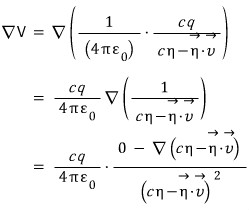
From here it gets a bit complicated…………………. but I’ll write it all out anyway!!!!
What we need to do now is calculate  , this guy. To look up the product rule, let’s flip open Chapter 1 again!!!! heh. At the very top of page 23 there’s this formula.

Applying this,

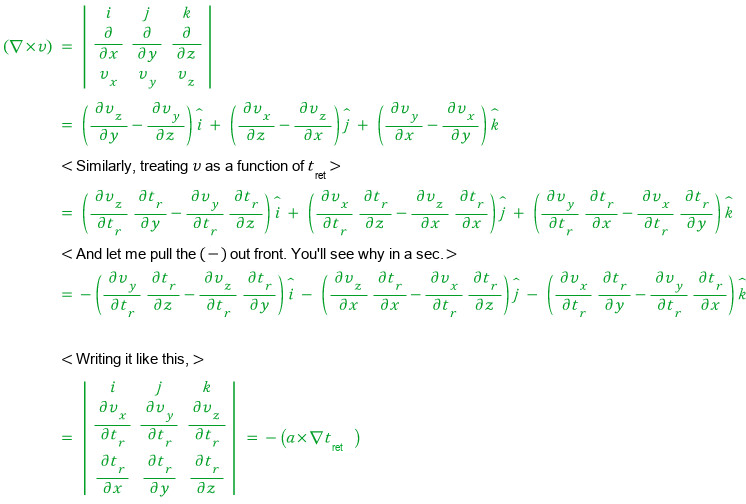
I’ll calculate the 4 terms in the book’s order: red, orange, green, blue.
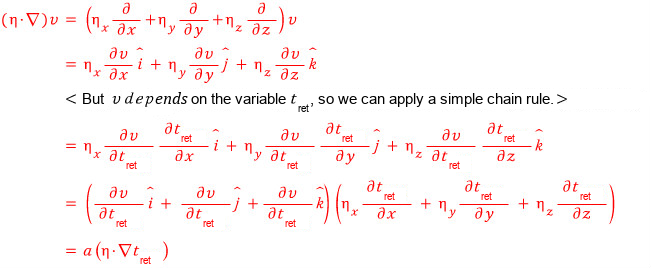
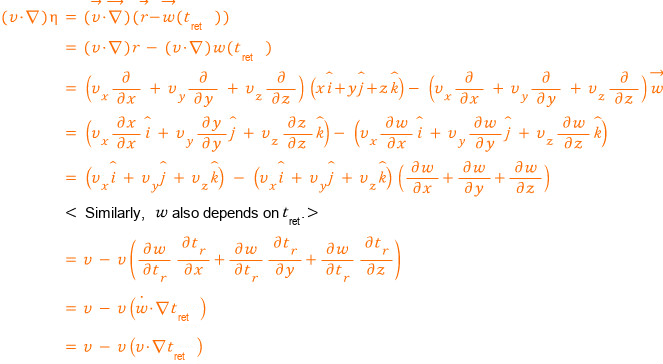
For  , start with
  , this guy!
Therefore
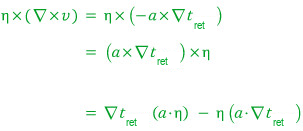
The blue one too!!! To handle  , let’s calculate
  first:
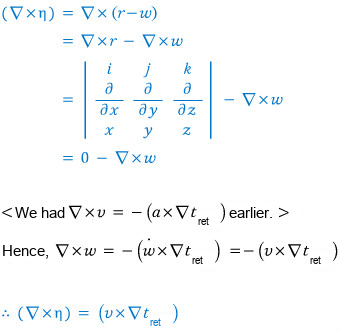
Th………..e…………..n
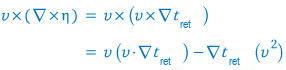
Now let’s gather them all in one place!!!

Do you remember what we went through all this freaking madness for? lol
Holy crap, lol. All this was just for grad $V$, lol.
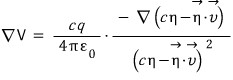
I’ll plug it in here!!!! I was about to plug it in, but -_-…….. I haven’t done this one yet:
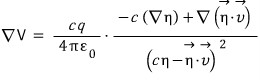
I have to take the gradient of relative r, hehehe. I’m about to lose it;;;
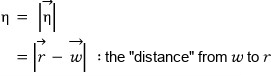
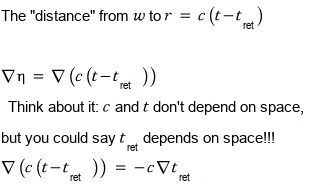
Now for real, I’m plugging it in!!!!!!!!!!
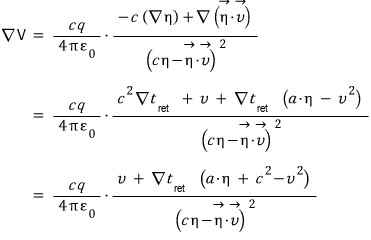
Getting rid of grad t_ret
Ah, come on, f—…. lol Now I have to rewrite $\nabla t_{\text{ret}}$ and get rid of all those upside-down triangles…. hehe lol Even getting rid of one takes this much time…. Ugh. Sigh….
Alright….. here we go.. Earlier, we derived this relation: 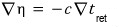 . Let me rework its left side for a moment.
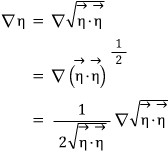
Here’s where that product rule from before
comes in.
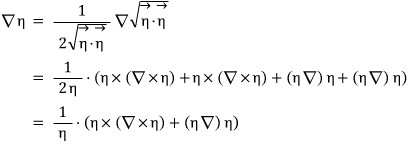
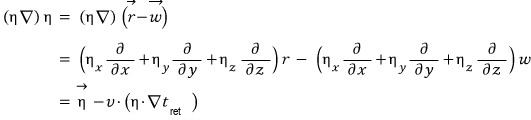
For  , luckily, we already did
  earlier:
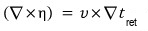
Therefore
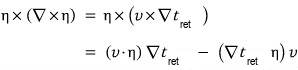
So
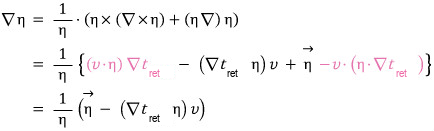
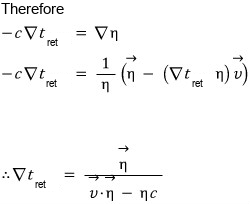
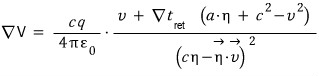
Substituting into this,
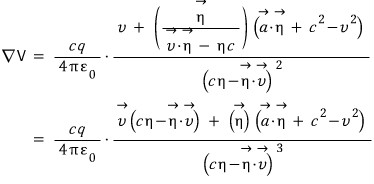
The last pieces and the fields
By now you’ve all got a feel for the calculation.

Curl $A$ can be obtained like this.
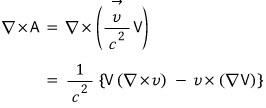
The ingredients are all ready, so now if I just write down the result…… after making the substitution  ,
,
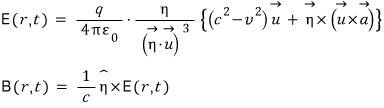
I sort of glossed over the very end, but I did derive every one of them at least once myself……………… at least once. Wouldn’t it be better if you did it too, just once….? You’re a college student, after all! hehehe
Heads-up. The figures here are the original notes, slips and all. A few things to watch for:
- The factor $\frac{1}{1 - \hat{\eta}\cdot\vec{v}/c}$ is bigger than 1 only when the charge moves toward the field point ($\hat{\eta}\cdot\vec{v} \gt 0$); moving away, it is smaller than 1. Since $v \lt c$, it is always positive.
- In $(\vec{\eta}\cdot\nabla)\vec{v}$ and $(\vec{v}\cdot\nabla)\vec{w}$, the derivatives $\partial\vec{v}/\partial x$ and $\partial\vec{w}/\partial x$ are already vectors, so no $\hat{i}, \hat{j}, \hat{k}$ belong on them: $(\vec{\eta}\cdot\nabla)\vec{v} = \vec{a}\,(\vec{\eta}\cdot\nabla t_{ret})$ and $(\vec{v}\cdot\nabla)\vec{w} = \vec{v}\,(\vec{v}\cdot\nabla t_{ret})$. The end results are right.
- In $\nabla\times\vec{v}$, the $\hat{j}$ terms need $\partial v_z/\partial t_{ret}$, and the last determinant equals $+(\vec{a}\times\nabla t_{ret})$, so it needs a minus sign in front; $\nabla\times\vec{v} = -(\vec{a}\times\nabla t_{ret})$ is right. Then $\vec{\eta}\times(\nabla\times\vec{v}) = \nabla t_{ret}\,(\vec{a}\cdot\vec{\eta}) - \vec{a}\,(\vec{\eta}\cdot\nabla t_{ret})$, which cancels the red $\vec{a}\,(\vec{\eta}\cdot\nabla t_{ret})$ term in the summary, and $\nabla(\vec{\eta}\cdot\vec{v}) = \vec{v} + (\vec{a}\cdot\vec{\eta} - v^2)\nabla t_{ret}$ is right.
- $\nabla\eta = \frac{1}{2\sqrt{\vec{\eta}\cdot\vec{\eta}}}\nabla(\vec{\eta}\cdot\vec{\eta})$: the gradient acts on $\vec{\eta}\cdot\vec{\eta}$, not on its square root.
- $\vec{\eta}\times(\vec{v}\times\nabla t_{ret}) = \vec{v}\,(\vec{\eta}\cdot\nabla t_{ret}) - (\vec{\eta}\cdot\vec{v})\nabla t_{ret}$, the opposite sign to the drawn line. Then the two $\vec{v}\,(\vec{\eta}\cdot\nabla t_{ret})$ terms cancel, $\nabla\eta = \frac{1}{\eta}\left(\vec{\eta} - (\vec{\eta}\cdot\vec{v})\nabla t_{ret}\right)$, and $-c\nabla t_{ret} = \nabla\eta$ gives the drawn result $\nabla t_{ret} = \frac{\vec{\eta}}{\vec{v}\cdot\vec{\eta} - \eta c}$, which is right.
- With $\nabla t_{ret}$ put in, $\nabla V = \frac{cq}{4\pi\varepsilon_0}\frac{(c\eta - \vec{\eta}\cdot\vec{v})\vec{v} - (c^2 - v^2 + \vec{\eta}\cdot\vec{a})\vec{\eta}}{(c\eta - \vec{\eta}\cdot\vec{v})^3}$ (minus before the $\vec{\eta}$ term), and $\frac{\partial\vec{A}}{\partial t} = \frac{cq}{4\pi\varepsilon_0}\frac{(c\eta - \vec{\eta}\cdot\vec{v})(-\vec{v} + \frac{\eta}{c}\vec{a}) + \frac{\eta}{c}(c^2 - v^2 + \vec{\eta}\cdot\vec{a})\vec{v}}{(c\eta - \vec{\eta}\cdot\vec{v})^3}$. The final $\vec{E}$ and $\vec{B}$ are right.
Comments
Discussion happens via GitHub Discussions. You'll need a GitHub account to comment.