Vector Spaces
Turns out "linear" literally just means line-shaped — lol — and here's why that embarrassingly simple idea is the backbone of basically all of math and STEM.
If you’re anywhere near a STEM field, you’ve heard the word “linear” approximately one billion times. Linear linear linear linear linear linear linear linear linear linear linear. An insane number of times.
You know what’s funny — when I first really heard the word “linear,” I somehow had no clue it just literally meant “line-shaped.” lol — is it just me?
I’d been treating it like some deep, profound abstract math concept hiding behind a heavy academic word — and lol, turns out… nope. Just “line-shaped.” That’s it.
OK but seriously — linear is important.
Why?
Because no matter how curvy a curve is — as long as it’s smooth — if you zoom in 3849024809290x with some absurd microscope, it looks like a line.
Honestly, you probably don’t even need 3849024809290x. Maybe just 10x? And it already looks like a line. That’s why we lean on approximation formulas all the time — that’s why Taylor series shows up everywhere, right?
Anyway. In linear algebra, “linear” means linear — shape of a line. “Algebra” is our friend algebra — the thing where we shove around x, y, z all day. So,
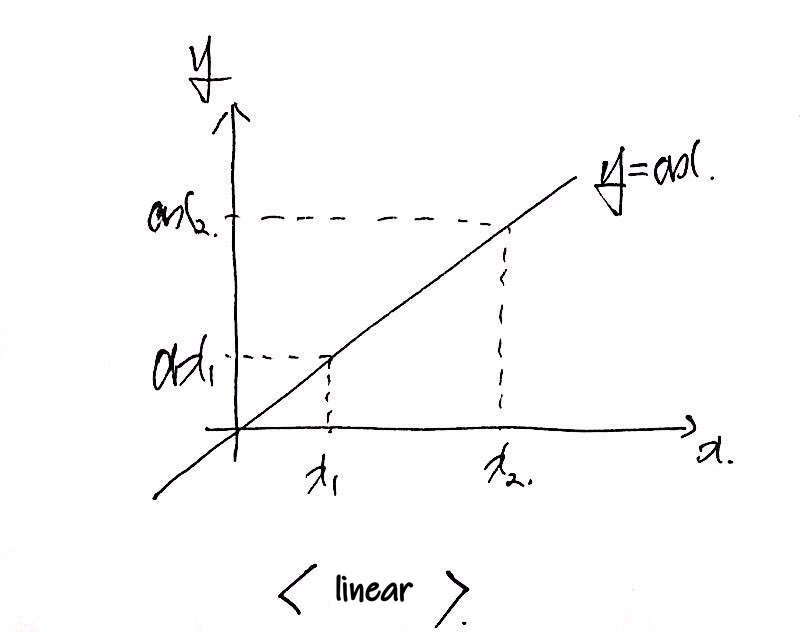
something that looks like that is what we call linear,
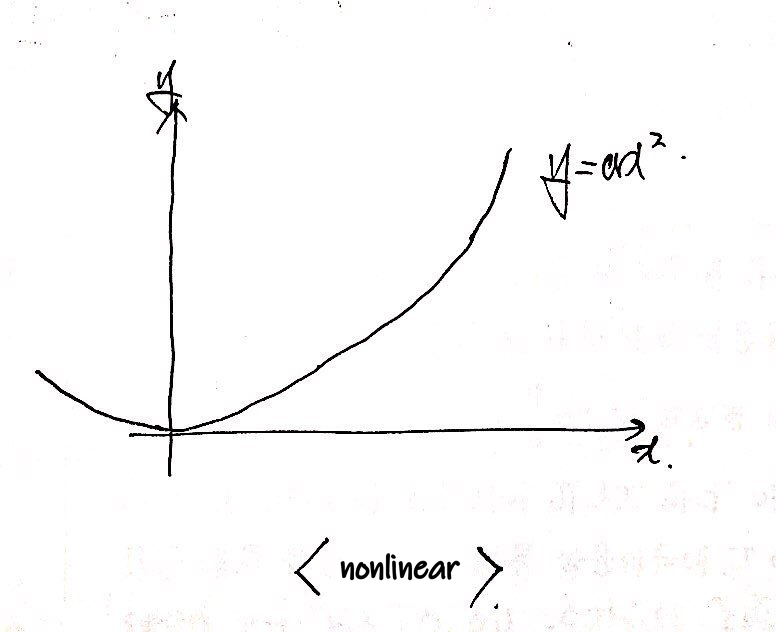
and meanwhile, in the actual world, there are way more things that look like this — nonlinear — than linear ones.
At the undergrad level, nonlinear stuff doesn’t really get touched directly, and when it does come up, it usually gets approximated as linear and handled that way. Which is exactly why you want to know your linear stuff cold~ (like I said earlier).
Alright. Let me pull out a few characteristics of linear functions. I already scribbled them on the photo above.
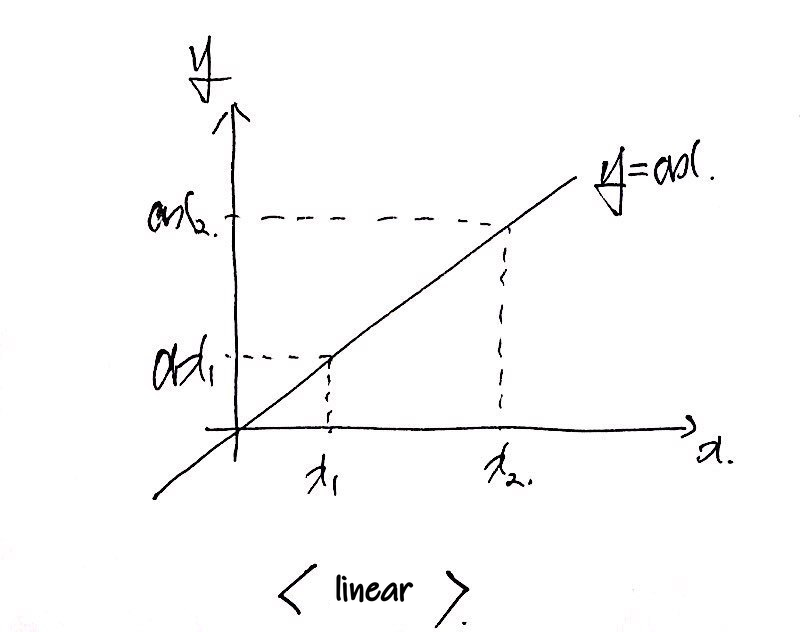
Say you’ve got two x values. Plug $x_1$ into the function → $ax_1$ pops out. Plug $x_2$ in → $ax_2$ pops out. OK yeah, obvious.
But here’s the cute part: plug  in, and
  comes out.
The function value of the sum equals the sum of the function values — compute each separately, add them up, same answer.
But this little party trick? It only works for linear functions. For nonlinear ones — don’t even dream about it.
OK so now let me reframe all this in the language of ‘sets.’
So, originally, a function is just a thing that takes you from one set to another set — that’s what a function is. Here, the sets will be vector spaces.
(This’ll come back later. Don’t panic.)
So, out of all the many many functions that go from one vector space to another, we’re zeroing in specifically on “linear functions” and their characteristics.
Now what’s a vector space in general?
Just think of “space” as roughly a ‘set,’ and a vector space is basically a set whose elements happen to be vectors.

You can picture it like this, I think. Then, for some vector space V,

let’s say this, and lay out the characteristics.
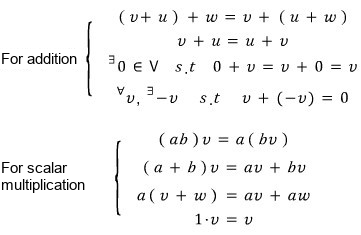
Let me decode the alien-runes for you.
 — exists (“there exists”)
 — for all (“for all ~”)
 — such that (“the property is: ~”)
Stupidly simple, right? Looks like I just said a bunch of completely obvious stuff.
But here’s the trick — instead of reading it as “a vector space has these properties~,” think of it this way: later on, when you run into some weird set you don’t recognize, and that set happens to have “these properties” → “boom, we define that thing as a vector space.” That’s why I bothered writing all this out even though it’s annoying!!!!
OK now actual concrete examples of vector spaces.
First — there’s this thing called a Field. If a set of numbers, with the usual arithmetic laws, is closed under addition, subtraction, multiplication, and division (division by zero aside), it’s called a ‘field.’
So what are some examples of fields?!
First — the set of natural numbers  isn’t even closed under subtraction. The set of integers
  isn’t closed under division. But the set of rational numbers
  , the set of real numbers
  , the set of complex numbers
  — these can be called fields. And these guys satisfy the vector space properties, riiight?!
(You’d already know these from way back, but in proper set notation — natural numbers  , integers
  , rationals
  , reals
  , complex numbers
  — this is how you’re supposed to write them, but the formula editor doesn’t have those blackboard-bold letters T_T — so I’ll just go with regular alphabet letters!)
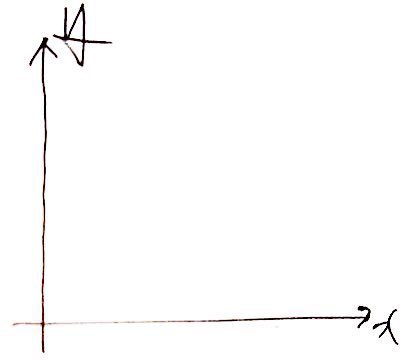
Every point on the coordinate plane can be written as a vector. A vector’s coordinates show up as a pair of two real numbers — x and y!!!! So that set gets written as  apparently — that’s what the books say anyway. These obviously satisfy the vector space properties, and
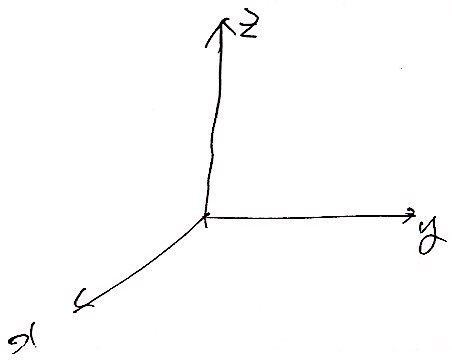
3D coordinate space runs on the exact same idea:  . These too satisfy the vector space properties!!!!
For n-dimensional space that we can’t even draw, we just say it’s 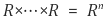 , apparently~~~ This also satisfies the vector space properties…. So it counts as a vector space.
Here’s another one. “All polynomials with real coefficients” ![R[t], the real polynomials in t](img_112.png) — this is how it’s written.
— this is how it’s written.

Add a polynomial to a polynomial — still a polynomial. Multiply a polynomial by a number — still a polynomial. There’s a 0 in there… This also counts as a vector space!!!!
![C[t], the complex polynomials in t](img_117.png) — also a vector space!!!!
— also a vector space!!!!
And there’s more, more: {f :  →
→  } = {all functions defined on the real numbers} = {f, g, h, …}. This too —

Wait, hold up?! Even multiplying a function by a number — still a function. Commutative law, associative law, all that good stuff — all checked off, so the set of functions also gets to be called a vector space!!!!
The whole reason I’m hammering on this section is to head off future brain-meltdowns…. I want to drill it in: just because the word ‘vector’ shows up, do NOT keep picturing a little arrow → floating above your head.
A polynomial can be a vector, a function can be a vector, and even just a plain old number can be a vector!!
Heads-up. The figures here are the original notes, slips and all. A few things to watch for:
- In the list of vector-space rules, $u, v, w$ stand for any vectors in $V$ and $a, b$ for any scalars. The zero vector has to satisfy $0 + v = v$ for every $v$, and both operations must keep their results inside $V$.
- In the picture with $f + g = h$, the set after $\in$ is missing: $f, g \in \{f : \mathbb{R} \to \mathbb{R}\}$.
Comments
Discussion happens via GitHub Discussions. You'll need a GitHub account to comment.