Surjective, Injective, and Bijective Functions
We nail down surjective, injective, and bijective functions — and prove why a linear map between finite-dimensional spaces of the same dimension needs only one condition to guarantee the other.
Alright, now then — let’s really head for the inverse matrix this time. For real for real.
That was a lie.
We’ll do the inverse matrix properly later. But there’s a concept we need to nail down first. And that concept is:
When $V$ and $W$ in the linear map $L : V \to W$ are finite-dimensional and have the same dimension,
① If $L$ is surjective $\to$ it automatically satisfies the injective condition $\to$ so $L$ is bijective.
② If $L$ is injective $\to$ it automatically satisfies the surjective condition $\to$ so $L$ is bijective.
That’s it. That’s the thing. We’re gonna prove it. Let’s gooo!!
OK so — we learned about inverse matrices back in high school too. Back then it went like this:

This thing called an inverse matrix? Not every matrix has one. Only some matrices do.
And what was an inverse matrix again — it means an inverse function, right?!
So then — if an inverse function exists, the function has to be a 1:1 correspondence… that’s what we drilled in high school, right?! Not every function has an inverse function. Only 1:1 correspondences had inverse functions!!!
We’re gonna use that exact same logic, but now in matrix-land. And in linear algebra, the 1:1 correspondence story goes like this:
When $V$ and $W$ in the linear map $L : V \to W$ are finite-dimensional and have the same dimension,
① If $L$ is surjective $\to$ injective for free $\to$ bijective.
② If $L$ is injective $\to$ surjective for free $\to$ bijective.
We need to prove this before going anywhere… we’re gonna need it later. (sob) Alright, destination set. Let’s keep moving.
So — before we get into it, everything we’ve been talking about so far has been  — linear maps between an $n$-dimensional vector space and an $m$-dimensional vector space, like that. The reason was to keep things as general as possible.
One thing to flag here: this is a finite-dimensional vector space!!! Apparently the story gets a little different in infinite dimensions.
OK. The linear map represented by some matrix $A$ —  — let’s say it’s this.
If $A$ has an inverse matrix, that means $L$ has an inverse function, right!?
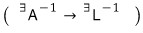
And “having an inverse function” means $L$ has an inverse function, so — we can say $L$ is a 1:1 correspondence!!!! Right?!
(For the record — in high school we got pretty hard-brainwashed with: “inverse function exists $\to$ 1:1 correspondence.” That’s why I keep saying it like that.)
If we describe a 1:1 correspondence using the archers-and-targets picture — “no empty targets, and no target with two or more arrows in it” — does that ring a bell?!
OK so this is gonna feel a little different in flavor from high school. Alright~~~, then — let’s look at surjective, injective, and bijective.
Surjective function (surjective, onto)
(Each archer has exactly 1 arrow. Having 1 arrow each is literally the definition of a function. A function can’t have a single domain element shooting out two image values into the codomain. If you plug $1$ into $f$ and both $3$ and $5$ come out — that’s not a function. Only when it maps to one value do you get to call it a ‘function’!!!)
For a surjective function, the order goes out to all the archers in $X$ (the domain). And the order is:
“I don’t care if a target gets hit by two arrows or three. Just make sure there are no empty targets.”
A function that obeys that order is surjective. You’ll have $|X|$ (size of the domain) $\geq |Y|$ (size of the codomain), right?!
Cleanly in math:

You can also read surjective the other way around: “Pick any target you like — there’s an arrow that hit it (or some archer who shot at it).” That reading works too!!!
Injective function (injective, one-to-one)
Same archers-and-targets analogy, different order:
“(Empty targets are fine.) Just make sure no target gets hit by two or more arrows.” — that’s the order this time.
This gives you $|X|$ (size of the domain) $\leq |Y|$ (size of the codomain). In nice mathy notation:

That’s it. Now let’s also write the contrapositive of that statement:

If I read this — “if a target has multiple arrows in it, those arrows are actually the same arrow”??? Eh, it’s just saying only 1 hit it.
Bijective function (one-to-one correspondence, bijection)
And the long-awaited one! This is the command that makes both previous commands hold at the same time. That is: “Each target gets exactly one arrow stuck in it — and no empty targets either!!!”
So you’ll have $|X|$ (size of the domain) $= |Y|$ (size of the codomain).

But here’s the interesting bit.
When $X$ and $Y$ are finite sets with the same number of elements — if you satisfy either the surjective order or the injective order, the other one comes along for free!!!
(The “finite” matters: on $\{0, 1, 2, \dots\}$, the map $n \mapsto n+1$ is injective but never hits 0. A nonzero real vector space has infinitely many vectors, so the version for linear maps between finite-dimensional spaces of the same dimension is a separate theorem, and that’s the one we’re about to prove.)
OK so from here — what we were calling $x_1, x_2, f(x_1), f(x_2)$ above, we’re gonna carry that whole thing over~~~ to matrices, exactly as is!!! Bring it over exactly~~~ as is.
Surjective = “no empty targets >_<”
The one we had before,

rewritten to fit our situation:

we can write it like this, right?!
So — pick any element $w$ from $W$, and there has to exist a $v$ such that $L(v) = w$. Which means we can also write the same thing like this:

No matter which $w$ we grab, $w$ can be written as a linear combination of the vectors $L(v_i)$.
Why is this the same statement?
Because $L$ is linear, so

holds, and because of that, whichever $w$ we bring,  — it can be expressed as a linear combination of those vectors!!!
Injective = “no target with two or more arrows >_<”
The one we had above,

let’s rewrite this one too, to fit our setup:

In words: if the function values of two vectors $v$ and $v'$ are the same, then the two vectors are the same (?) (Two different elements can’t share a target.)
This statement —
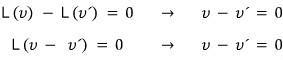
can also be expressed like this, so

we can write it like this,

and since this means —

we get to say this.
Now let’s drop in the condition “when the dimensions are equal” and ride this all the way to the conclusion.
If $V$ and $W$ have the same dimension $n$,
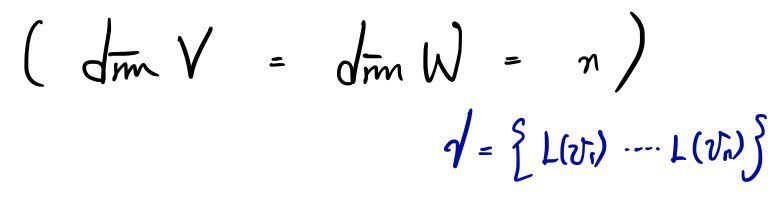
in that setup, if $L$ is surjective, then???
Didn’t we say $\text{span}(\gamma) = W$?!
Which means every element of $\gamma$, from $L(v_1)$ all the way to $L(v_n)$, got used — not a single one wasted.
So it becomes the statement that $L(v_1)$ through $L(v_n)$ are linearly independent, i.e. $\dim(\text{span}(\gamma)) = n$. That’s what this is saying. So $L$ also satisfies the injective condition, and we can see $L$ is bijective.
If $L$ is injective, that means $\gamma$ is linearly independent, right???
Which means nothing inside $\gamma$ overlaps, so $\text{span}(\gamma) = W$ holds!!!
That is, $\dim(\text{span}(\gamma)) = n$, $\text{span}(\gamma) = W$. So $L$ is automatically surjective, and therefore $L$ is bijective!!!
Conclusion
When $V$ and $W$ in the linear map $L : V \to W$ are finite-dimensional and have the same dimension,
① If $L$ is surjective $\to$ injective condition holds for free $\to$ $L$ is bijective.
② If $L$ is injective $\to$ surjective condition holds for free $\to$ $L$ is bijective.
“Has an inverse matrix”?
A matrix has an inverse matrix $\downarrow$ means the linear map it represents has an inverse function $\downarrow$ which means that function is bijective. (1:1 correspondence)
(cf. Everyone knows a 1:1 function and a 1:1 correspondence function are different things, right?!)
Surjective, injective, bijective — these come back later. If you skim past them now, you’ll get hit with the misfortune of having to backtrack later — which is exactly what happened to me lol. I was studying something further down the line and had to come crawling back to the front to study this stuff again, that kind of thing heh heh heh.
Heads-up. The figures here are the original notes, slips and all. A few things to watch for:
- In the two figures that define a surjective function the first quantifier should be $\forall y \in Y$: every target $y$ has some $x$ with $f(x) = y$. The figures write $\exists y \in Y$.
- The figure under the bijective heading shows only $x_1 = x_2 \to f(x_1) = f(x_2)$, which every function satisfies. Bijective means injective ($f(x_1) = f(x_2) \to x_1 = x_2$) and surjective at the same time.
Comments
Discussion happens via GitHub Discussions. You'll need a GitHub account to comment.