Isomorphism and the Dimension Theorem
Kernel and image lead us to isomorphism — when a bijective linear map links two vector spaces, they share the same structure, so each one is the other in disguise!!!!
There’s so much more we can squeeze out of kernel and image!! Today I’m using them to dig into isomorphism and the dimension theorem!!!!
OK so. Not every square matrix has an inverse. Only special ones do, and this whole time we’ve been talking about linear maps represented by exactly those kinds of matrices — so let me pull everything together using the proper word for it: invertible matrix.
A matrix that has an inverse is called an invertible matrix. Which means: the linear map represented by an invertible matrix is a bijection. Honestly… that’s pretty much everything we’ve covered up to now T_T
And here’s what an invertible matrix looks like, feature-wise:
- The kernel is 0. ($\ker L = 0$)
- The image spans everything.
- If $A$ is invertible, then $A^T$ is invertible too.
I haven’t proven the third one yet, so just take it on faith for a sec. We’ll get there.
Oh, and there was this: when $V$ and $W$ in the linear map $L: V \to W$ are finite-dimensional and have the same dimension,
① If $L$ is surjective → it automatically satisfies injectivity → so $L$ is bijective.
② If $L$ is injective → it automatically satisfies surjectivity → so $L$ is bijective.
Isomorphism
OK now let’s say $V$ and $W$ have the same dimension!!

If $L$ is bijective, an inverse exists, and

Also, a basis $v_1, \ldots, v_n$ of $V$ is linearly independent, and so are $L(v_1), \ldots, L(v_n)$ in $W$.
So what I’m trying to say is: once $L$ pairs up their vectors, $V$ and $W$ have the same algebraic structure, so through that pairing we can treat them as the same abstract vector space. (One space written in two different bases is the classic example, not the definition.) That’s the punchline.
When this happens, we say $V$ and $W$ are isomorphic. The linear map that ties two isomorphic vector spaces together is called an isomorphism!!!!
Quick etymology aside — the prefix “iso-” means “same.” Like, “isotope” = same place on the periodic table. So “isomorphic” = same shape, basically.
OK so let me reframe everything with this in hand.
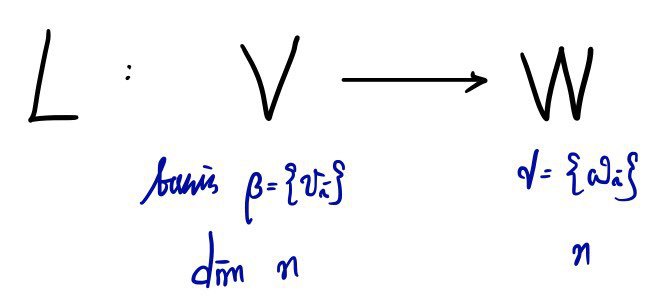
Say $V$ has basis $v_1, \ldots, v_n$ and $W$ has basis $w_1, \ldots, w_n$, and call the matrix of this linear map $A$. Since $L$ is bijective, $A$ is invertible!!!!
So now, take some element $v \in V$,

and let’s push this vector through $L$ over to $W$.
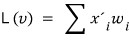
Looks like this. But let me rewrite the left side this way:

Using that, I mean —
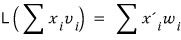
Now what does this mean?
It means: what was expressed in the $\beta$ basis can also be expressed in $\gamma$!!!
Remember we said the ordered tuple of basis coefficients is the coordinates?!? The tuple of $x_i$’s is the coordinate vector in $\beta$, and the tuple of $x_i'$’s is the coordinate vector in $\gamma$!!! Stack those coordinates as a column vector, and
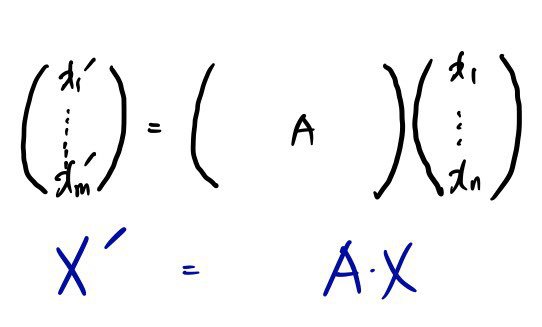
it can be written as a matrix.
You’re probably wondering — why did that just pop out of nowhere?
Don’t worry, this picture will start to make sense. Just keep going!!!
Now, since $L$ is bijective and linear,  expressed in the
  basis:

(meaning: “ written in the
  basis~~~” — that’s what the little subscript $\beta$ on the bracket is doing.)
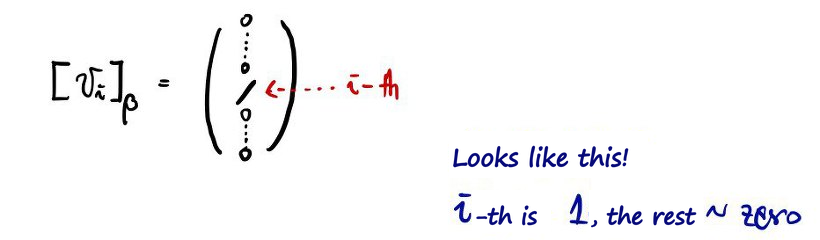
Then by the same logic,

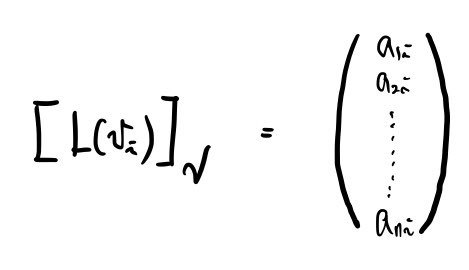
Oh ho~

Didn’t we just say these are linearly independent?! Let’s pull those linearly independent vectors out as columns~
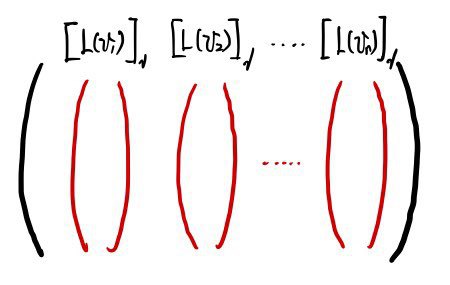
Wait — what is this?! Isn’t this matrix $A$?!
(Or you can think of it the other way: split $A$ into its $n$ columns, and those column vectors are linearly independent of each other, and when they span, they cover all of $n$-dimensional space — wait?! What?! Each of those column vectors is

isn’t it?! So you can read it that way too.)
Therefore $A$ is invertible!!!
Let me say the same thing one more time, differently.
A bijective linear map $L: V \to W$ takes the basis vectors of one vector space straight onto a basis of another! That is: “right, $v_i$ is a basis of $V$, but after I run it through $L$, it also becomes a basis of $W$!!!!”
We’ve just dug up another basis of $W$, on top of  !! (Remember a vector space can have a bunch of different bases at once?!)
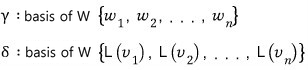
And since $L$ is bijective, we can pair up every vector in $V$ with exactly one vector in $W$, and vice versa. The pairing looks like this!!!
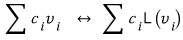
So the message is: once the vectors are paired up, $V$ and $W$ behave exactly alike — matching sums go to matching sums, matching multiples to matching multiples. Same structure, just different names on the vectors!!!
Following so far?? T_T
When this happens we say $V$ and $W$ are isomorphic, meaning: the two have the same algebraic structure.
So why do we care about isomorphism?
Plain and simple — because change of coordinates, which is the very next thing we’re going to do, is itself an isomorphism. Like, a single vector in 2D can be represented in tons~~~ of different ways depending on which basis you pick. The map that does that re-representation!!!!
So here’s a picture we’ll use later:
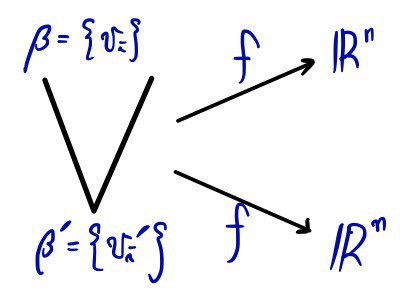
the map $f$ and the map $f'$ are actually both isomorphisms that represent the same vector space $V$ in $\mathbb{R}^n$!!!!
You’ll learn later that this is the change-of-basis matrix, and the very important conclusion is: the change-of-basis matrix is an invertible matrix.
If we say “isomorphism” in the language of kernel and image:
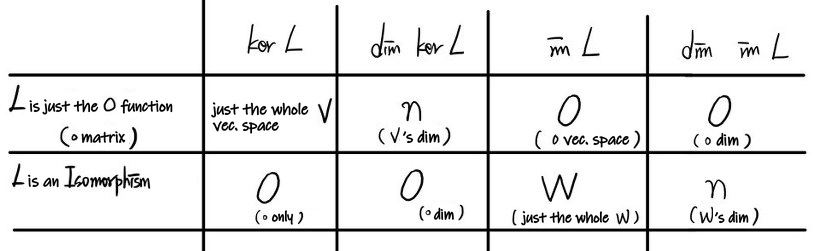
The Dimension Theorem
Now let’s see how this kind of thing holds for an arbitrary $L$. (This is where the dimension theorem starts.)
Simplest example first:

the matrix $A$ of the linear map looks like
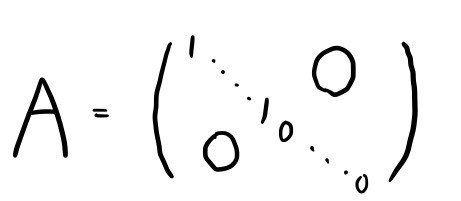
(Get the picture? It’s saying: up to some diagonal entry it’s all 1s, after that diagonal entry it’s all 0s, and everything off the diagonal is 0~)
If you tally up all the 1s and 0s on the diagonal, you get $n$. Call the count of 1s $r$, and the count of 0s $n-r$.
Now when we push

through the linear map,

$v_1$ through $v_r$ behave like this, and $v_{r+1}$ through $v_n$ become

Let me write that in kernel/image language:
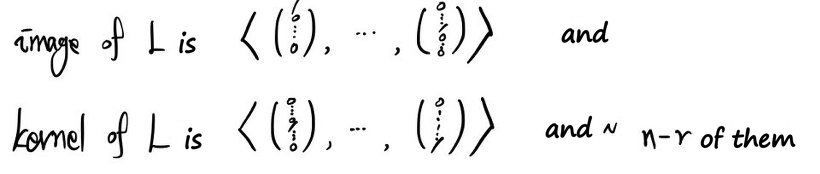
Restricted to this case,

we can write it like this.
OK now the actual Dimension Theorem. Let me drop the conclusion up front:

Let me kick it up to the fully general setup.
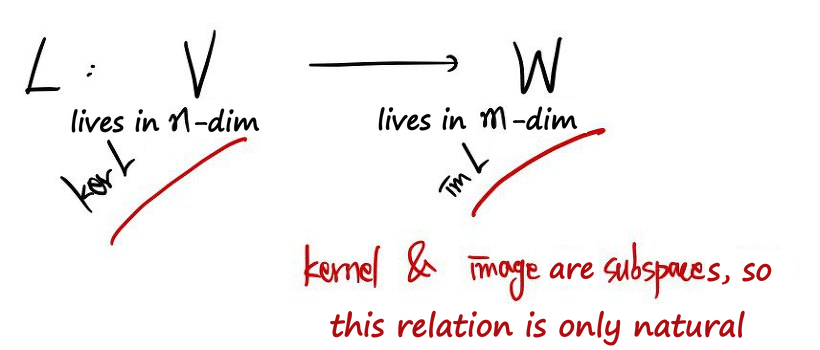
Say the basis of $\ker L$ has $n-r$ elements.

When we declare these to be the basis of $\ker L$, two things are baked in: they’re linearly independent of each other, and they’re a subset of the whole vector space $V$… that’s all implied.
But a basis of $V$ has to have $n$ elements!!! Because $V$ is $n$-dimensional. So when $r > 0$, the kernel’s $n-r$ basis vectors aren’t enough to be a basis of all of $V$. (When $r = 0$, $L$ is the zero map, $\ker L = V$, and the kernel’s basis already is a basis of $V$: we add nothing.)
So with this currently linearly independent set $\beta'$, I’ll just keep tacking on linearly independent elements one by one~ ($r$ of them) until it grows into a full basis of $V$!!!!
While I’m padding it out:

the freshly added ones are in blue, and the original kernel basis vectors are in red.
From here on out,

I’m going to argue that the images $L(v_1), \ldots, L(v_r)$ of these are a basis of $\operatorname{im} L$.
Any element $v \in V$,

can be written as a linear combination of $v_1, \ldots, v_n$. When we shove these over to $W$ via $L$,

expanding the sigma:

there it is.
Oh ho?! I’ve seen this thing somewhere before?! Ahhh~~~ but wait, the values $L(v_{r+1}), \ldots, L(v_n)$ are all zero. Zero! Because those guys are in the kernel of $L$!!?? OK got it.
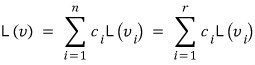
Which means: elements of the subspace $\operatorname{im} L$ can be written as a linear combination of $r$ vectors,
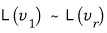
makes sense! Let me bundle them into a set.

Can the things bundled into this set $\gamma$ be a basis? Are they linearly independent?!
Let’s test it. Start from a combination that equals zero:
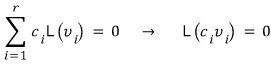
And since $v_1, \ldots, v_r$ are the vectors we added beyond the kernel’s basis (so no combination of them, except the all-zero one, can land in the kernel), for

to be true, the coefficients $c_i$ in front have to be 0.
So,

these are linearly independent of each other. (If that step lost you, peek back at the earlier post on “linear independence.”)
Therefore,

So,

this equation holds~~~~!
And that, right there, is the Dimension Theorem (for a linear map $L$ out of a finite-dimensional space $V$).
Heads-up. The figures here are the original notes, slips and all. A few things to watch for:
- In the $X' = AX$ picture the left column should end in $x'_n$: $W$ is $n$-dimensional here too. The picture writes $x'_m$.
- In the picture with two arrows to $\mathbb{R}^n$, the lower arrow should be labelled $f'$; the picture writes $f$ twice.
- In the last two formulas of the independence test the pictures write $L(c_i v_i) = 0$; it should be $L\left(\sum_{i=1}^{r} c_i v_i\right) = 0$, with the whole sum inside $L$.
Comments
Discussion happens via GitHub Discussions. You'll need a GitHub account to comment.