Similar Matrices
Before we can actually crunch a determinant, we load up on similar matrices — plus why det A = 0 is the snap-decision test for invertibility.
OK so. Now we’re really getting into determinants. Wait — no, to be precise, this post is about laying down the background knowledge before we go calculate a determinant for real.
So first, let me hit you with the definition. How am I going to hit you with it? Well — like I half-spoiled earlier: the Alternating form on $n \times n$ matrices (as a function of the columns, like last time) that satisfies  — that’s what we define as the determinant. (That form is unique, because an Alternating form is pinned down by its value on the identity matrix.)
Note:

So, $\det A$ is
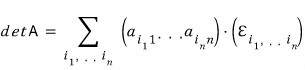
That’s the thing. OK, let me organize the properties of this determinant guy that you can basically just see. (These hold for any $n \times n$ matrices, but for the sake of explanation let me show the first one on a $3 \times 3$: transposing doesn’t change the determinant, $\det A^T = \det A$. The picture writes out both sums.)
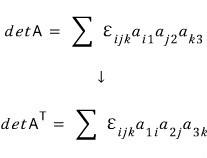
I’ll skip writing the proof out. (It’d get way too long.) And the second property: for two $n \times n$ matrices $A$ and $B$, the determinant of the product $AB$ is the product of the two determinants:

(Skipping that proof too.) So if you organize the determinant’s properties this way — and if $A$ is an invertible $n \times n$ matrix —

which means

that’s what it says!
So so so so:
- $A$ is non-invertible ↔ $\det A = 0$
- $A$ is invertible ↔ $\det A \neq 0$
Both of these become legit, working statements. (Careful, though: the pictures above only prove one direction, “$A$ invertible ⇒ $\det A \neq 0$”. The other one, “$\det A \neq 0$ ⇒ $A$ invertible”, is true too — we’ll prove it later, with the adjoint matrix — but not here.)
Whether the determinant is zero or not zero — snap! — you can decide right then and there whether the matrix is invertible or not.
Didn’t I say this post was about laying down background knowledge? Background knowledge for what, you ask?
I said: background knowledge for charging toward “let’s find — snap!!! — the exact value of the determinant!!!” What I’m saying is, we need to load up the concept of similar matrices.
So — let’s go find out what similar matrices are. First, let me summon this figure from post #8 one more time (a linear map $L: V \to W$ between finite-dimensional spaces, with bases $\beta, \beta'$ of $V$ and $\gamma, \gamma'$ of $W$).
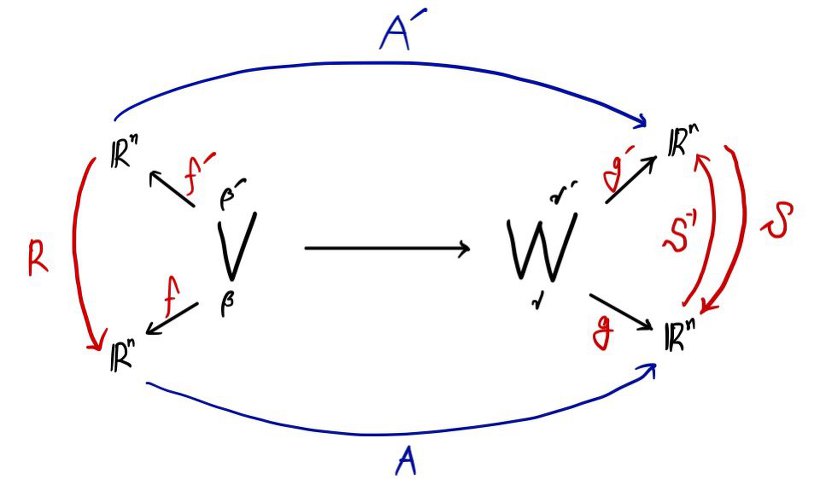
And this is the summary we organized earlier!
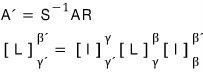
One more thing we absolutely must not forget! Let me copy-paste from an earlier post. In post #8, here’s how I wrapped up at the end:
The way to build the coordinate transformation matrix $R$ is to gather the basis vectors of the target space as column vectors, one by one. (Precisely: take the vectors of the new basis, write each one in coordinates of the old basis, and stack those coordinate columns side by side. That $R$ turns new coordinates into old ones: $[v]_\beta = R\,[v]_{\beta'}$.)
A special case
But I said we’d be loading up similar matrices here, right? Let’s slap on a few more constraints and look at a special case. The special case I want to look at — with these added constraints — is:
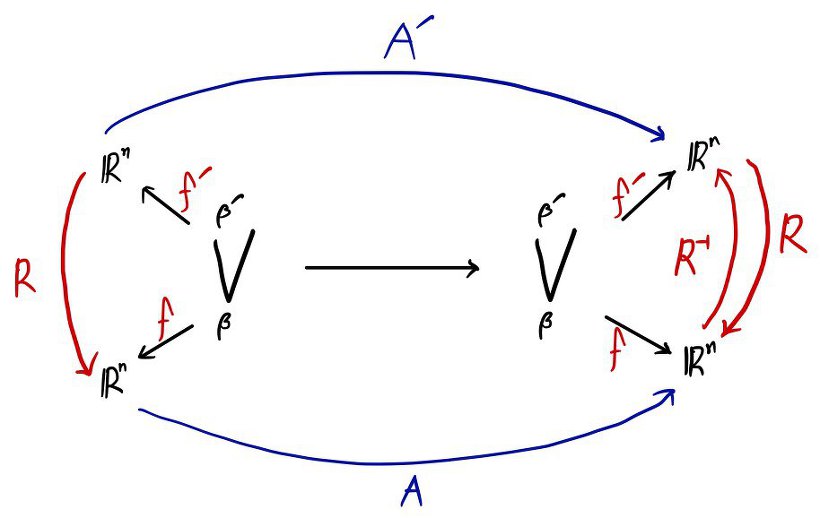
Catch this: the vector space on the right is $V$, and the basis is not $\gamma$ — it’s $\beta$! (Likewise $\beta'$ instead of $\gamma'$. So $W = V$, and $S$ turns into $R$.) Say there’s a linear map $L$ that sends a finite-dimensional vector space $V$ to itself, vector space $V$.
Let’s understand it the same way as before. There were 2 ways to express this $A'$:
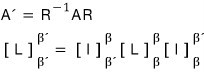
* One thing to especially keep in mind: please, please keep $\beta \to \beta$, $\beta' \to \beta'$ in your head!
Now let’s take the determinant of both sides of the first equation.

You can’t just swap the matrices on the two sides of $A$ (matrix multiplication isn’t commutative) — but since a determinant is “some number,” you can shuffle the order of the multiplication.
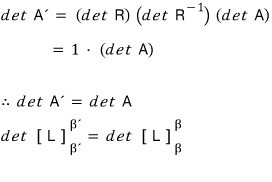
Huh?? What is this?? lol lol — WHAT IS THIS?!
Now now now now now — please, don’t get too mad. We’re in the middle of loading up similar matrices right now, so please don’t get mad. Looking at that formula, it doesn’t quite click yet, does it?
OK, let me give a concrete example. Never, ever forget this:
The way to build the coordinate transformation matrix $R$ is to gather the basis vectors of the target space as column vectors, one by one (each written in coordinates of the old basis). Here we go!
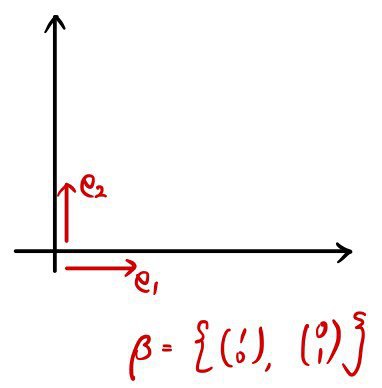
The linear map that sends the space defined by this basis to itself, with this basis used for the input and for the output — let’s say, for example, its matrix is
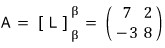
this one. The determinant of this $2 \times 2$ matrix is $ad - bc = 7 \cdot 8 - 2 \cdot (-3) = 56 + 6 = 62$ (the rows are $(a\ b)$ and $(c\ d)$).
Then, with this other basis, $\beta'$, used for the input and for the output,
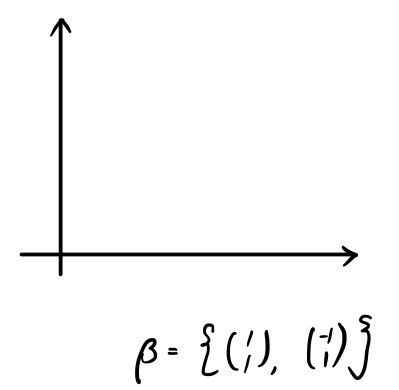
the same linear map $L$ gets a matrix $A'$, and $A'$ is in this relationship with $A$ —
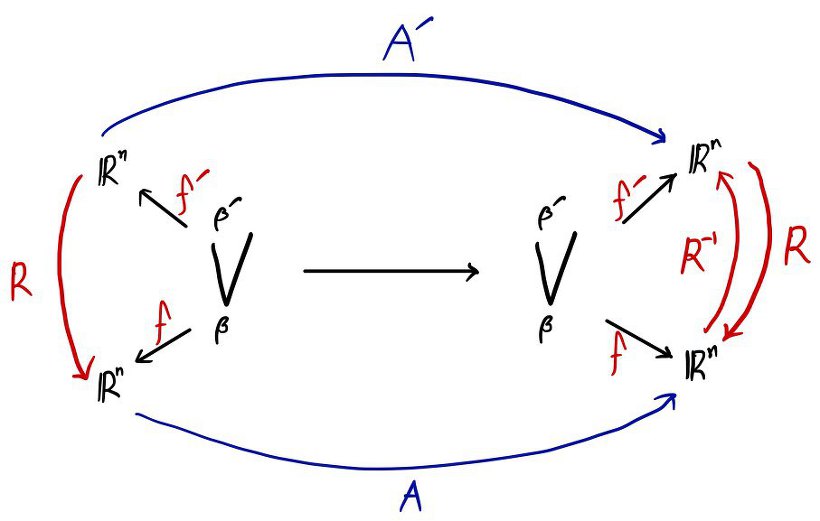
— let’s say it’s in this relationship. Meaning, $A'$ can be written in terms of $A$.
Now now now now now — how did we build the matrix $R$? We said: stack the basis vectors as column vectors, one by one.
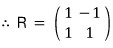
And I’ll also find the inverse of $R$, which we need for the calculation.

So,

Now — what’s the determinant of this $A'$?!
Yep… it’s $7 \cdot 8 - 3 \cdot (-2) = 56 + 6 = 62$. Right?
The determinant of $A$, and the determinant of $A'$ (which we built using the coordinate transformation matrix) — they’re the same!
Similar matrices
OK then. Let’s get into the definition of similar matrices.
Let $A$ and $A'$ be square matrices of the same size, $n \times n$. If there is an invertible $n \times n$ matrix $R$ such that $A'$ equals  , then we write
  , and this means “$A$ and $A'$ are similar.”
Property: The determinants of similar matrices are equal. Second (we’ll come back to this later): the traces are also equal.
Let me organize a few more properties of the similarity relation. $A \sim B$ : $A$ and $B$ are in a similarity relation. Then,
① $A \sim B \to B \sim A$. If $A$ and $B$ are similar, there’s also a similarity relation from $B$’s side to $A$.
(Meaning — it’s a horizontal relationship, not a vertical one.)
Proof. $A \sim B$ means (for some invertible $R$)  — and it’s totally fine to multiply both sides of an equation by the same matrix, as long as it goes on the same side of both: $R$ on the left, $R^{-1}$ on the right. If we multiply like this,
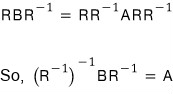
Make sense? That’s $A = Q^{-1}BQ$ with $Q = R^{-1}$ (invertible), which is exactly $B \sim A$.
② If $A \sim B$ and $B \sim C$, then $A \sim C$. Let me prove this too.
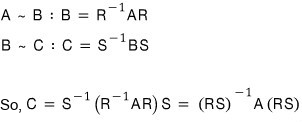
($RS$ is invertible too, since $R$ and $S$ are, and $(RS)^{-1} = S^{-1}R^{-1}$.) Proof done! Easy, right!
(And of course $A \sim A$, just take $R = I$. Together with ① and ②, that’s what makes the “factions” below well defined.)
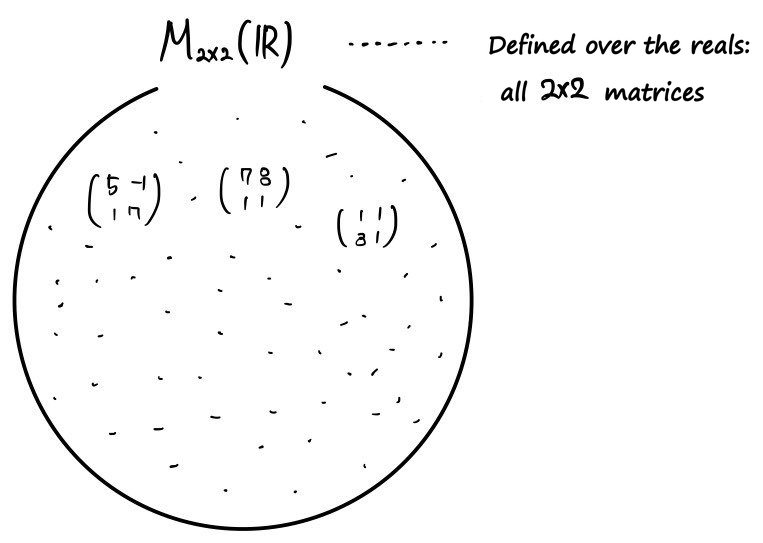
Let me sketch what we just did as a bigger picture.
↓
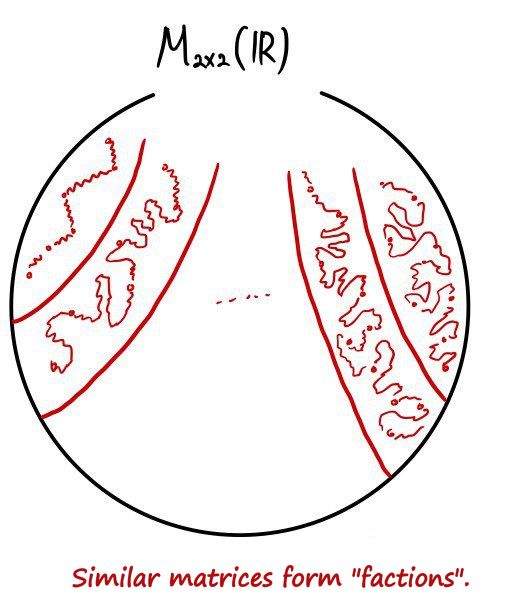
OK now — let me summarize all this in the language of determinants. First: if two matrices have different determinants, they definitely belong to different factions — no exceptions.

OK then, by the same logic — if two matrices belong to the same faction, they naturally have the same determinant. OK OK?
BUT — can we say that if the determinants are equal, they belong to the same faction?!
Turns out — nope. For example:
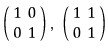
These two matrices both have determinant 1, but they are not similar.
Meaning — you cannot make them equal by multiplying some matrix and its inverse on both sides: $R^{-1} I R$ is always just $I$, never the second matrix.
And let’s also look at the trace. Similar matrices have the same determinant, and I said earlier the trace is also the same, right?
What’s the trace, you ask? The trace of a square matrix is written Tr., and it means the sum of all the diagonal elements. That is,
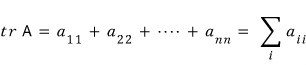
What are the properties of the trace? (For $n \times n$ matrices $A$, $B$, $C$:)

The order doesn’t shuffle around randomly — it only rotates, in cyclic order — and rotating the matrices like that doesn’t change the trace. So, rotating the last $R$ around to the front,

OK, doing up to this point… the post has gotten long again…. ugh… ;_; “Finding — snap!!! — the determinant quantitatively” — that one’s for the next post.
Heads-up. The figures here are the original notes, slips and all. A few things to watch for:
- In the big diagram repeated from post #8, the two spaces on the $W$ side should be $\mathbb{R}^m$; the picture writes $\mathbb{R}^n$.
- In the picture that writes the second basis $\{(1,1), (-1,1)\}$, the label should be $\beta'$ (as in the next picture and the text); the picture reuses $\beta$, the name of the standard basis.
- The picture with "different faction $\iff \det A \ne \det B$" should have a one-way arrow: $\det A \ne \det B \Rightarrow$ different factions. The converse fails, as the next pictures show.
Comments
Discussion happens via GitHub Discussions. You'll need a GitHub account to comment.