Is Further Block Decomposition Always Possible?
Poking at a special case where the minimal and characteristic polynomials match as a power of an irreducible polynomial, and what that tells us about block decomposition.
Today we’re gonna look at some special cases and poke at their properties. But — if this is the first post of mine you’re seeing, this is gonna feel like it dropped out of nowhere, so let me just paste in the conclusion from the very end of the last post. Where did we leave off last time —
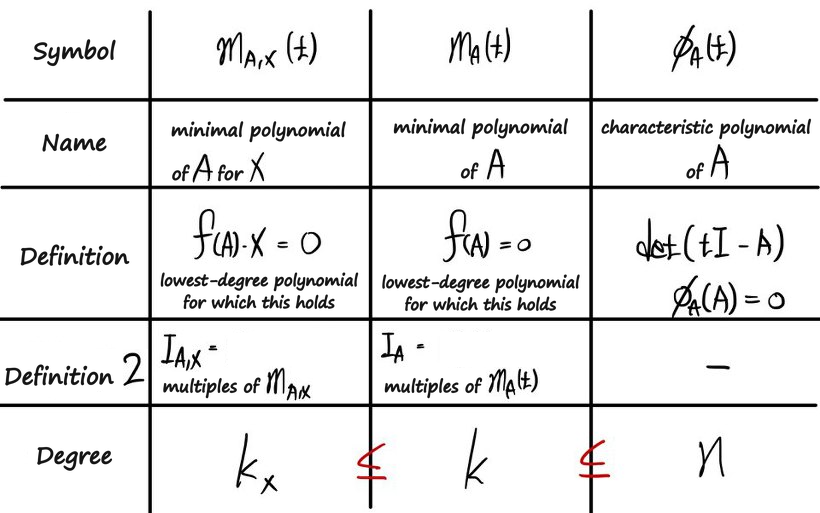
Right here. That’s as far as we’d sorted things out.
A special case
OK so — what special case are we gonna look at?
What if  is the case?!?! What happens then??
If that holds, the inequality that used to be  collapses into
  , like this… Which means all three polynomials have the same degree, and since each one divides the next (and they’re all monic),

it has to come out like this. And what this is telling us is — among all the matrices similar to A, there’s an $A'$ that can be written as a companion matrix.
Being written as a companion matrix meant that the basis that builds $A'$ has the shape

like this, so it must mean there’s an X that, satisfying 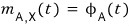 , makes
possible, right?!?!
Yep. That’s the one. There’s an X that makes it happen!!! When  , that is?!?! What this is really saying is: it’s the same as asking what happens when
 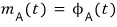 . And what on earth does that even mean…… It’s not hard!!!

Here, $p(t)$ is an irreducible polynomial. Let’s say the minimal polynomial and the characteristic polynomial are the same — but they’re the same in the form of a power of an irreducible polynomial. We set up the situation above because, starting from a special case like this, we can talk about general properties.

$\ker B$ is a set of vectors — specifically, the set of vectors X satisfying $BX = 0$. So 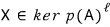 means X is one of the X’s satisfying
  . And if we multiply both sides of that equation by $p(A)$,
 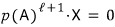 holds automatically too. So the chain of inclusions up there holds automatically, of course.
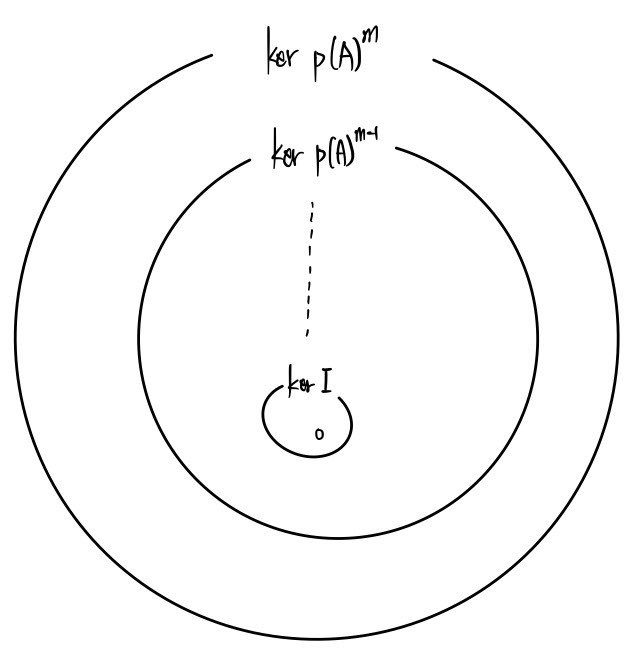
Look at the far left end. X belonging to $\ker I$ means X satisfies $IX = 0$ — so the only thing that fits is the zero vector. ∴ $\ker I = \{0\}$ and the dimension is 0…
On the far right, the X’s belonging to  are the X’s satisfying
  .
.
But is there even an X that satisfies this?!?!
→ There are a TON of them lol!!! It holds for absolutely every single vector!!! Because!!! 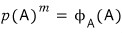 , so it’s just 0!!! So it holds for all vectors.
∴ $\ker p(A)^m$ is a vector space containing every vector in sight!!! Its dimension is $n$!!!
If you draw this as a Venn diagram, apparently it looks like this.
A proposition
Now I’m gonna toss out a proposition.

Here, in 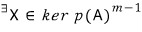 , X does not belong to $\ker p(A)^{m-1}$, so we’re talking about a vector X that does not land inside $\ker p(A)^{m-1}$ but lives only inside $\ker p(A)^m$. And for that X,
 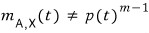 holds, and
 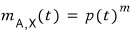 is the case!!!
Now — b.u.t. !!!
Outside 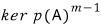 , does an X like that — one that only lives inside
  — actually exist?!?!
Yep….. it exists with 100% probability lol!! Because what we assumed means and can never, ever be equal, not in a million years. If the two sets were equal, 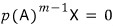 would hold for every X, so the minimal polynomial of A would become
  (or something that divides it). And then the assumption we set up at the very start would be broken. Can’t allow that.
That is,
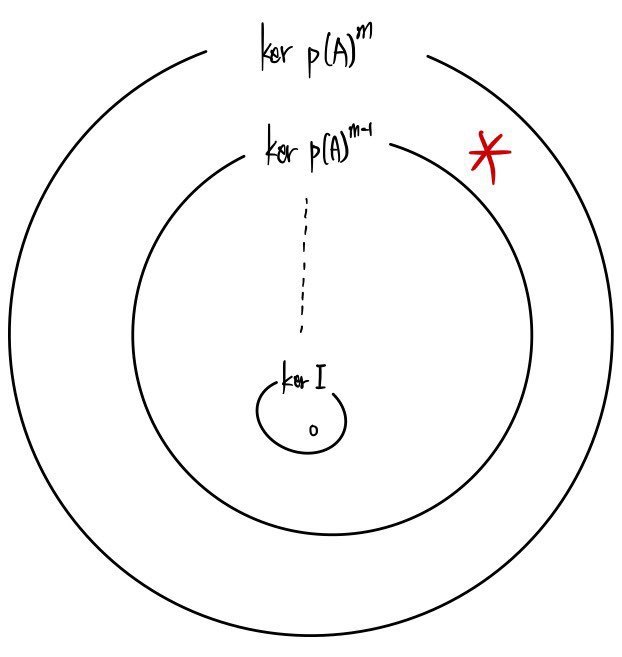
an element like the red star always!!! exists!!!
That is,

this is one property!!! Yeah!
Another important property
A matrix A like this one — with , and with everything a power of a single irreducible $p(t)$ — has yet another important property. And that one is~~~~~
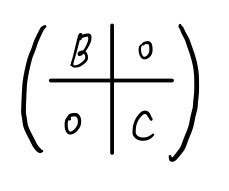
a similar matrix $A'$ decomposed like this can absolutely never be made.
Let me prove it. The assumption is “decomposition is possible” — I’ll assume that and roll with it.
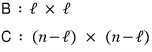
I’ll assume the sizes look like this, and  — that part is of course obvious. And here, we said
 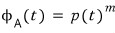 , right?!?! Then
  and
and  will each be written as
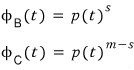
like this.
OK so,  , but that would have to be
 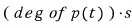 , wouldn’t it?!?! By the same logic,
  =
=  , riiight~~~~
Also,  is a divisor of , and
  is a divisor of . The ingredients are all on the counter now.
Let’s think about  . Well, would be
 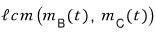 , and if we work it out using the ingredients we just prepped,

the conclusion that pops out is — $q$ has to be strictly less than $m$.
Whoa~~~~~~ but we said 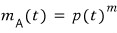 !!! That is, the result we got is that they can absolutely never be equal — so it’s a contradiction!
What was the contradiction?!?!
“Assuming decomposition is possible” — that was the contradiction.
(In the situation where 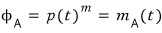 holds, I mean.) Q.E.D. — quod erat demonstrandum.
That was the moment one of those long-simmered, long-simmered questions finally got resolved!!!
Our very first question was “Is diagonalization possible for all matrices?!?!”
↓
“Ohhhhh so if we just keep blocking and blocking, it’ll end up diagonalized?!?!”
↓
“Then is there a case where blocking is not possible?!?!”
↓
And now we get to add one more piece of flesh to the bone right here.
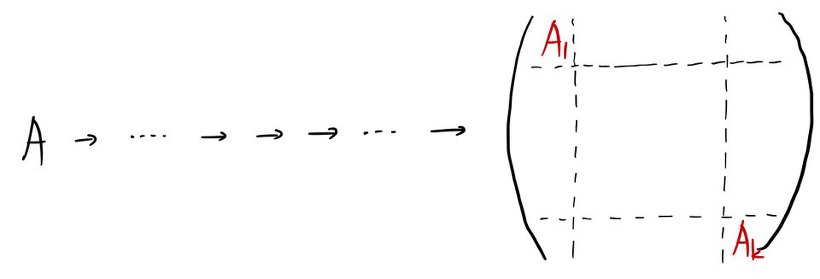
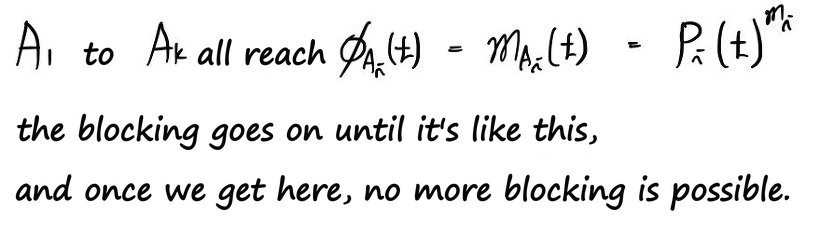
Heads-up. The figures here are the original notes, slips and all. A few things to watch for:
- The proposition is about an $X$ outside the smaller kernel: $\exists X \notin \ker p(A)^{m-1}$, and for that $X$, $m_{A,X}(t) = p(t)^m$ (the pictures write $\in$; for an $X$ in $\ker p(A)^{m-1}$, $m_{A,X}(t)$ divides $p(t)^{m-1}$).
- In the least common multiple, $m_B(t)$ only divides $p(t)^s$ and $m_C(t)$ only divides $p(t)^{m-s}$, so $\operatorname{lcm}(m_B(t), m_C(t))$ divides $\operatorname{lcm}(p(t)^s, p(t)^{m-s})$ rather than equalling it; either way it is $p(t)^q$ with $q \le \max(s, m - s) \lt m$, so the conclusion is right.
Comments
Discussion happens via GitHub Discussions. You'll need a GitHub account to comment.