Stylized Facts of Economic Growth
We're finally zooming out to the long run — why do some countries keep winning? Enter Solow's aggregate production function Y = F(K, N), and the real fun begins.
OK so up till now we’ve been staring at “business cycle fluctuations” all this time.
But honestly? The real endgame for economists — like, the actual reason we sit here doing economics in the first place — is
“Alright, so this is how the world works… now what do we do to make it better?” — wouldn’t you say that’s the actual goal??
“What should we do, and how, to make our country — and beyond that, the whole world — actually develop?”
Yes!! Short-term done. Medium-term done.
Now we zoom way out and look at the world from the very-long-term perspective.
Why is it that on this little blue planet of ours, there are countries that just keep winning and pulling ahead,
while others… can’t? What’s the deal?!?!?!
Let’s get into it.
We’re going to study the model first cooked up by MIT economist Robert Solow back in the 1950s.
This model is exactly the model that takes a swing at the questions above.
And that thing is none other than the aggregate production function.
Back in Chapter 6, we wrote the aggregate production function as $Y = AN$,
making total output $Y$ proportional to labor productivity $A$ and quantity of labor $N$.
And from the medium-term lens, we used that to pull out the relationship between labor and output.
Since the goal back then was to nail down the relationship between $N$, $Y$, and the unemployment rate $u$, the variables in the production function were set up for that. Of course they were.
(Also, the reason we got away with treating other variables as constant was “because, hey, it’s medium-term.” That’s it. That was the whole excuse.)
But! Now that we’re in long-term land, we need to throw a couple more variables into the mix.
In the long run, there are things that don’t stay constant and that absolutely affect $Y$.
Those things are — yep — capital $K$, and the level of technology, function $F(\sim)$.
(Labor productivity $A$ is also going to become a variable eventually, but we’ll let it loose in a later chapter. For now, $A = 1$. Pinned down.)
So with these as our model’s variables, the inputs to total output $Y$ are: capital $K$, labor $N$, and function $F(\sim)$.

Compared to Chapter 6, we’ve added capital $K$ as a new variable,
and on top of that — unlike Chapter 6 — we’ve ditched the “$Y$ and $N$ are linearly related!!!” assumption
and gone with a more flexible function $F$ instead!!!
(Flexible my ass — all this thing tells us is that $N$ and $K$ are variables, and gives us absolutely zero info about whether it’s a square root, a square, a log, or what. So really it’s an expression that pushes your brain into an even deeper meltdown. Whatever. lol lol lol.)
That said — this is still a wildly simplified thing.
Even with this expanded version, we still can’t capture the whole world.
(cf. between a company with tons of machines and a company with tons of offices, which one ends up with a bigger $Y$? Same $K$, totally different effect on $Y$ depending on type. Same $N$, totally different effect depending on whether those workers are middle-school grads, high-school grads, college grads, master’s, PhDs… and this model still can’t express any of that.)
Let’s think about function $F$ for a sec.
Writing $F(K, N)$ only tells us that $K$ and $N$ are the variables — it hasn’t said anything concrete about how each one actually pushes $Y$ around.
If we just go off the economic meaning, we can say $F$ stands for “the level of technology.”
Because the shape of function $F$ will be different from country to country!!!!! (OK I’m hand-waving a little… you get the idea, right?)
Hmm~ but wait — wouldn’t a country’s social/cultural stuff, its political situation, all that, also feed into its level of technology?!?!
Yeah. Exactly. So for now, $F$ is the “technology level” in this big bundled-up sense —
basically that kind of “everything-lumped-in” technology level.
Anyway, point is: $F$ is different for every country!!!!

OK so let’s think.
When $K = 5$ (machines) and $N = 5$ people,
say $Y = 5$.

Now let’s say we double up — 5 more machines, 5 more workers!!!!
What does $Y$ become?!?!?!?!

Yes!!! Stack 5 more of each the same way and it should double, right?!?!?
So function $F$ has this property:

That kind of property.
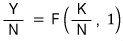
We’re going to use this property. Plug in $x = 1/N$!!!
That’s what we get.
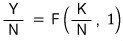
By collapsing the variables down to a single thing — $K/N$ — we can read $K/N$ as “capital per person.”
And the left side, $Y/N$, we can read as “output per person.”
How clean is that?!
So that thing,
when you draw it, looks like
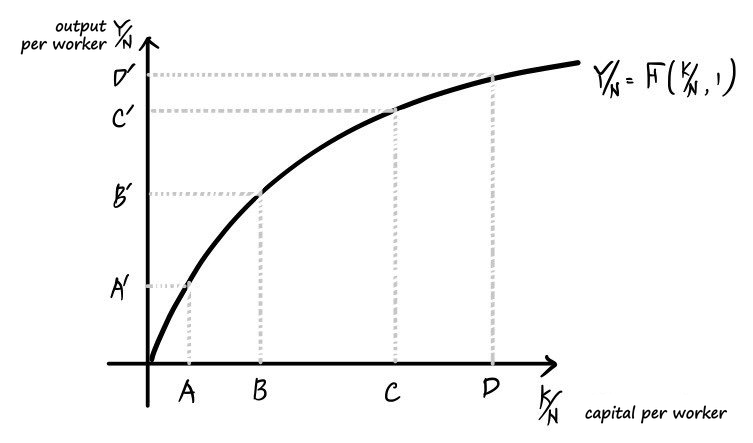
this.
The thing we need to think about: “why does the slope keep flattening out????” — that’s the question.
Let’s think about it microeconomically.
When I say microeconomically — remember the law of diminishing marginal utility from micro?
Same vibe. The bigger capital per person gets, the smaller the bump in output per person becomes —

I’m just talking about a function whose slope keeps decreasing.
So the conclusion we can pull out of this:
per-capita GDP — that is, $Y/N$, the thing we said we’d watch as our “economic growth” indicator — depends on capital per person!!!!
And on top of that, the rate of increase keeps shrinking???
So is $K/N$ — per-capita capital (= per-capita capital accumulation) — the only variable driving economic growth?
Nope nope nope.
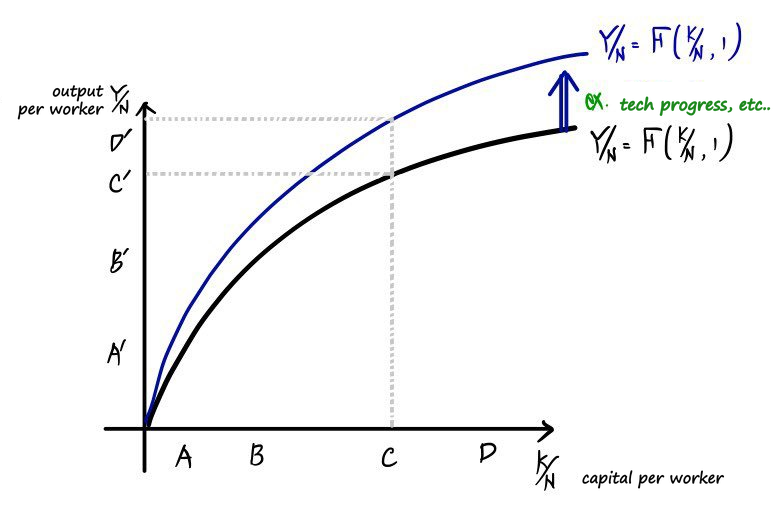
There’s also function $F$. We said earlier that $F(\sim)$ stands for the overall level of technology,
so now we can finally land the real conclusion.
A country’s economic growth depends on capital accumulation & the level of technology.
Reference)
Comments
Discussion happens via GitHub Discussions. You'll need a GitHub account to comment.