The Cobb-Douglas Production Function
We finally pin down that vague f(K/N) with the Cobb-Douglas production function and crank through the math to get a concrete steady-state output formula.
Heads up — this one’s gonna be pretty short.
Promise.
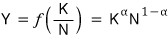
So that vague little function I keep waving around,

let’s actually pin it down.
The one people actually use in practice — apparently — is the Cobb-Douglas production function.
Back in 1928, Charles Cobb (mathematician) and Paul Douglas (economist) cooked up an

that fit the economy of their time pretty nicely~
…and it stuck.
Here’s what Cobb-Douglas looks like:
In other words,
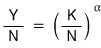
That’s it!!!! (Basically just $f(x) = x^{\alpha}$, right?)
Now bring back the steady state from last post —
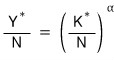
That’s the steady-state version.
And what we want to do is take that $Y^*$ — the output when growth is zero — and write it out using the actual production function we just plugged in!!!!
OK so the steady state is set by
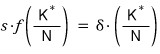
Plug in Cobb-Douglas:
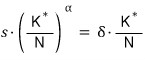
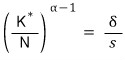
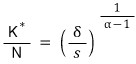
Now raise both sides to the $\alpha$:
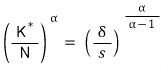
And the left side — that’s our steady state output per worker under Cobb-Douglas. So:
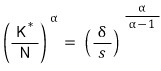
Way more concrete than last post, sure. But…
we don’t know $\alpha$?!?!?!? How are we supposed to nail down $\alpha$??!
Turns out — if you just rough-fit it against actual economic data,~
When $K$ is treated as physical capital only, apparently $\alpha = 1/3$.
Plug that in →

When you let $K$ cover physical and human capital, apparently $\alpha = 1/2$ is the right call.
And then →

Comments
Discussion happens via GitHub Discussions. You'll need a GitHub account to comment.