Expected Present Discounted Value
So what's a future stream of payments actually worth right now? We walk through present value, discount factors, and interest rates — the stuff you kinda already know.
Copied from the book: the expected present discounted value of a future flow of payments answers the question of what that expected flow of payments is worth right now.
“You have to compute the expected present discounted value using information about the expected payment stream and the interest rate.”
Honestly… this is the kind of thing we all learned back in high school, right? Converting future money into present value! Yeah yeah, it’s obvious, I kinda want to just skip it — but that’d be rude, so let’s actually walk through it.
OK. Say you’ve got $P$ won right now. If you just leave it sitting in the bank as-is~, the money grows at the interest rate  .
.
(A nominal interest rate is measured in money terms, so it can describe either a bank deposit or a bond. The bank is just easier to picture.)
So $P$ won becomes  won after 1 year. Now flip it around.
If a friend is gonna pay me won 1 year from now, then right now… how much do I effectively have??
Yeah… same as having $P$ won today. Then if a friend’s gonna pay me $P$ won 1 year from now instead, that’s currently worth the same as having  won.
won.
So this guy,  , is called the discount factor, apparently. It’s the thing that discounts a future amount back to its present value.
So sometimes the nominal interest rate doesn’t even get called the nominal interest rate — apparently people call it the discount rate~!!
OK now let’s try 2 years.
If I keep my $P$ won invested at those rates~~~,

in general you’d write it like this. And if a friend pays me $P$ won 2 years from now, that’s worth the same as having this much right now:

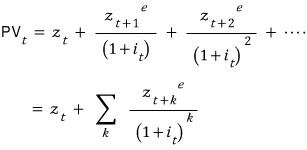
Now — what if today I get a bond coupon $z_t$, then 1 year later $z_{t+1}$, 2 years later $z_{t+2}$, … and $n$ years later $z_{t+n}$?!
How much is all that worth right now? We can write it like this!!

(Writing this one with a sigma is kinda awkward~)
OK, now instead of thinking of $z_t, z_{t+1}, \ldots$ there as a bond’s coupons, you can also think of them as a firm’s profits. That means profit 1 year from now, profit 2 years from now, … There’s also the difference that there’s no way to know things like the interest rate 1 year from now.
So,

we write it like this as a simple forecast-based approximation. With genuinely uncertain rates and payments, their interaction and risk matter; plugging separate expected values into the formula is not a general exact valuation rule. Within this model, there are 2 things we’re supposed to feel from it.
1. The bigger  gets, the bigger PV (present value) gets. 2. The bigger
  gets, the smaller PV gets.
Alright, let’s make it simple.
i) The case where the interest rate stays constant at :
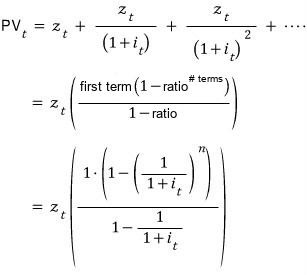
ii) The case where both the interest rate and the payment stay constant: the picture counts n payments including today, from t through t+n−1. If the last payment is t+n instead, there are n+1 terms.
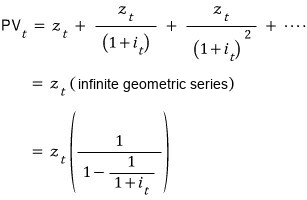
iii) The case where both the interest rate and the payment stay constant forever, with i > 0 so the sum converges. This includes today’s payment: the result is z(1+i)/i. If the first payment comes next year, it is z/i.
OK, here’s something curious. Let me write the most general equation one more time.

Now — the future payment doesn’t have to be money, does it??
It can also be goods. Using the real interest rate (the interest rate in units of goods), the present value can also be written like this:

OK so the most basic nominal-vs-real relationship is “divide by the price level”:

Divide by the price level at that point in time and you get the real present value in units of goods — does this same kind of relationship hold here too??
Curiously enough, apparently it does.
Let me try to prove it using consistent forecast paths for prices, payments, and rates. With uncertainty, a ratio of expected values is not generally the expected ratio, so this algebra is the same simplified forecast calculation.
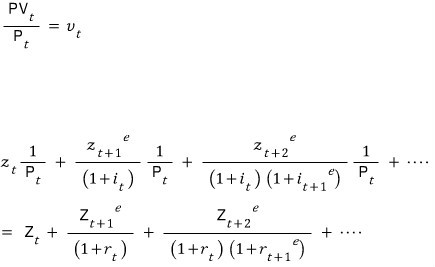
Matching up the first terms:

Way too obvious, skipping.
Matching up the second terms:
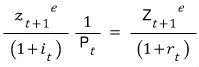
I’ll just pull one tiny trick on the left-hand side.
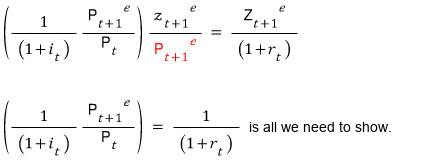
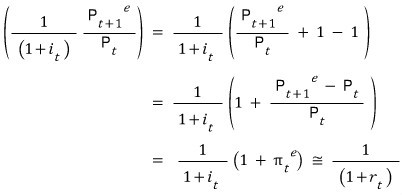
QED.
Heads-up. The figures here are the original notes, slips and all. A few things to watch for:
- Three subscripts: in the first general formula, the second denominator is $(1 + i_t)(1 + i^e_{t+1})$, as the later copy writes it (the first has $i^e_{t+2}$); in the real version, the second rate is the expected $r^e_{t+1}$ (the picture drops the $e$); and in the last step, the expected inflation is $\pi^e_{t+1} = \frac{P^e_{t+1} - P_t}{P_t}$, not $\pi^e_t$.
Comments
Discussion happens via GitHub Discussions. You'll need a GitHub account to comment.