Demand Curve and Supply Curve
We build the demand curve from scratch using red ginseng as our example market, then unpack the law of demand plus direct vs. derived demand — heh heh.
Alright, let’s keep this thing rolling. First up - supply and demand analysis! This is something everyone already knows cold, so I’m gonna breeze through it a bit. Heh.
OK, let’s draw the demand curve, shall we?
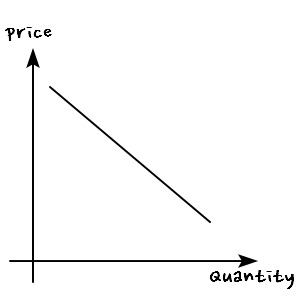
Done? Haha. Aw c’mon, this is still my major after all. Let me think for a sec about what principle actually produces that shape.
I’ll use the red ginseng extract I’ve been religiously chugging every day lately as our market.
So let’s say there are a crazy lot of people here. Like this.

And you go up to every single one of these people and ask: “Yo, human! How much would you pay for some red ginseng?!”
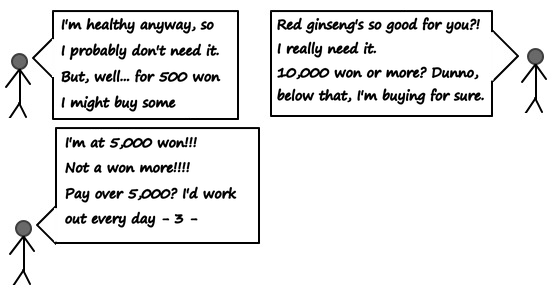
And each person’ll have their own personal limit, like this.
Now I’m gonna line all those folks up in a single row - but how?
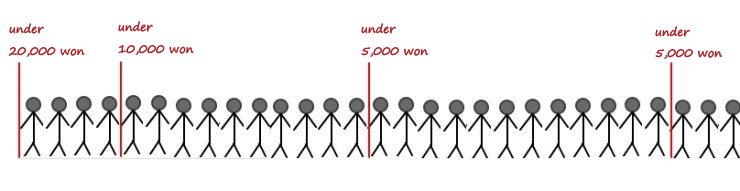
Like this. Heh. Since we’re just gonna draw a graph anyway, let’s count the humans:
4 people / 4 people + 10 people / 4 people + 10 people + 12 people / …
Yeah, something like that. Here we’re counting one unit per human.
Now let’s slap a coordinate axis on top and plot it.
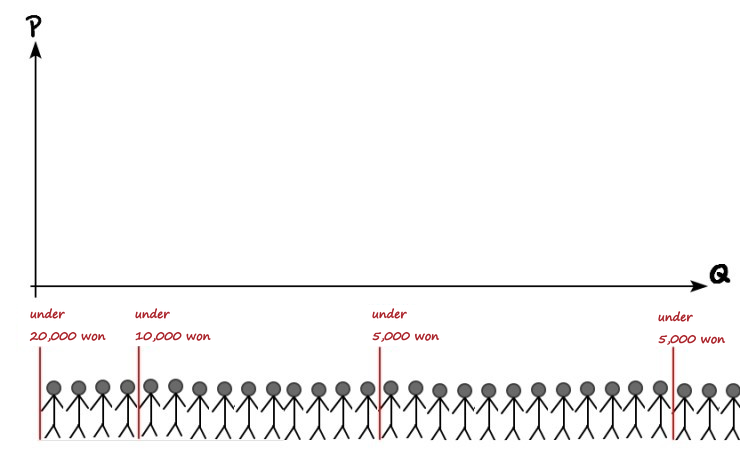
With the axes drawn like this, the way we’ll mark points is: “When the price is p, how many units of red ginseng would people want to buy?! Right, this many!” That’s the kind of marking we’re doing.
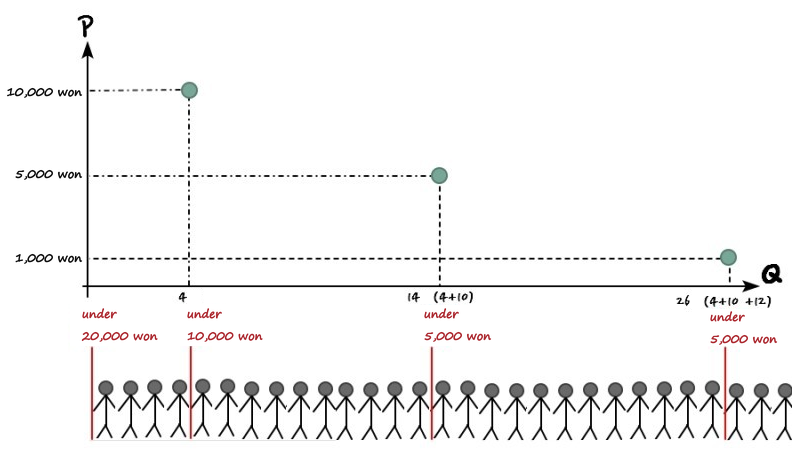
Now treat $P$ as a continuous variable and imagine checking every single price. With a crowd this big, let’s smooth the steps in the total number of buyers into a curve. It’ll look like this.
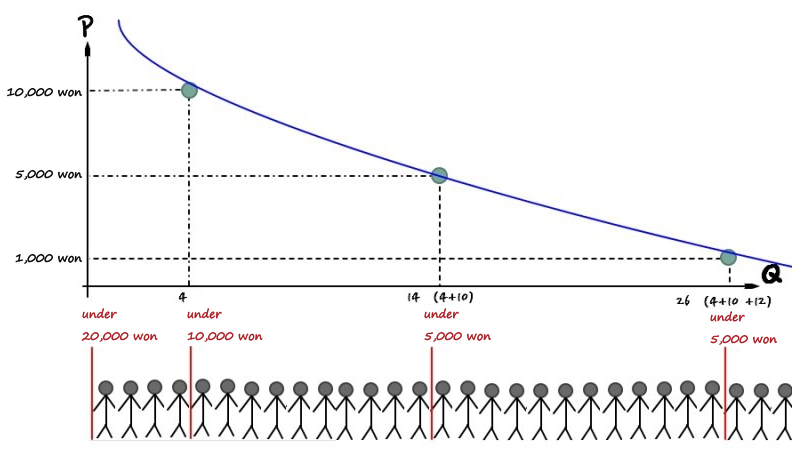
I also baked in the idea that the cheaper it gets, the faster the number of would-be buyers grows!
Now, now. I’m pretty sure you have a crystal-clear sense of why the demand curve is drawn the way I just tossed at you up top. Heh. I went through this roundabout derivation for 2 reasons.
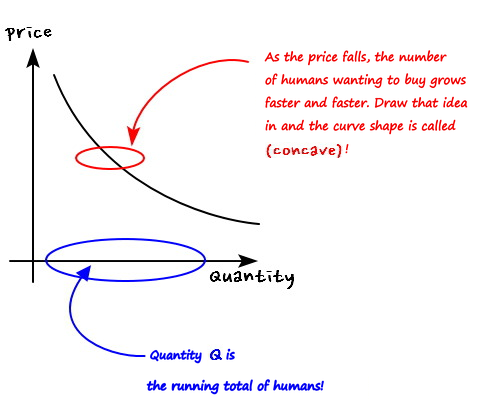
And we can also say the “law of demand” is sitting right there in that graph. Let me run through it.
Law of demand: holding every other factor that affects demand fixed, there’s an inverse relationship between price and quantity demanded.
One more thing: apparently you can also classify the demand baked into the demand curve. Finer classification comes later. For now, broadly, two flavors: direct demand and derived demand.
Direct demand is, just like it says on the tin, demand for the good itself. Derived demand comes from the production or sale of other goods. For example, the demand for sugar contains within it the demand for cola - that kind of thing.
Even if literally no one wants more sugar for its own sake, if a ton of people want cola, the demand for sugar has got to go up by some amount. That’s the deal!
Obvious stuff, but the point is: inside the demand curve, all the demand across an entire nation is mashed together to give us the demand for “one market.” Heh.
OK, that wraps the basic demand talk, and now I’m gonna get into the basics of supply. But honestly… isn’t the supply talk basically already done? When am I gonna draw all of that out again? Let me recycle what there is to recycle and derive the supply curve nice and kindly too.
First, let’s say there are a bunch of suppliers as well.
And we ask each one of these supplier folks, one by one: “Yo! How much you gonna sell it for?”
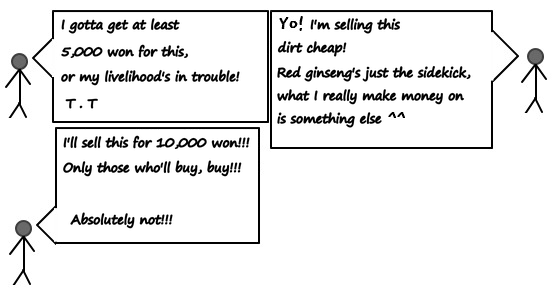
Lining ’em up in a single row again.
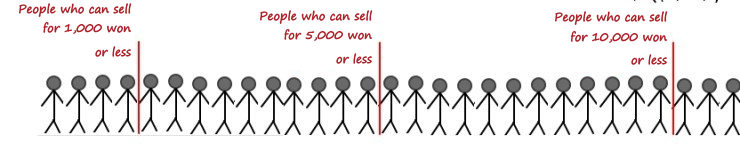
And we drop the same coordinate axes on top as before. I’ll just make the next figure the one with all the points already plotted.
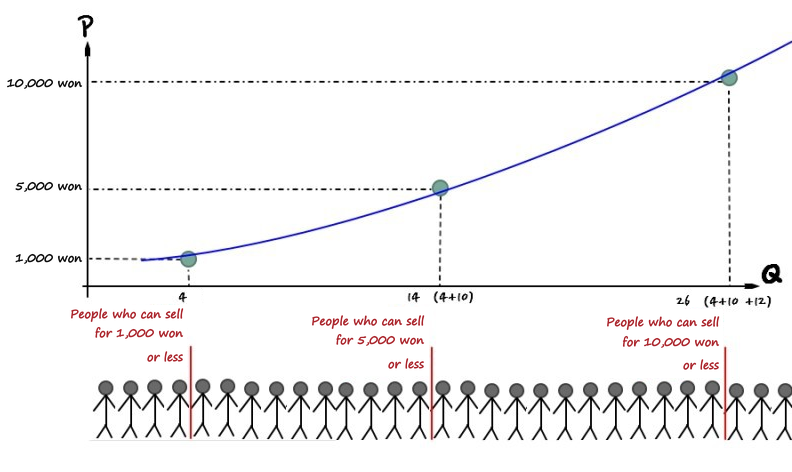
For the supply curve too, the $Q$ value means the cumulative quantity. You can also spot the difference between a straight line and a curve where the total grows at a changing rate.
Eh, it’s all the exact same context as the demand curve, so I’ll skip the play-by-play. OK, on to the next thing.
Heads-up. The figures here are the original notes, slips and all. A few things to watch for:
- In the four pictures with the line of people, the last red label repeats “under 5,000 won”; it should be “under 1,000 won” (the people after the 26th), which is why the last point sits at 1,000 won.
- The red note calls the curved demand line “concave”. As a function $P(Q)$ this curve is convex: it bows toward the origin. The note only means that the straight line turned into a curve.
Comments
Discussion happens via GitHub Discussions. You'll need a GitHub account to comment.