Equilibrium
Turns out economic equilibrium is a dynamic concept — and it clicks way easier once you see it's basically the same thing as thermal equilibrium in physics.
Equilibrium in economics is actually a dynamic equilibrium concept —
so I’m just gonna touch on this real quick and move on.
I think it’ll click way easier if we first see what dynamic equilibrium looks like in science, and then realize the exact same thing is happening in economics.
(Wait. Hold on — bro, why are you suddenly talking about science in an econ post?????
Econ was, from the very beginning, a field that was born by yoinking concepts out of physics and slapping them onto economic phenomena.
And Léon Walras, who was right there at the front of the line, is the dude who dragged “equilibrium” over from physics!!!! heh heh heh
Isn’t that wild?!! I thought it was super wild!!!! lol)
OK so, there are actually a bunch of things in science that sit in a state of dynamic equilibrium…..
What’s the best example here….
I’ll just go with the most classic one — “thermal equilibrium.”
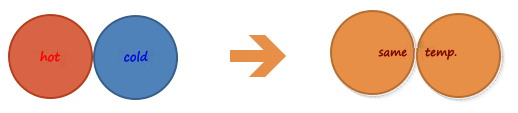
We’ve seen this kind of thing a million times, right?!?!!!!
But the thing is — this is really just “how it looks to our eyes.” …heh. heh heh
The truth is,
heat is bouncing back and forth, infinitely, on repeat,
and the whole thing settles at some equilibrium point.
What’s actually repeating, infinitely, looks like —

This kind of situation is repeating forever,
but to our eyes it just shows up as “the same temperature.”
This state is what we call a state of “dynamic equilibrium.” heh heh heh heh
OK now — by what logic does this same dynamic equilibrium thing work in economics?
First off, it’s because of the grand assumption.
“Every single human being is as rational as a supercomputer!!!”
It works because of this one assumption.
Because people look at what’s going on in the market and rationally figure out prices.
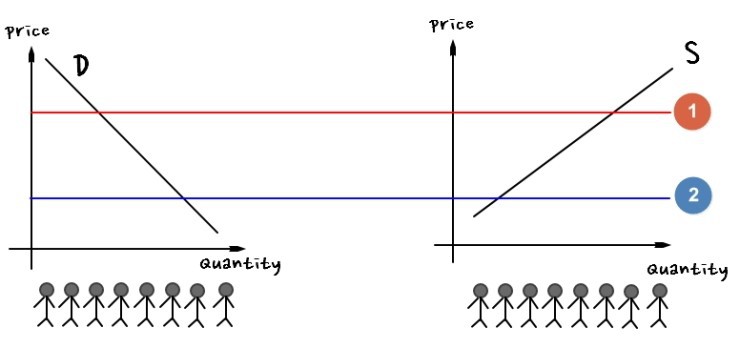
I think it’ll be cleaner to walk through these one at a time.
Market price is 1!!!
People who wanna buy: 3. People who wanna sell: 6!
3 get sold, 3 are left sitting there….
Then the suppliers go —
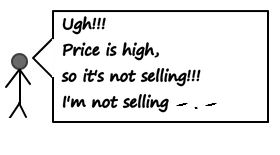
Market price is 2.
People who wanna buy: 6 / People who wanna sell: 2
2 get sold, and 4 — people want to buy them, but… they don’t exist…..
That kind of vibe goes floating around the market.
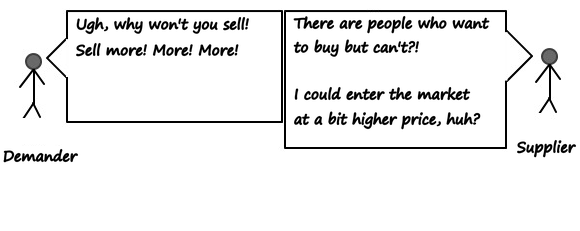
So since people aren’t stupid,
they bump the price up again, though to something a little lower than the previous 1,
and then boom, excess demand shows up again and people start dropping out of the market,
and then when the price drops back excess demand shows up again
and some supplier hops in —
and in this way, excess supply and excess demand keep flipping back and forth
and repeating, infinitely, but eventually the range of those flips gets sooooo tiny that to our eyes it
basically looks frozen, and that spot is what we call the equilibrium.
So, the equilibrium point lives right here on the P-Q graph.
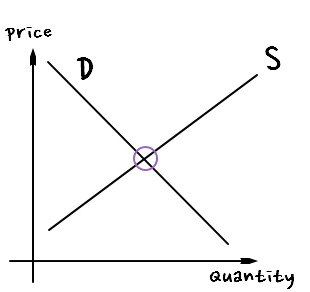
That purple part right there is the equilibrium — there are ridiculously tiny fluctuations going on, but to our eyes it looks like it’s just sitting still~
Equilibrium, done!!!
Comments
Discussion happens via GitHub Discussions. You'll need a GitHub account to comment.